
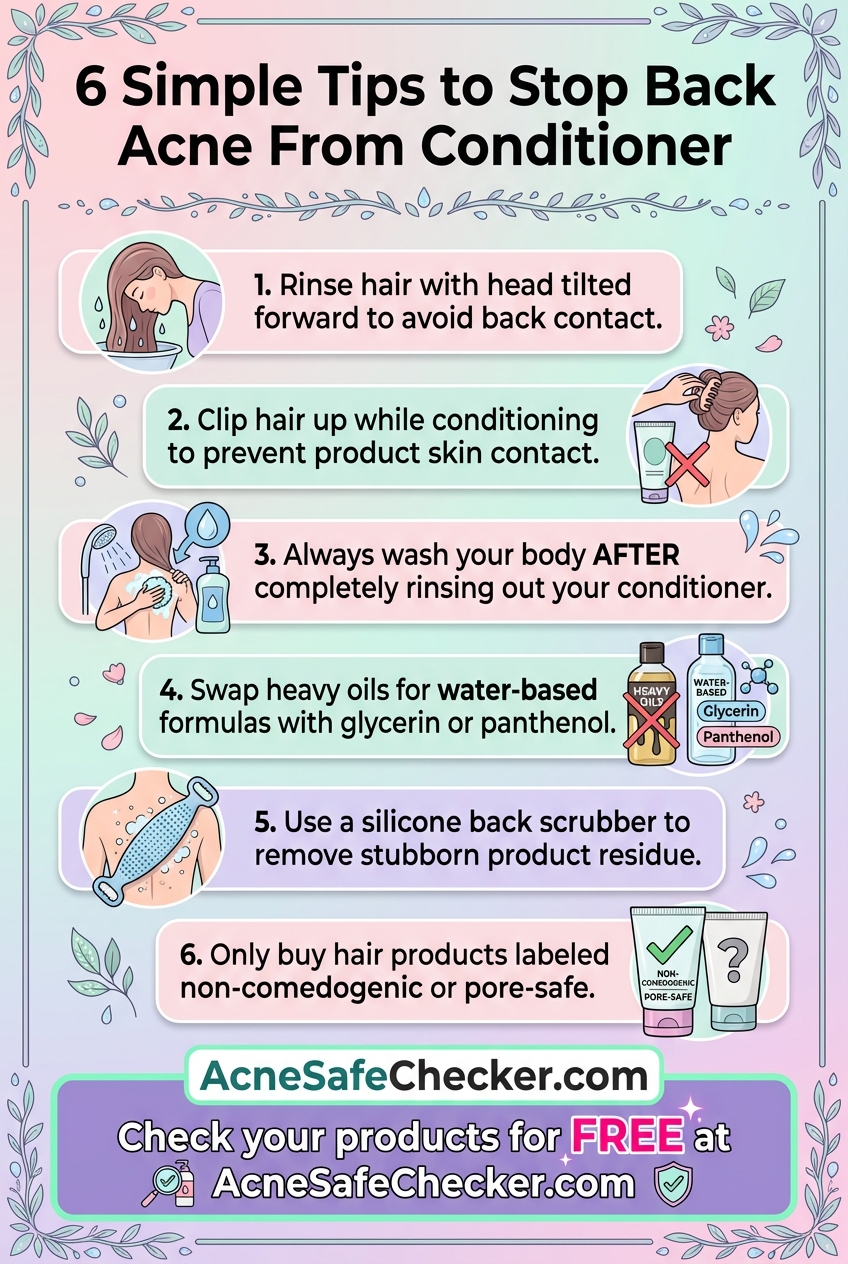
For many of my patients, the battle against acne doesn’t end at the jawline. Back acne—or "bacne"—is a frustratingly common condition that can persist even when your facial skincare routine is flawless. While many factors contribute to body breakouts, one of the most overlooked culprits is sitting right on your shower shelf: your conditioner.
Is Your Routine Acne-Safe?
Do not guess. Instantly check your products for pore-clogging ingredients with our AI-powered tool.
Check Ingredients NowAs a dermatologist, I often see cases of acne cosmetica, a form of acne caused by topical products. In this guide, we will explore why your hair care might be sabotaging your skin and how to choose a conditioner that keeps your hair silky without clogging your pores.
The Science: Why Conditioner Triggers Back Acne
Conditioners are designed to coat the hair shaft to provide moisture, shine, and manageability. To achieve this, they often contain heavy oils, waxes, and silicones. While these ingredients are excellent for smoothing hair cuticles, they are frequently "comedogenic," meaning they are scientifically proven to clog pores.
When you rinse conditioner out of your hair, the residue travels down your back. Because conditioners are formulated to adhere to surfaces (the hair), they don't always wash away easily from the skin. This residue creates an occlusive film that traps sweat, bacteria, and sebum inside your follicles. Over time, this leads to the formation of comedones (blackheads and whiteheads) and inflammatory papules.
The "Red Flag" Ingredients to Avoid
If you are prone to body breakouts, the first step is to audit your current product. Look at the ingredient list for these common pore-clogging offenders:
1. Heavy Silicones
While not all silicones are problematic, heavy versions like Dimethicone and Simethicone can create a barrier on the skin that is difficult to remove without harsh scrubbing. This barrier can trap acne-causing bacteria against your skin.
2. Isopropyl Myristate and Palmitate
These are esters used to improve the texture of products. They are notorious in the dermatology community for being highly comedogenic. If these are in the first five ingredients of your conditioner, they are likely contributing to your back acne.
3. Natural Oils and Butters
Many people switch to "natural" products thinking they are safer for the skin. However, ingredients like Coconut Oil (Cocos Nucifera) and Cocoa Butter are highly comedogenic. While they are great for dry hair, they are a nightmare for acne-prone skin on the back.
4. Sodium Laureth Sulfate (SLES)
While primarily a surfactant found in shampoos, if it is present in your conditioner, it can irritate the skin barrier, making it more susceptible to infection and inflammation.
What to Look For: Choosing a "Pore-Safe" Conditioner
When shopping for a conditioner that won't cause back acne, look for specific labeling and lightweight alternatives.
- Non-Comedogenic Labeling: While not a guarantee, products labeled "non-comedogenic" or "non-acnegenic" have been formulated specifically to avoid pore-clogging.
- Water-Based Formulas: Look for conditioners where water is the primary ingredient and moisture is provided by humectants like Glycerin or Panthenol (Pro-Vitamin B5) rather than heavy oils.
- Lightweight Silicones: Ingredients like Cyclomethicone are more volatile and less likely to leave a stubborn film on the skin compared to Dimethicone.
- Salicylic Acid: Some specialized conditioners now incorporate BHA (Salicylic Acid) to help chemically exfoliate the scalp and skin as you rinse.
The Professional Showering Protocol
Sometimes, it isn't just what you use, but how you use it. To minimize the risk of breakouts, I recommend my patients follow this specific showering sequence:
- The Lean-Over Rinse: When rinsing conditioner, tilt your head forward or to the side so the product runs off your hair and directly down the drain, rather than down your back.
- Clip It Up: While the conditioner is soaking into your strands, clip your hair up off your shoulders and back to prevent prolonged contact with your skin.
- The Final Wash: This is the most critical step. Always wash your body AFTER you have completely rinsed the conditioner from your hair. Use a gentle, fragrance-free body wash or a wash containing benzoyl peroxide or salicylic acid. This ensures that any residual hair product is stripped away from the skin surface.
- Exfoliate Regularly: Use a long-handled silicone back scrubber (which is more hygienic than a loofah) to ensure you are reaching the mid-back area where residue often accumulates.
Conclusion
Achieving clear skin shouldn't mean sacrificing the health of your hair. By understanding the link between hair care ingredients and pore occlusion, you can make informed choices at the beauty counter. Look for lightweight, oil-free, or non-comedogenic formulas, and always prioritize washing your body as the final step in your routine.
If you have switched your products and adjusted your routine but still see no improvement after 6–8 weeks, it may be time to consult a board-certified dermatologist to discuss prescription options or to rule out other conditions like fungal folliculitis.