
If you have ever spent thirty minutes in a drugstore aisle staring at a tiny list of ingredients on the back of a moisturizer, you are not alone. For those of us dealing with acne-prone skin, every new product feels like a gamble. One ingredient that frequently appears in everything from cleansers to hair conditioners is Laureth-23.
Is Your Routine Acne-Safe?
Do not guess. Instantly check your products for pore-clogging ingredients with our AI-powered tool.
Check Ingredients NowBut is Laureth-23 a hidden culprit behind your latest breakout? As a dermatologist, I often see patients who have optimized their routine but are still seeing stubborn whiteheads and clogged pores. Today, we are going to dive deep into the science of Laureth-23, its comedogenicity rating, and whether it deserves a place in your skincare regimen.
What is Laureth-23?
Laureth-23 is a high molecular weight synthetic polyether that functions primarily as a surfactant and emulsifier. In simpler terms, it helps oil and water mix together, ensuring your creams stay smooth and don't separate in the bottle. It is derived from lauryl alcohol and ethylene oxide.
In the cosmetic industry, it is prized for its ability to solubilize fragrances and stabilize formulas. You will find it in a wide array of products, including:
- Facial cleansers
- Leave-on moisturizers
- Sunscreens
- Hair styling products (which can often migrate to the forehead and cause "pomade acne")
The Comedogenicity Question: Does It Clog Pores?
To understand if Laureth-23 causes acne, we have to look at its comedogenicity rating. This is a scale from 0 to 5 that measures how likely an ingredient is to cause a comedone (a clogged pore).
- 0: Will not clog pores
- 1-2: Low chance of clogging pores
- 3: Moderate chance
- 4-5: High chance
Laureth-23 typically carries a comedogenicity rating of 2 to 3.
This puts it in a "gray area." It is not as notoriously pore-clogging as ingredients like coconut oil (rating of 4) or isopropyl myristate (rating of 5), but it is certainly not "non-comedogenic." For someone with very resilient skin, a rating of 3 might never cause an issue. However, for those with a high sebum production and a genetic predisposition to acne, a 3 can be enough to trigger a breakout.
The Science of Laureth-23 and Skin Irritation
Beyond just clogging pores, Laureth-23 can also contribute to acne through irritation. Acne is an inflammatory condition. When the skin barrier is irritated, it triggers an inflammatory response that can worsen existing acne or lead to "acne cosmetica"—a form of acne caused by topical products.
As a surfactant, Laureth-23 has the potential to strip away some of the skin’s natural lipids. If a product contains a high concentration of Laureth-23, it might compromise your skin barrier, making your skin more susceptible to the bacteria (C. acnes) that cause breakouts.
The "Formulation Matters" Rule
It is important to note that an ingredient’s rating on a piece of paper doesn't always tell the whole story. The behavior of Laureth-23 depends heavily on two factors:
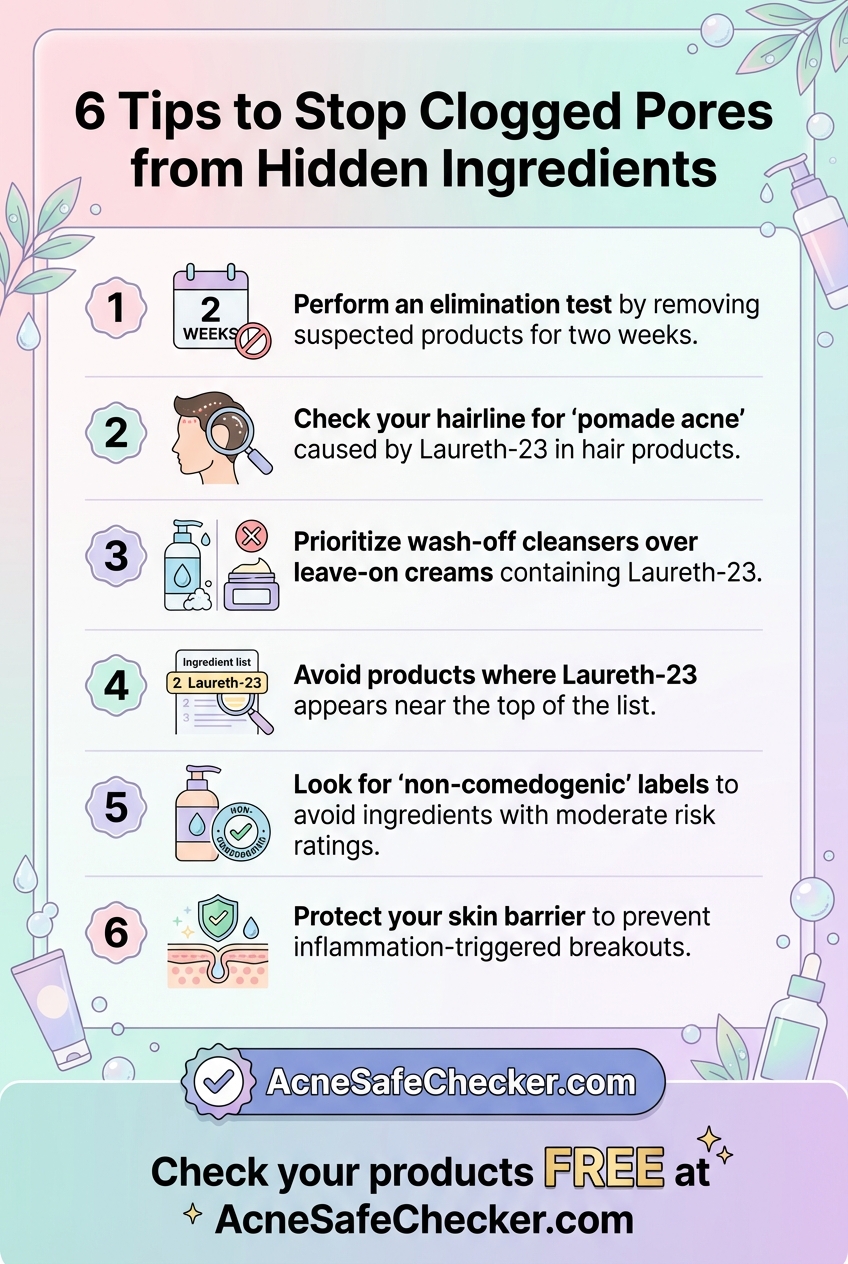
- Concentration: If Laureth-23 is the second or third ingredient on the list, it is much more likely to cause issues than if it is the very last ingredient.
- Wash-off vs. Leave-on: In a cleanser, Laureth-23 is on your skin for maybe 30 seconds before being rinsed away. In a moisturizer or sunscreen, it sits on your skin all day, significantly increasing the window of time it has to penetrate the pore.
Who Should Avoid Laureth-23?
If you have "normal" skin and rarely break out, Laureth-23 is likely safe for you to use. However, I recommend avoiding products with high concentrations of Laureth-23 if you fall into these categories:
- Oily and Acne-Prone: If your skin produces excess oil, your pores are already under pressure. Adding a moderately comedogenic ingredient like Laureth-23 can be the "tipping point."
- Cystic Acne Sufferers: Those dealing with deep, painful inflammation should stick to products rated 0 or 1 on the comedogenicity scale to minimize external triggers.
- Sensitive or Rosacea-Prone Skin: Because Laureth-23 can be slightly irritating, it may exacerbate the redness associated with sensitive skin types.
Practical Steps for Healthy Skin
If you suspect a product containing Laureth-23 is causing breakouts, here is how to handle it:
1. The Elimination Test
Stop using the suspected product for two weeks. If your skin begins to clear up, you’ve likely found the culprit. This is the most effective way to test how your specific skin chemistry reacts to an ingredient.
2. Check Your Haircare
If you have acne along your hairline or on your forehead, check your shampoo and conditioner. Laureth-23 is common in hair products. When you rinse your hair, the residue can run down your face, leading to breakouts in those specific areas.
3. Look for "Non-Comedogenic" Labels
While not a government-regulated term, products labeled "non-comedogenic" are generally formulated to exclude ingredients with ratings of 3, 4, or 5. This is a safer starting point for acne sufferers.
Conclusion
So, does Laureth-23 cause acne? For the average person, no. However, for those with acne-prone or sensitive skin, its moderate comedogenicity rating of 2-3 makes it a potential trigger.
Skincare is deeply personal. An ingredient that provides a luxurious feel for one person might cause a flare-up for another. If you are struggling with persistent breakouts, take a close look at your ingredient lists. Removing moderately comedogenic ingredients like Laureth-23 might be the simple shift your skin needs to finally find its balance.