
If you have ever spent more than five minutes scrolling through skincare forums or examining the back of a serum bottle, you have likely encountered the term "non-comedogenic." For those of us with acne-prone or sensitive skin, this word is more than just marketing—it is a safety net.
Is Your Routine Acne-Safe?
Do not guess. Instantly check your products for pore-clogging ingredients with our AI-powered tool.
Check Ingredients NowAmong the most celebrated ingredients in modern dermatology is Niacinamide. Known for its versatility, it is often touted as a holy grail for everything from redness to fine lines. But if you are prone to breakouts, you might be asking the pivotal question: Is niacinamide comedogenic?
As a dermatologist, I see patients daily who are terrified that a new product will trigger a cycle of congestion and cysts. Today, we are going to dive deep into the science of niacinamide, its relationship with your pores, and why your "niacinamide breakout" might not be what you think it is.
Understanding the Comedogenic Scale
To understand if niacinamide is comedogenic, we first need to define what that means. In dermatology, a "comedo" is a clogged pore—either a blackhead (open) or a whitehead (closed). An ingredient is considered comedogenic if it has a high probability of blocking pores and causing these lesions.
Ingredients are typically rated on a scale of 0 to 5:
- 0: Will not clog pores
- 1-2: Low probability of clogging pores
- 3-5: High probability of clogging pores
Is Niacinamide Comedogenic? The Science
Directly put: Niacinamide has a comedogenic rating of 0.
Niacinamide, also known as Vitamin B3, is a water-soluble vitamin. Unlike heavy oils or thick waxes that sit on the surface of the skin and create a physical plug in the follicle, niacinamide is easily absorbed and works at a cellular level. It does not possess the physical or chemical properties required to block a pore.
In fact, far from being a culprit of congestion, niacinamide is one of the few ingredients that actively works to keep pores clear.
Why Niacinamide is an Acne-Prone Skin’s Best Friend
Rather than causing acne, niacinamide is frequently prescribed to treat it. Here is how it functions to support clear skin:
1. Sebum Regulation
One of the primary drivers of acne is the overproduction of sebum (skin oil). When excess oil mixes with dead skin cells, a clog forms. Clinical studies have shown that topical niacinamide can significantly reduce the amount and rate of sebum excreted by the skin. By keeping oil levels in check, it indirectly prevents the formation of comedones.
2. Anti-Inflammatory Properties
Acne is fundamentally an inflammatory condition. Niacinamide stabilizes the skin’s barrier function and reduces the inflammatory response. This means that if you do get a breakout, niacinamide can help reduce the swelling, redness, and discomfort associated with it.
3. Pore Size Minimization
While you cannot technically "shrink" your pores, they look larger when they are filled with debris or when the surrounding skin loses elasticity. By keeping pores clear of oil and supporting collagen production, niacinamide helps pores appear tighter and less visible.
4. Barrier Repair
Niacinamide increases the production of ceramides and fatty acids in the stratum corneum (the outermost layer of the skin). A strong skin barrier is essential for preventing the bacterial invasions that lead to acne.
If Niacinamide Isn't Comedogenic, Why Am I Breaking Out?
This is the most common frustration I hear. A patient starts a niacinamide serum and suddenly sees a flurry of new bumps. If the ingredient itself isn't comedogenic, what's happening? There are three likely culprits:
The "Other" Ingredients
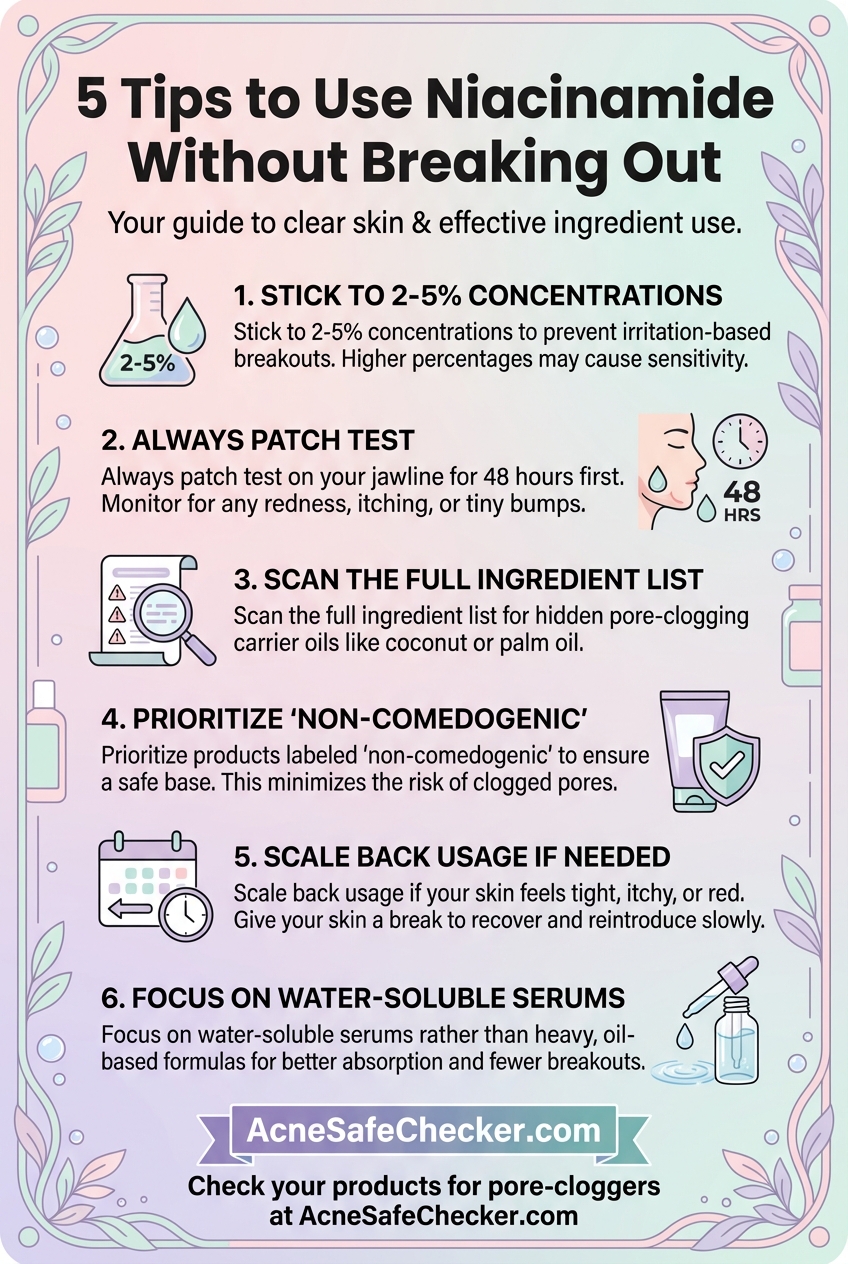
Skincare products are rarely made of a single ingredient. While niacinamide is safe, the carrier ingredients in the serum or cream might not be. Thickening agents, certain oils (like coconut oil derivatives), or isopropyl myristate can be highly comedogenic. Always check the full ingredient list of the product, not just the active star.
The Concentration Trap
In the world of skincare, more is not always better. Many popular serums use concentrations of 10% or even 20% niacinamide. However, clinical research shows that 2% to 5% is the "sweet spot" for efficacy. At very high concentrations, niacinamide can cause irritation and contact dermatitis in sensitive individuals. This irritation can manifest as small, red bumps that look like acne but are actually a localized reaction.
The Purging Myth
Technically, niacinamide does not cause "purging" because it doesn't increase cell turnover in the same way retinoids or AHAs do. However, if your niacinamide is formulated with an exfoliant (like salicylic acid) or if it’s irritating your skin barrier, it may cause existing congestion to come to the surface faster.
Practical Steps for Incorporating Niacinamide Safely
If you are worried about breakouts but want the benefits of Vitamin B3, follow these professional tips:
- Start Low and Slow: Look for products with a 3% to 5% concentration. This is less likely to irritate the skin while still providing all the sebum-regulating benefits.
- Patch Test: Apply the product to a small area of your jawline for 48 hours before applying it to your entire face.
- Check for "Non-Comedogenic" Labeling: While not a perfect guarantee, it indicates the brand has formulated the product specifically to avoid pore-clogging bases.
- Monitor Your Skin Barrier: If your skin feels tight, itchy, or overly red, you may be using too much or too high a concentration. Scale back to every other day.
Conclusion
In the search for clear skin, niacinamide remains one of the most effective and safest tools in our dermatological toolkit. To answer the question: No, niacinamide is not comedogenic. It is a non-clogging, oil-regulating, and barrier-strengthening powerhouse.
If you find yourself breaking out after using a new product, don't blame the niacinamide immediately. Instead, look at the overall formulation and the concentration level. When used correctly, niacinamide is not the cause of your clogged pores—it is the solution.