
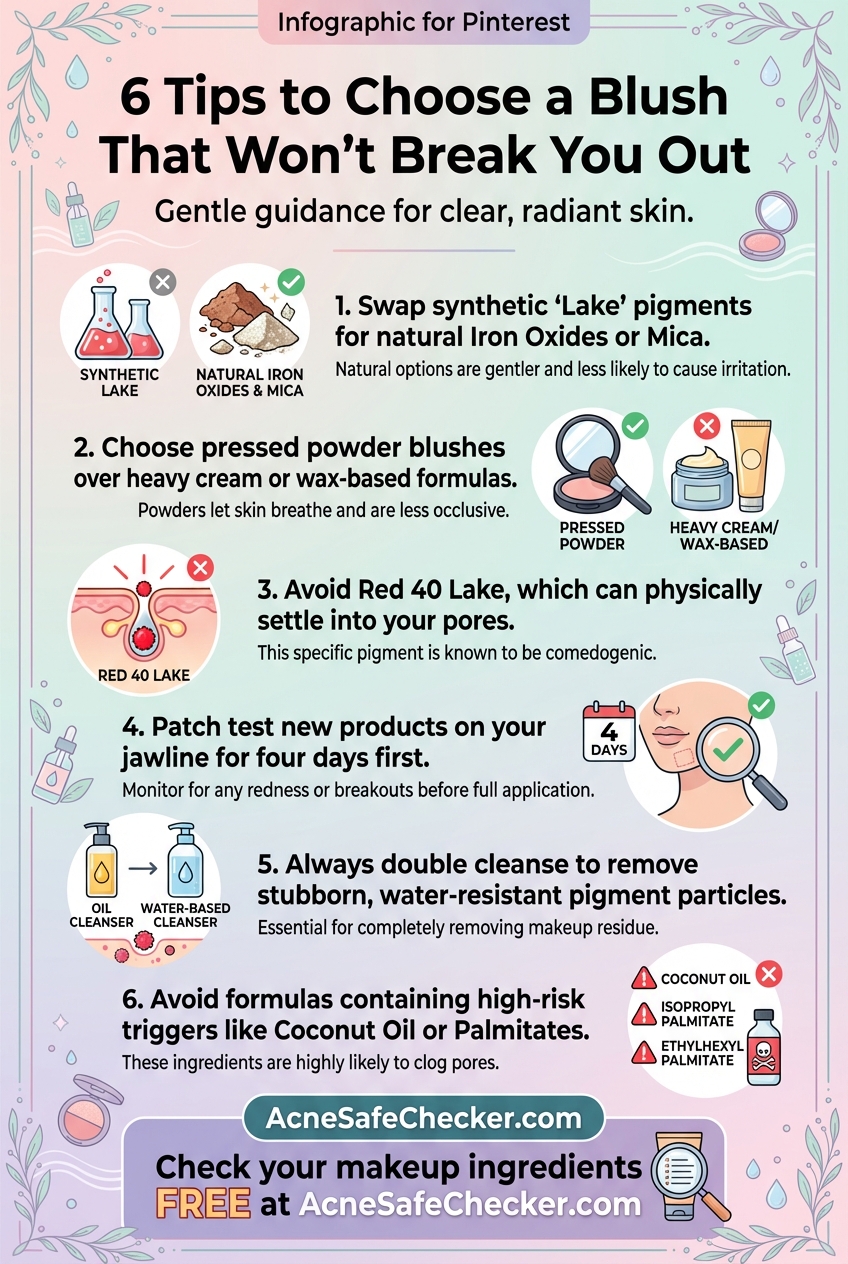
Finding the perfect flush of color for your cheeks shouldn’t come at the cost of your skin’s clarity. If you have ever experienced a sudden breakout on your cheekbones after trying a new blush, you aren’t alone. For those with acne-prone skin, the ingredients list on a makeup compact can feel like a minefield.
Is Your Routine Acne-Safe?
Do not guess. Instantly check your products for pore-clogging ingredients with our AI-powered tool.
Check Ingredients NowOne ingredient that frequently appears in cosmetics—and often raises eyebrows—is Red 40 Lake. But is Red 40 Lake actually comedogenic? As a dermatologist, I see many patients who meticulously check their serums and moisturizers for pore-cloggers but overlook their color cosmetics. Today, we are going to break down the science of Red 40 Lake and determine if it deserves a place in your makeup bag.
What is Red 40 Lake?
To understand its impact on your skin, we first need to understand what this ingredient is. In the world of cosmetics, "Red 40" (Allura Red AC) is a synthetic azo dye. However, in blushes, lipsticks, and eyeshadows, you will almost always see it listed as Red 40 Lake.
A "Lake" pigment is created by reacting a dye with a binder, typically a metallic salt like aluminum hydroxide. This process makes the color insoluble in water, allowing it to stay vibrant and stable on the skin without bleeding or fading. While this is great for the longevity of your makeup, the chemical transformation changes how the ingredient interacts with your pores.
Is Red 40 Lake Comedogenic?
The short answer is: Yes, it can be.
On the standard comedogenicity scale—which ranks ingredients from 0 (non-pore-clogging) to 5 (highly likely to clog pores)—Red 40 Lake generally sits at a 2 or 3.
While a rating of 2 or 3 is considered "moderately" comedogenic, for someone with highly reactive or acne-prone skin, this can be enough to trigger inflammatory acne or closed comedones (whiteheads). Unlike the water-soluble Red 40 dye, the "Lake" version has a heavier molecular structure and a tendency to settle into the follicular opening (the pore).
Why Blush is Particularly Risky
Blush is applied to the "malar" region of the face—the tops of the cheeks. This area contains a high density of sebaceous glands. When you apply a product containing moderately comedogenic pigments like Red 40 Lake and then layer it over a heavy foundation or primer, you create an occlusive environment that traps sebum and bacteria, leading to breakouts.
The Difference Between Red 40 and Red 40 Lake
It is a common point of confusion: if Red 40 is a food-grade dye, why is it a problem in skincare?
- Physical State: Red 40 is a dye that dissolves. Red 40 Lake is a pigment particle. Particles are more likely to physically lodge in a pore.
- The Aluminum Connection: The aluminum salts used to create the Lake pigment can be irritating to some skin types. Inflammation is often the precursor to a pore becoming clogged.
- Concentration: Blushes require high pigment loads to show up on the skin. The more vibrant the pink or red, the higher the concentration of Red 40 Lake likely present in the formula.
Other Pigments to Watch For
Red 40 Lake isn't the only culprit in the red family. If you are acne-prone, you should also be cautious with other synthetic "Lakes," particularly:
- Red 30 Lake: Often rated a 3 on the comedogenicity scale.
- Red 27 Lake: Another frequent offender for cheek breakouts.
- D&C Red 3, 21, and 36: These are frequently cited by estheticians and dermatologists as high-risk ingredients for acne patients.
How to Choose an Acne-Safe Blush
You don’t have to give up your rosy glow just because you have acne-prone skin. Here is how to shop smarter:
1. Look for Mineral Pigments
Instead of synthetic Lakes, look for blushes that use Iron Oxides or Mica for color. These are generally considered non-comedogenic and are less likely to cause irritation or follicular plugging.
2. Check the Formula Type
If you are prone to breakouts, a pressed powder blush is often safer than a cream blush. Cream formulas often contain waxes, oils (like coconut oil or ethylhexyl palmitate), and esters that, when combined with Red 40 Lake, create a "pore-clogging cocktail."
3. The Patch Test
Before applying a new blush all over your cheeks, test it on a small area near your jawline for three to four days. If you notice small bumps or increased texture, the pigments (or the base) are likely too heavy for your skin.
4. Double Cleanse
Because Lake pigments are designed to be long-lasting and water-resistant, they are difficult to remove with a simple water-based cleanser. Use a micellar water or a non-comedogenic cleansing oil first to fully dissolve the pigments before your main wash.
Conclusion: The Final Verdict
Is Red 40 Lake the enemy? Not necessarily for everyone. If you have "normal" skin that rarely breaks out, you can likely use products containing this pigment without a second thought.
However, if you are currently struggling with acne or are "acne-prone," Red 40 Lake is an ingredient you should approach with caution. It has a moderate potential to clog pores, and when combined with other heavy makeup ingredients, it can certainly contribute to the cycle of breakouts.
For the healthiest skin possible, prioritize blushes colored with iron oxides and always prioritize thorough cleansing at the end of the day. Your pores will thank you.