
The Hidden Culprits in Your Beauty Routine
Is Your Routine Acne-Safe?
Do not guess. Instantly check your products for pore-clogging ingredients with our AI-powered tool.
Check Ingredients NowYou’ve spent hundreds of dollars on the latest serums, moisturizers, and foundations, yet your skin continues to break out. You look at the bottle and see the words "non-comedogenic" and "dermatologist tested," so why are you still dealing with persistent whiteheads and localized inflammation?
As a dermatologist, I see this scenario daily. The reality is that the term "non-comedogenic" is not strictly regulated by the FDA. A product can claim to be pore-friendly while still containing ingredients that trigger acne in sensitive individuals. This is where a cosmetic ingredient safety checker becomes an essential tool in your skincare arsenal. By understanding how to audit your own products, you can bridge the gap between marketing claims and clinical reality.
What is a Cosmetic Ingredient Safety Checker?
A cosmetic ingredient safety checker is a digital tool or database designed to cross-reference the International Nomenclature of Cosmetic Ingredients (INCI) list on your product packaging against known scientific data. These checkers typically focus on two primary metrics:
- Comedogenicity: The likelihood that an ingredient will clog pores and cause acne (comedones).
- Irritancy: The potential for an ingredient to cause redness, peeling, or contact dermatitis.
While some checkers focus on general toxicity or environmental impact (like the EWG Skin Deep database), acne-sufferers specifically benefit from tools that utilize the comedogenic scale to flag "pore-cloggers."
The Science of the Comedogenic Scale
To use these tools effectively, you must understand the science behind them. The comedogenic scale traditionally ranges from 0 to 5:
- 0: Will not clog pores.
- 1–2: Low probability of clogging pores.
- 3: Moderate probability; may cause issues for acne-prone individuals.
- 4–5: High probability of causing breakouts.
How These Ratings Are Determined
Historically, these ratings were established using the Rabbit Ear Assay, where ingredients were applied to the sensitive inner ear of a rabbit to observe follicular changes. While modern testing has moved toward human volunteer trials and in vitro models, the legacy data still forms the backbone of many safety checkers.
It is important to note that an ingredient’s concentration matters. For example, an ingredient rated a "4" might be problematic if it is the second item on the list, but may be perfectly safe if it is the very last ingredient (present at less than 1%).
Common Red-Flag Ingredients to Watch For
When you run your products through a checker, you will likely see certain repeat offenders. If you are struggling with adult acne or congestion, keep a close eye out for these high-rated comedogens:
- Isopropyl Myristate and its derivatives: Used to give products a "slip" or smooth feel, but highly comedogenic.
- Coconut Oil (Cocos Nucifera): While great for the body or hair, it is a notorious pore-clogger for facial skin.
- Algae Extract: Often found in high-end "marine" skincare, certain species are highly comedogenic due to their mineral and salt content.
- Sodium Laureth Sulfate (SLS): A surfactant that can be both irritating and pore-clogging for those with a compromised skin barrier.
How to Use an Ingredient Checker Like a Pro
If you want to take control of your skin health, follow these steps to perform a professional-grade audit of your vanity:
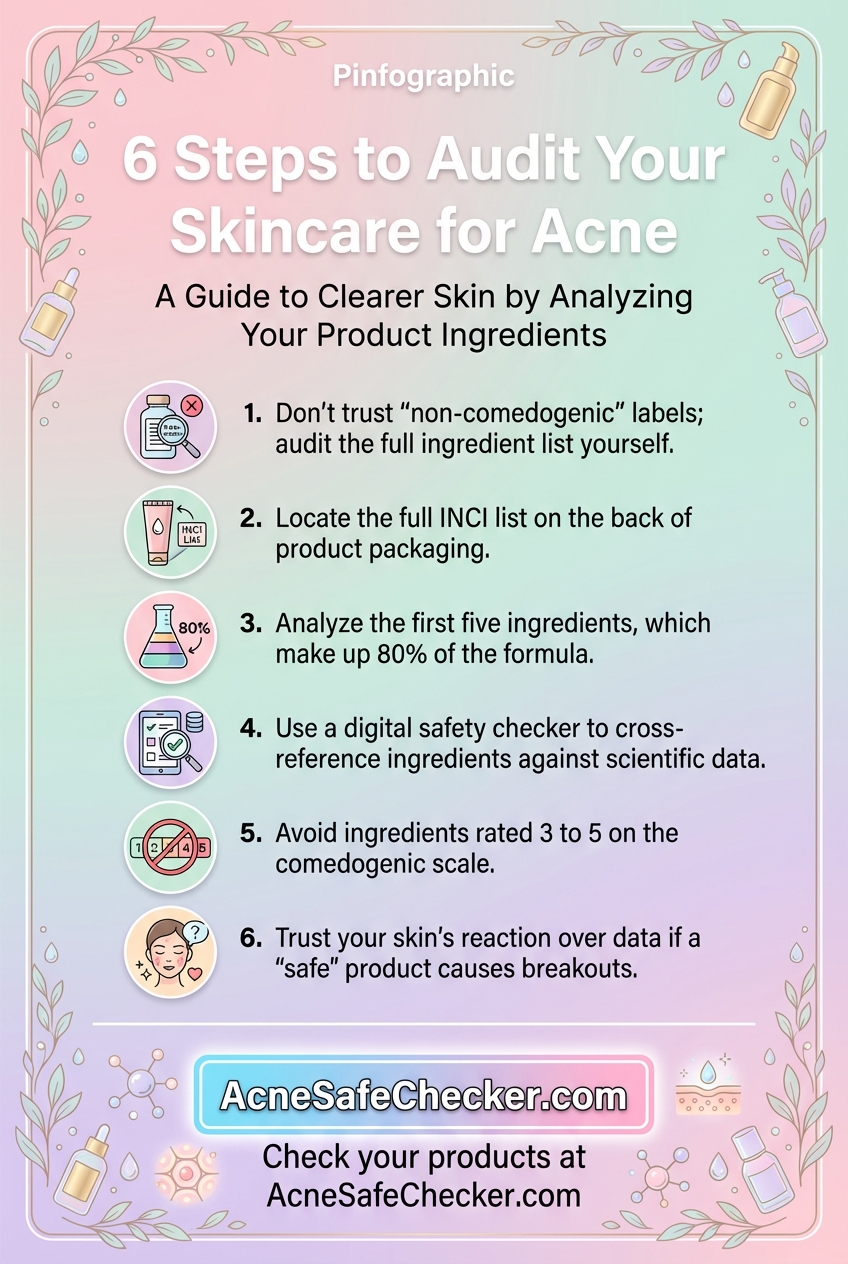
1. Locate the Full INCI List
Don't rely on the "Key Ingredients" listed on the front of the box. Find the full list, usually found on the back or the outer packaging. If you’ve thrown the box away, look up the product on the official brand website.
2. Copy and Paste into a Trusted Tool
There are several reputable online databases. Look for those that specifically allow you to paste a full list of ingredients. These tools will instantly highlight each ingredient and assign it a safety or comedogenicity score.
3. Analyze the First Five Ingredients
In skincare formulation, the first five ingredients typically make up about 80% of the product. If a highly comedogenic ingredient (rated 4 or 5) appears in the top five, it is likely the reason for your breakouts.
4. Cross-Reference with Your Skin's Reaction
Data is helpful, but your skin is the ultimate laboratory. If a checker says a product is "safe" but you consistently break out after using it, trust your skin. You may have a specific sensitivity to an ingredient that isn't widely considered a clogger.
Limitations: Context is Everything
As a specialist, I must offer a caveat: Formulation is a science of synergy. Sometimes, an ingredient that is comedogenic in its raw state behaves differently when chemically bound or diluted in a complex formula. Furthermore, "safety" doesn't just mean "no acne." A product might be non-comedogenic but contain high amounts of denatured alcohol, which can strip the skin barrier and lead to "reactive seborrhea"—where the skin overproduces oil to compensate for dryness, leading to more acne.
Conclusion: Empowerment Through Information
Achieving clear skin is often a process of elimination. By using a cosmetic ingredient safety checker, you move away from the "guess and check" method of buying skincare and toward a data-driven approach.
If you are tired of the cycle of clearing and breaking out, start by auditing your current routine. Identify the red flags, simplify your regimen, and prioritize ingredients that support your skin barrier without suffocating it. Your skin is your body's largest organ; treating it with the precision of scientific data is the fastest way to the healthy, glowing complexion you deserve.