
If you have ever dealt with tiny, itchy, uniform bumps that refuse to budge despite using traditional acne treatments like benzoyl peroxide or salicylic acid, you might not be dealing with acne at all. Instead, you could be experiencing Malassezia folliculitis, commonly known as fungal acne.
Is Your Routine Acne-Safe?
Do not guess. Instantly check your products for pore-clogging ingredients with our AI-powered tool.
Check Ingredients NowAs a dermatologist, I often see patients who are inadvertently "feeding" their skin concerns with high-end serums and moisturizers. The primary culprits? A specific group of chemical compounds known as esters. In this guide, we will break down the science of why esters trigger fungal acne and provide a comprehensive list of ingredients to watch out for.
Understanding the Science: Why Esters Matter
To understand why certain ingredients are problematic, we first need to understand the biology of the organism involved. Unlike hormonal acne, which is caused by bacteria (P. acnes), fungal acne is caused by an overgrowth of Malassezia yeast.
This yeast is a natural part of the skin's microbiome, but it is "lipophilic," meaning it loves fat. Specifically, Malassezia feeds on fatty acids with carbon chain lengths between 11 and 24.
What are Esters?
An ester is a compound formed by a reaction between an alcohol and a fatty acid. In skincare, esters are used as emollients, surfactants, and texture enhancers because they provide a silky feel and help stabilize formulas.
When you apply a product containing esters to your skin, the Malassezia yeast produces enzymes called lipases. These enzymes break the ester bond, releasing the fatty acid component. If that fatty acid falls within the C11–C24 range, the yeast consumes it, multiplies, and triggers an inflammatory response in your follicles—resulting in those stubborn, itchy bumps.
The Comprehensive List of Esters to Avoid
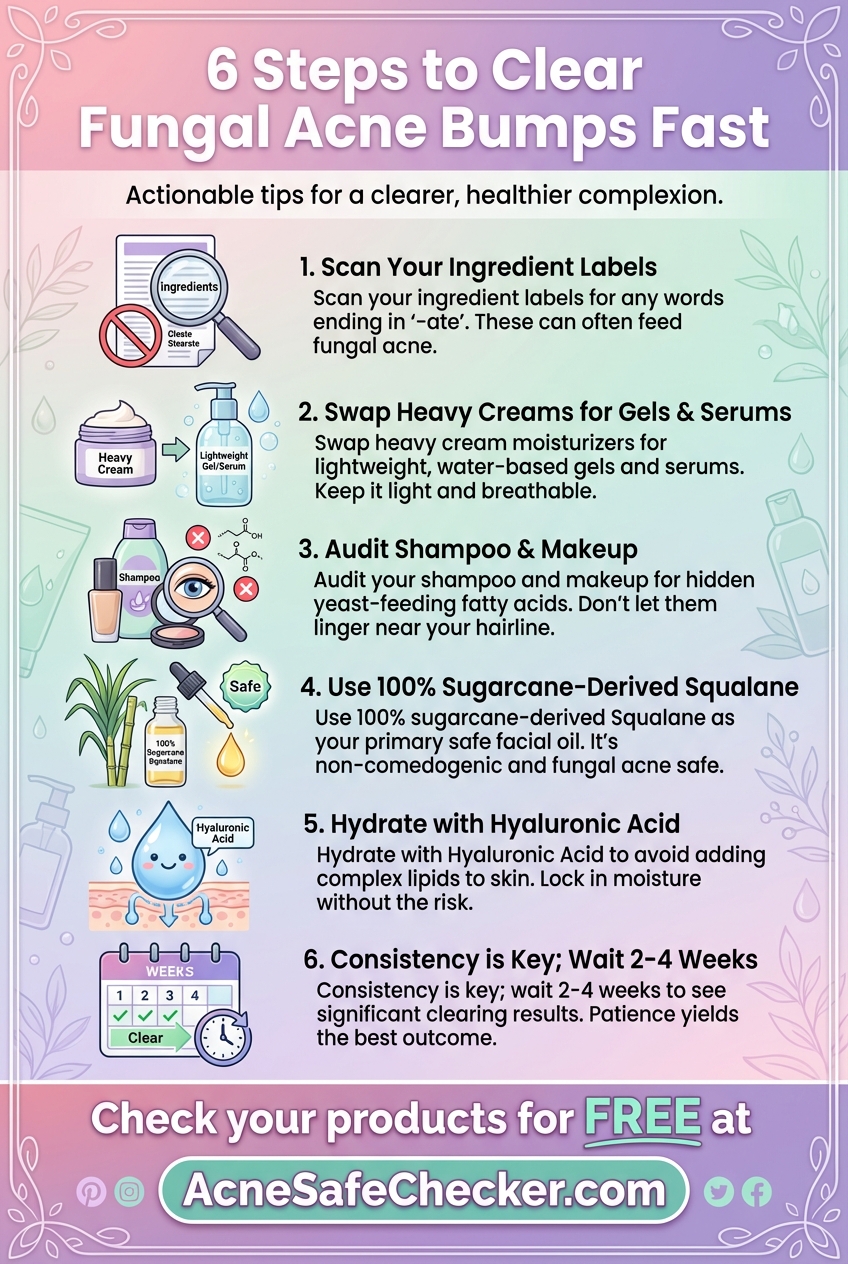
When scanning your ingredient labels, look for words that usually end in "-ate." While not every ingredient ending in "-ate" is an ester, the vast majority used in skincare are.
Common High-Risk Esters
These are some of the most frequent offenders found in foundations, moisturizers, and sunscreens:
- Isopropyl Palmitate: One of the most common triggers, often used to give products a "slip."
- Isopropyl Myristate: A popular emollient that is highly comedogenic and a major food source for yeast.
- Ethylhexyl Palmitate: Often used as a silicone alternative; highly problematic for fungal acne-prone skin.
- Glyceryl Stearate: A very common emulsifier found in almost all traditional creams.
- Isopropyl Isostearate: A heavy emollient that should be avoided entirely if you suspect Malassezia overgrowth.
- Decyl Oleate: Used for its skin-conditioning properties but highly triggering.
Other Esters and Related Ingredients
- Myristyl Myristate
- Cetyl Ethylhexanoate
- Glyceryl Oleate
- Polyglyceryl-3 Diisostearate
- Sorbitan Stearate
- Sucrose Cocoate
- Polysorbates (20, 40, 60, 80): These are technically esters (ethoxylated sorbitan esters) and are notorious for fueling fungal acne.
Are All Esters Bad?
It is important to note that not all esters are created equal. The scientific consensus is that the carbon chain length is the deciding factor. For example, esters derived from very short-chain fatty acids (C8–C10) like Caprylic/Capric Triglyceride (derived from coconut oil but processed to remove longer chains) are generally considered safe by most experts, though some extremely sensitive individuals still prefer to avoid them.
Practical Steps for Managing Fungal Acne
Transitioning to a fungal acne-safe routine can feel overwhelming, but following these steps can help clear your complexion significantly.
1. Audit Your Current Routine
Take every product you use—including shampoo and makeup—and check the ingredient list against the list of esters above. Even a "wash-off" product like a cleanser can leave enough residue to trigger a breakout.
2. Look for "Malassezia-Safe" Alternatives
Instead of heavy ester-based creams, look for:
- Gels and Water-based Serums: These are less likely to contain complex lipids.
- Squalane Oil: Specifically, 100% sugarcane-derived squalane. Unlike other oils, squalane is a saturated hydrocarbon that the yeast cannot metabolize.
- Hyaluronic Acid: A great way to hydrate without adding fats.
3. Simplify and Observe
When you remove esters from your routine, it usually takes about 2 to 4 weeks to see a significant reduction in fungal acne bumps. During this time, avoid introducing new oils or waxes to ensure your skin has time to rebalance its microbiome.
4. Consult a Professional
If your skin does not clear up after removing esters and fatty acids, consult a board-certified dermatologist. We can provide a definitive diagnosis via a skin scraping or prescribe antifungal treatments like Ketoconazole or Fluconazole to jumpstart the healing process.
Conclusion
Managing fungal acne is a game of elimination. While esters are excellent ingredients for many people, they act as fuel for those prone to Malassezia overgrowth. By learning to identify these "-ate" ingredients on your labels, you take back control of your skin health. Remember: your skin is an ecosystem, and sometimes, the best thing you can do is stop feeding the unwanted guests.