
The Hidden Culprits in Your Vanity: Why Ingredients Matter
Is Your Routine Acne-Safe?
Do not guess. Instantly check your products for pore-clogging ingredients with our AI-powered tool.
Check Ingredients NowHave you ever purchased a high-end moisturizer labeled "dermatologist-tested" or "non-comedogenic," only to find your skin erupting in breakouts a week later? As a dermatologist, this is one of the most common frustrations I hear from patients. The reality is that the skincare industry is loosely regulated when it comes to labeling. A product can claim to be safe for acne-prone skin while still containing ingredients that act like a literal plug for your pores.
This is where a pore clogging ingredient checker becomes an essential tool in your skincare arsenal. By understanding how to decode an International Nomenclature of Cosmetic Ingredients (INCI) list, you can move past marketing fluff and make science-backed decisions for your skin health.
What Does "Comedogenic" Actually Mean?
To understand why we need a checker, we first need to understand the science of a "comedo." A comedo is the clinical term for a clogged pore. When sebum (your skin's natural oil) combines with dead skin cells and external substances, it forms a plug. If this plug stays under the skin, it’s a whitehead; if it oxidizes at the surface, it’s a blackhead.
The Comedogenic Scale
In the late 1970s, researchers developed the Comedogenic Scale, which ranks ingredients from 0 to 5:
- 0: Will not clog pores
- 1-2: Low risk of clogging
- 3: Moderate risk
- 4-5: High probability of clogging pores
While the original testing was performed on rabbit ears (which are more sensitive than human skin), the scale remains a foundational reference for identifying potential triggers for acne-prone individuals.
How a Pore Clogging Ingredient Checker Works
A pore clogging ingredient checker is a digital database or tool that allows you to copy and paste a product’s full ingredient list. The tool then cross-references each component against known comedogenic databases.
Why You Shouldn't Just Trust the Label
Many products marketed as "oil-free" use synthetic esters or waxes that are actually more comedogenic than certain natural oils. For example, Isopropyl Myristate is a common texture enhancer that gives products a silky feel, but it is highly comedogenic (scoring a 5 on the scale). Without a checker, the average consumer would never know that their "silky" serum is the root cause of their cystic acne.
Common Red Flags to Look For
When using a checker or manually scanning a label, keep an eye out for these frequent offenders that often slip under the radar:
1. Heavy Oils and Butters
While great for the body, ingredients like Coconut Oil (Cocos Nucifera Oil) and Cocoa Butter are notorious for clogging facial pores. They have large molecular structures that sit on the surface and trap sebum.
2. Synthetic Esters
Ingredients ending in "-ate," such as Ethylhexyl Palmitate or Laureth-4, are often used to make products spread easily. However, these are frequent triggers for sub-clinical acne (those tiny, skin-colored bumps).
3. Algae Extracts
Many "marine-based" luxury creams contain algae extracts. While antioxidant-rich, certain types of algae are high in iodides, which can irritate the pore lining and trigger breakouts in acne-prone individuals.
The Limitations: It’s Not Just the Ingredient, It’s the Formula
As a specialist, I must offer a scientific caveat: The dose makes the poison. An ingredient that ranks a 4 on the comedogenic scale might not break you out if it is listed at the very bottom of the ingredient list (meaning it’s present in a concentration of less than 1%).
Furthermore, the "formulation science" matters. How an ingredient is delivered and what it is paired with can change its behavior on the skin. A pore clogging ingredient checker is a fantastic screening tool, but it is a guide, not an absolute law. If a product contains a level 2 ingredient but your skin loves it, you don’t necessarily need to toss it.
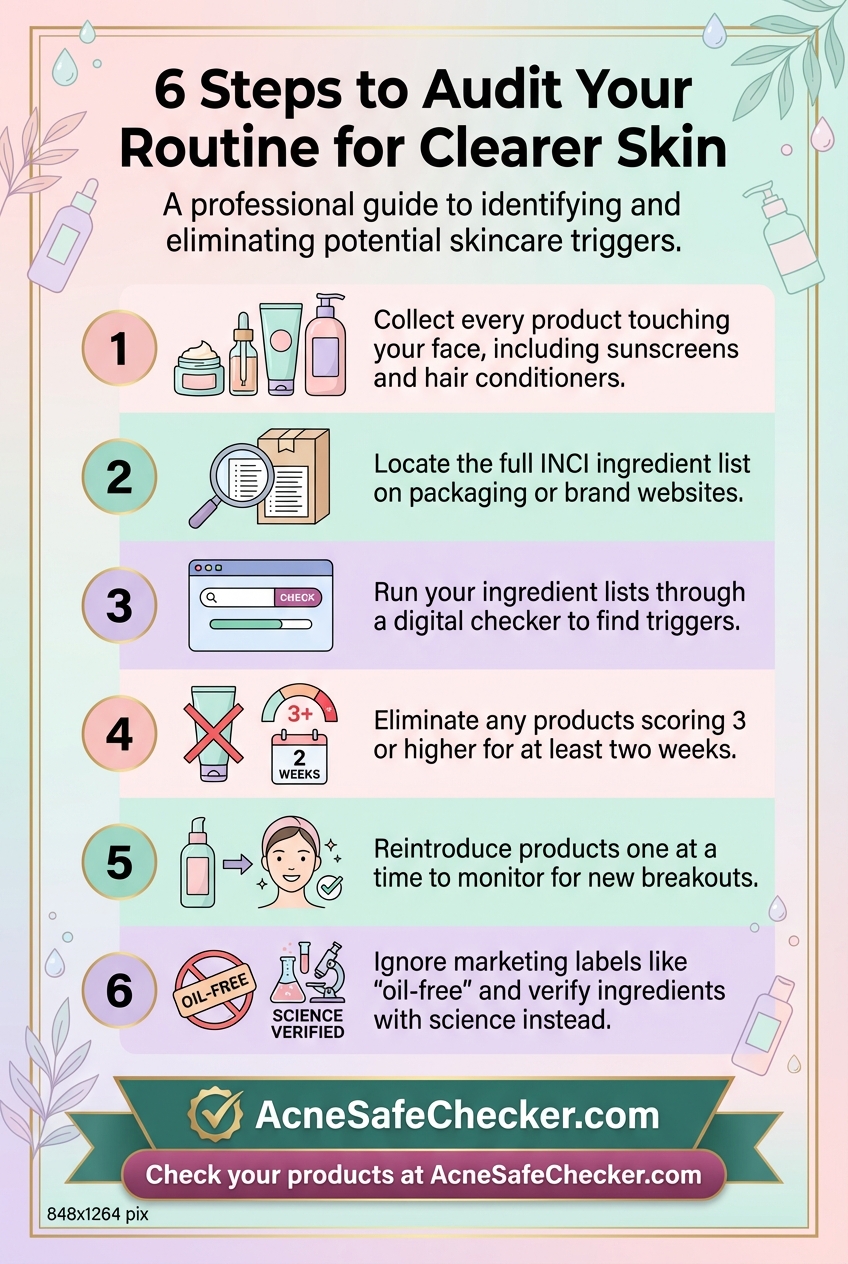
Practical Steps: How to Audit Your Routine
If you are currently struggling with persistent breakouts, follow this dermatological protocol using an ingredient checker:
- Gather Your Products: Line up everything that touches your face—cleansers, moisturizers, sunscreens, and even hair conditioners (which can cause "pomade acne" along the hairline).
- Find the INCI List: Look for the full list of ingredients on the packaging or the brand's website.
- Run the Audit: Paste the lists into a reputable checker tool. Highlight any ingredients scoring a 3, 4, or 5.
- The Elimination Phase: Remove products with high-scoring ingredients for at least two weeks.
- Reintroduce Carefully: If your skin clears up, you’ve found your culprit. If you want to test a product, reintroduce it one at a time and monitor for new bumps for 72 hours.
Conclusion: Empower Your Skincare Journey
Managing acne-prone skin often feels like a guessing game, but it doesn't have to be. By utilizing a pore clogging ingredient checker, you take the power back from marketing departments and put it into the hands of science.
Remember, the goal isn't necessarily to find a product with a "perfect" score, but to identify the specific triggers that affect your unique skin chemistry. Clear skin is a marathon, not a sprint, and understanding what you’re putting on your face is the first step toward a healthier complexion.