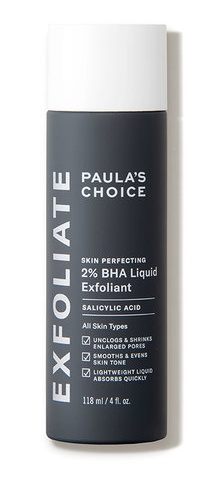
Paula's Choice Skin Perfecting 2% Bha Liquid Exfoliant
Paula's Choice Skin Perfecting 2% BHA Liquid Exfoliant is a globally recognized skincare staple designed to transform skin texture and clarity. As a leave-on chemical exfoliant, it utilizes Salicylic Acid (a Beta Hydroxy Acid) to penetrate deep into the lining of pores, dissolving the debris and oil that lead to congestion. The formula features a lightweight, fluid texture that feels like a toner, absorbing quickly into the skin without any greasy residue. Key ingredients like Methylpropanediol and Butylene Glycol act as delivery agents and humectants, ensuring the active BHA works effectively while maintaining surface hydration. Additionally, the inclusion of Green Tea extract provides antioxidant benefits to soothe potential irritation. This product is specifically engineered to target blackheads, minimize the appearance of enlarged pores, and smooth out fine lines. By gently shedding dead skin layers, it reveals a more radiant and even-toned complexion, making it an essential step for anyone seeking to refine their skin's surface without the harshness of physical scrubs.
Our Analysis
Our analysis of Paula's Choice Skin Perfecting 2% BHA Liquid Exfoliant confirms a LOW comedogenic risk level, making it an excellent choice for those prone to breakouts. The formula is free from common pore-clogging waxes, oils, and thickeners. Instead, it relies on Salicylic Acid, an oil-soluble ingredient that actively prevents acne by keeping pores clear of sebum. Since no flagged ingredients were found in the first five components or the broader list, this exfoliant is highly unlikely to trigger new comedones. It stands out as a safe, effective option for maintaining clear skin.
Skin Type Recommendations
This product is ideal for oily, combination, and acne-prone skin types that struggle with congestion and blackheads. Those with sensitive skin can also benefit due to its soothing ingredients, though they should start slowly. Very dry skin types should follow up with a rich moisturizer to balance the exfoliating effects.
Flagged Ingredients
This product does not contain known high-risk comedogenic ingredients.
MACR Analysis
5-Axis AI-Powered Risk Assessment
The MACR score is higher than the basic analysis because it evaluates additional risk factors like barrier disruption, irritation potential, and real-world user reports — not just traditional pore-clogging ingredients.
Recommendations
This treatment is best suited for individuals with oily, acne-prone skin who can tolerate potent exfoliants and are not sensitive to barrier disruption or fungal acne triggers.
Oily, acne-prone skin (with caution)
Sensitive skin, Dry skin, Fungal acne-prone skin, Individuals prone to irritation
Individuals with a compromised skin barrier, Those with known sensitivity to Salicylic Acid or pH adjusters, Anyone experiencing active inflammation or severe dryness
- •Patch test on a small area before applying to the entire face.
- •Start by using only 2-3 times per week, and gradually increase frequency if tolerated.
- •Always follow with a hydrating and barrier-repairing moisturizer.
- •Ensure consistent use of sunscreen during the day, as Salicylic Acid increases photosensitivity.
- •Discontinue use immediately if significant irritation, redness, or peeling occurs.
Overall Risk Score
Lower is better
Score by Skin Type
Lower is better
Same product, different risks based on your skin type
This leave-on treatment formulation, centered around Salicylic Acid, presents a moderate to high risk of comedogenicity and barrier disruption, particularly for acne-prone and sensitive skin types. The presence of multiple penetration enhancers and pH adjusters exacerbates these concerns, while the inclusion of Polysorbate 20 adds a potential fungal acne risk.
Risk Breakdown
Ingredient Interactions
These ingredients may interact to increase risk beyond their individual scores.
The combination of multiple penetration enhancers with salicylic acid significantly increases the risk of driving the active deeper into the skin, potentially leading to increased irritation, dryness, and barrier disruption.
Methylpropanediol and Butylene Glycol act synergistically to lower the skin's resistance, allowing Salicylic Acid, a potent BHA, to penetrate more effectively. This enhanced penetration can overwhelm the skin's natural defenses, leading to a greater risk of peeling, redness, and inflammation.
The presence of a strong alkali (Sodium Hydroxide) alongside an exfoliating acid (Salicylic Acid) increases the risk of significant barrier disruption and pH imbalance.
Sodium Hydroxide, used for pH adjustment, can elevate the pH of the formulation. If not perfectly neutralized, this can compromise the skin's natural acid mantle. Salicylic Acid itself, while lipophilic, can also contribute to irritation. Together, they can create a harsh environment that strips the skin of its protective lipids and disrupts its barrier function, leading to increased sensitivity and potential breakouts.
Why This Score?
The overall score is driven by the combined effects of Salicylic Acid's inherent potential for pore plugging and barrier disruption, amplified by multiple penetration enhancers (Methylpropanediol, Butylene Glycol) and a pH-adjusting agent (Sodium Hydroxide). Polysorbate 20 adds to the fungal acne risk. The high concentration of these key ingredients in the top half of the INCI list also contributes to the elevated score.
Main factors:
- •Salicylic Acid (PR, BR, UR)
- •Penetration Enhancers (Methylpropanediol, Butylene Glycol) (BR)
- •Sodium Hydroxide (BR)
- •Polysorbate 20 (FR, UR)
Reducing factors:
- •Leave-on product format (as opposed to rinse-off, which would have been lower)
- •Inclusion of plant extract (Camellia Oleifera Leaf Extract) which offers some antioxidant benefits (OR)
- •EDTA's low concentration and generally considered mild at typical use levels
Skin Type Considerations
This analysis uses the Multi-Axis Comedogenic Risk (MACR) system. Results are AI-estimated and cannot account for actual ingredient concentrations. Individual reactions may vary. Consult a dermatologist for personalized advice.