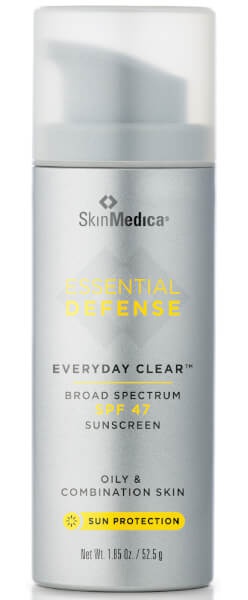
SkinMedica Essential Defense Everyday Clear Broad Spectrum Spf 47
SkinMedica Essential Defense Everyday Clear Broad Spectrum SPF 47 is a professional-grade sunscreen formulated to provide superior protection without compromising skin clarity. This lightweight, oil-free formula features a high-performance blend of chemical and physical filters, including 7.5% Octinoxate and a significant 12% Zinc Oxide, ensuring broad-spectrum defense against harmful UVA and UVB rays. Beyond its sun-shielding capabilities, this sunscreen is enriched with Niacinamide (Vitamin B3), a powerhouse ingredient known for its ability to calm redness, refine skin texture, and support a healthy skin barrier. The texture is designed to be sheer and weightless, utilizing Cyclopentasiloxane to create a silky, smooth finish that glides onto the skin effortlessly. Unlike many traditional sunscreens, the 'Everyday Clear' formulation is engineered to be virtually invisible, making it an ideal choice for all skin tones and perfect for wearing under makeup. It offers a clean, non-greasy feel that keeps the skin protected and comfortable throughout the day.
Our Analysis
Our deep-dive analysis of SkinMedica Essential Defense Everyday Clear SPF 47 confirms a low comedogenic risk level. We scanned the full ingredient list and found no flagged ingredients known to clog pores or trigger acne flares. The formula relies on non-comedogenic silicones for a smooth application and includes Zinc Oxide, which is generally well-tolerated by reactive skin. The addition of Niacinamide further enhances its profile by providing anti-inflammatory benefits. This product is a factual 'green light' for those concerned about pore congestion, as it lacks the heavy oils and waxes often found in high-SPF formulations.
Skin Type Recommendations
This sunscreen is highly recommended for oily, combination, and acne-prone skin types due to its non-comedogenic, oil-free nature. Sensitive skin users will appreciate the soothing properties of Niacinamide and Zinc Oxide. While excellent for most, those with extremely dry skin may prefer layering it over a dedicated hydrating moisturizer.
Flagged Ingredients
This product does not contain known high-risk comedogenic ingredients.
MACR Analysis
5-Axis AI-Powered Risk Assessment
Recommendations
This sunscreen is a moderate-risk option, best suited for those without significant acne or sensitivity concerns, and potentially beneficial for dry skin types seeking hydration.
Normal skin types, Dry skin types (due to silicones and humectants), Daily SPF protection
Oily skin types prone to breakouts, Sensitive skin types, Acne-prone skin
Individuals with a known sensitivity to ethoxylated compounds or preservatives like Sorbic Acid, Individuals highly reactive to barrier-disrupting ingredients
- •Patch test on a small area of skin before full application.
- •If experiencing any breakouts or irritation, discontinue use.
- •Ensure thorough cleansing at the end of the day to prevent potential pore occlusion.
Overall Risk Score
Lower is better
Score by Skin Type
Lower is better
Same product, different risks based on your skin type
This sunscreen formulation presents a moderate risk, primarily driven by potential barrier disruption from ethoxylated ingredients and penetration enhancers, coupled with some user-reported concerns regarding texture polymers. While UV filters and silicones are generally well-tolerated, the combination of mild surfactants and penetration enhancers warrants caution for acne-prone and sensitive skin.
Risk Breakdown
Ingredient Interactions
These ingredients may interact to increase risk beyond their individual scores.
Butylene Glycol enhances the penetration of other ingredients, including potentially irritating or barrier-disrupting ingredients like Oleth-3 Phosphate, increasing the overall barrier risk.
Butylene Glycol's role as a penetration enhancer facilitates deeper absorption of Oleth-3 Phosphate, which can lead to a more pronounced barrier disruption than either ingredient would cause individually.
Why This Score?
The overall score is calculated by weighting each axis (PR=7, BR=5, FR=3, OR=2, UR=3) and summing the results. The primary drivers of risk are moderate barrier disruption (BR) from ingredients like Oleth-3 Phosphate and Butylene Glycol, and some user-reported issues (UR) with polymers. Plugging risk (PR) and fungal risk (FR) are low, reflecting the formulation's use of silicones and lack of high-risk oils. Oxidation risk (OR) is also minimal.
Main factors:
- •Barrier Risk (BR) due to penetrative and mildly surfactant ingredients
- •User-Reported Risk (UR) from texture-modifying polymers
- •Synergistic barrier disruption from penetration enhancers and ethoxylates
Reducing factors:
- •Presence of beneficial ingredients like Niacinamide and Hyaluronic Acid.
- •Use of silicones which are generally non-comedogenic.
- •Low overall concentration of potentially problematic ingredients due to INCI position.
- •The product is a leave-on sunscreen, not a rinse-off product, so full axis scores apply.
Skin Type Considerations
This analysis uses the Multi-Axis Comedogenic Risk (MACR) system. Results are AI-estimated and cannot account for actual ingredient concentrations. Individual reactions may vary. Consult a dermatologist for personalized advice.