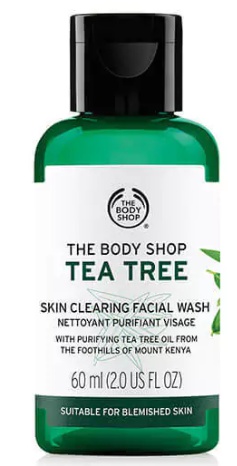
The Body Shop Tea Tree Skin Clearing Facial Wash (Discontinued)
The Body Shop Tea Tree Skin Clearing Facial Wash (now discontinued) was a long-time favorite for those struggling with oily and blemish-prone skin. This cooling gel cleanser was formulated with Community Fair Trade tea tree oil from Kenya, renowned for its natural antibacterial properties and ability to purify the skin. The product aimed to wash away excess oil and impurities to reveal a clearer-looking complexion. While it utilized Glycerin to provide a touch of hydration, the formula primarily focused on deep cleansing. The texture was a lightweight, refreshing green gel that produced a satisfying lather, leaving the skin feeling 'squeaky clean.' Although this classic formulation has been phased out, its legacy remains for its signature medicinal scent and invigorating feel. However, for those with specific acne triggers, the ingredient list reveals a few components that require a closer look to determine if it was truly 'acne-safe' for all users.
Our Analysis
Our analysis assigns a Moderate comedogenic risk level to this facial wash. While tea tree oil is excellent for blemishes, the formula contains Sodium Laureth Sulfate (SLES), which holds a 3/5 rating. SLES can be stripping, potentially disrupting the skin barrier and leading to compensatory oil production. Additionally, the inclusion of Tamanu Oil and Tocopherol (Vitamin E)—both rated 2/5—poses a slight risk for pore clogging. Tamanu oil is healing but thick, and pure Vitamin E can be heavy for some. These ingredients may cause issues for those with highly reactive or congestion-prone skin.
Skin Type Recommendations
This cleanser is best suited for very oily skin types that can tolerate stronger surfactants. It is not recommended for dry or sensitive skin due to the stripping nature of SLES. Those with inflammatory acne or a compromised skin barrier should avoid it, as the combination of sulfates and oils may cause further irritation.
Flagged Ingredients
Less irritating than SLS due to ethoxylation, but still capable of stripping oils and causing barrier disruption.
Thick, healing oil; heavy texture but anti-bacterial.
Pure Vitamin E is thick and sticky; safe in small amounts as an antioxidant, but potentially clogging in pure oil form.
Want Deeper Analysis?
Run our MACR (Multi-Axis Comedogenic Risk) analysis to get a comprehensive 5-axis risk assessment. This AI-powered analysis evaluates ingredients for Plugging Risk, Barrier Damage, Fungal Acne Risk, Oxidation Risk, and real-world User Reports — giving you personalized scores for your skin type.