
In the quest for a glowing, hydrated complexion, natural botanical oils have become a staple in many skincare routines. From marula to rosehip, the options are endless. However, if you have ever dealt with the frustration of a sudden breakout after trying a new product, you know that not all oils are created equal. One oil that often sparks debate is avocado oil.
Is Your Routine Acne-Safe?
Do not guess. Instantly check your products for pore-clogging ingredients with our AI-powered tool.
Check Ingredients NowAs a dermatologist, I am frequently asked: Is avocado oil comedogenic, and will it cause me to break out? To answer this, we need to dive into the science of pore-clogging ingredients and the specific fatty acid profile of this lush green oil.
Understanding the Comedogenic Scale
Before we look at avocado oil specifically, it is essential to understand the comedogenic scale. This is a system used by dermatologists and cosmetic chemists to rank how likely a specific ingredient is to clog pores. The scale ranges from 0 to 5:
- 0: Will not clog pores
- 1: Very low probability of clogging pores
- 2: Moderately low probability
- 3: Moderate probability
- 4: Fairly high probability
- 5: High probability of clogging pores
What is Avocado Oil’s Rating?
Avocado oil generally falls into the 2 to 3 range on the comedogenic scale. This means it is considered "moderately low" to "moderate" in terms of its potential to cause comedones (blackheads and whiteheads). While it isn't as risky as coconut oil (which sits at a 4), it isn't as "safe" for acne-prone individuals as hemp seed oil or argan oil (which sit near 0 or 1).
The Chemistry of Avocado Oil: Oleic Acid vs. Linoleic Acid
To understand why avocado oil behaves the way it does on the skin, we have to look at its fatty acid composition. Avocado oil is exceptionally high in Oleic Acid, an omega-9 fatty acid.
Scientific research suggests that people with acne-prone skin often have a deficiency of linoleic acid in their surface skin lipids. When linoleic acid is low, the skin’s sebum becomes thick and sticky, leading to clogged pores. Because avocado oil is high in oleic acid and lower in linoleic acid, it is a "heavy" oil. For some, this richness provides intense moisture; for others, it acts as a sealant that traps bacteria and dead skin cells inside the follicle.
Is Avocado Oil Right for Your Skin Type?
Whether avocado oil is a "hero" or a "hazard" depends almost entirely on your unique skin chemistry and concerns.
1. Dry and Dehydrated Skin
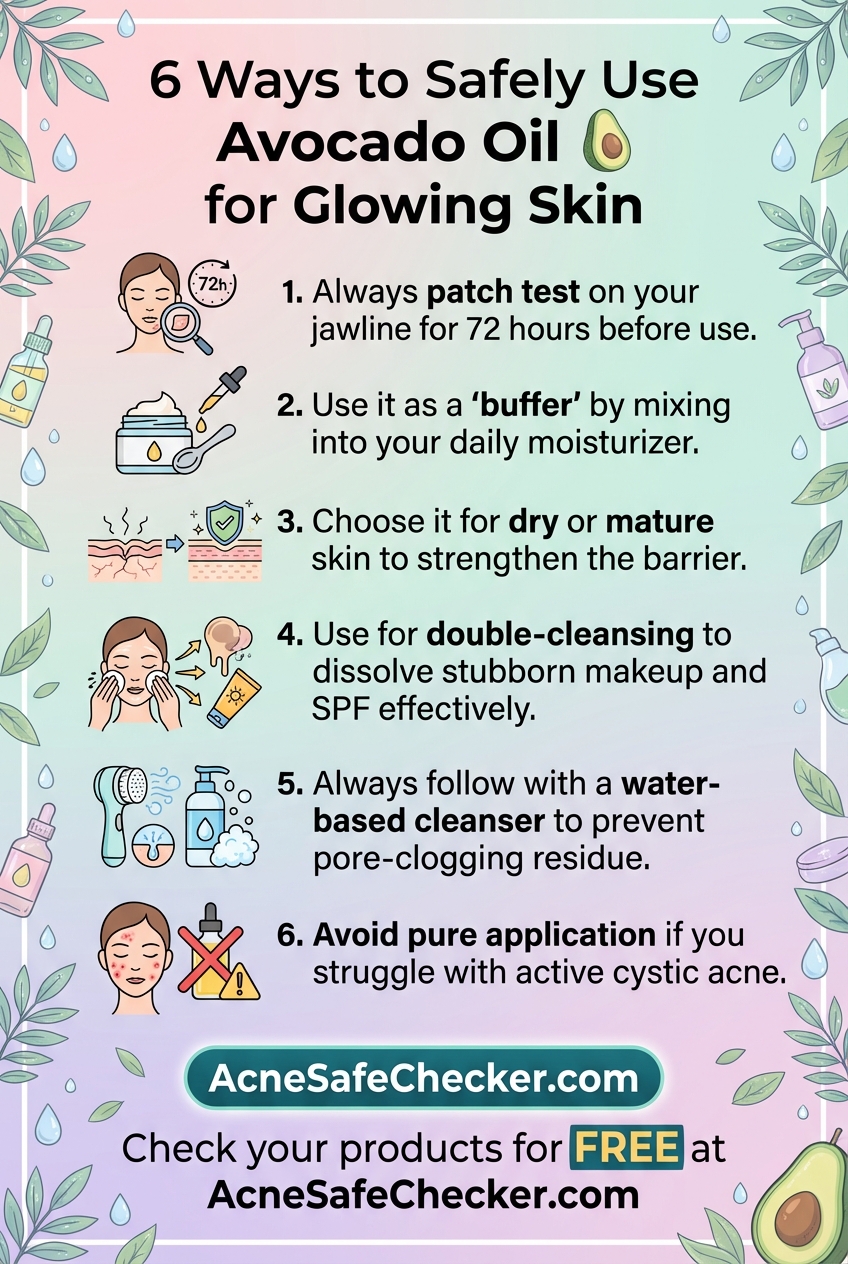
If you have chronically dry or flaky skin, avocado oil can be a miracle worker. Its high concentration of Vitamin E, potassium, and lecithin helps to strengthen the skin barrier and prevent transepidermal water loss. For these skin types, the risk of clogging is significantly lower because the skin absorbs the lipids efficiently.
2. Acne-Prone and Oily Skin
If you struggle with active acne or excessively oily skin, you should proceed with caution. Because avocado oil is a "3" on the scale for some formulations, it may exacerbate congestion. If you are prone to cystic acne, I generally recommend sticking to oils with a comedogenic rating of 0 or 1.
3. Mature or Aging Skin
Avocado oil is excellent for mature skin. It contains sterolins, which are known to soften the skin and reduce the appearance of age spots. The moderate comedogenic rating is rarely an issue here, as sebum production naturally decreases as we age.
Practical Steps: How to Use Avocado Oil Safely
If you want to incorporate avocado oil into your facial routine but are worried about breakouts, follow these clinical recommendations:
Perform a Patch Test
Never apply a new oil to your entire face at once. Apply a small amount to the side of your jawline for three consecutive nights. If you don't see any small bumps or redness after 72 hours, you are likely safe to proceed.
Use it as a "Buffer" or Mixer
Instead of using pure avocado oil, look for it as an ingredient in a well-formulated moisturizer. Professional formulations often balance the heavy oleic acid of avocado oil with lighter ingredients to mitigate the risk of pore-clogging.
Consider the Oil Cleansing Method (OCM)
Avocado oil is a fantastic first step in a double-cleansing routine. Because "like dissolves like," the oil can help break down stubborn makeup and sunscreen. However, you must follow it with a gentle, water-based foaming cleanser to ensure no residual oil stays on the skin to clog pores.
The Verdict
So, what is the final word on avocado oil's comedogenic rating for the face? It is a moderately safe oil that offers incredible nourishing benefits, but it is not universal.
If you have dry or aging skin, it is a powerhouse of antioxidants and hydration. If you are battling frequent breakouts, its moderate rating of 2-3 means it might be a bit too heavy for your pores. Skincare is deeply personal—listen to your skin, watch how it reacts, and when in doubt, consult with a board-certified dermatologist to build a routine that supports your specific skin goals.