
For many men, the journey to growing a thick, luscious beard is often interrupted by an unwelcome guest: 'beardne.' If you’ve noticed painful bumps, whiteheads, or persistent redness beneath your facial hair, you aren't alone. As a dermatologist, I frequently see patients who believe they have to choose between a well-groomed beard and clear skin.
Is Your Routine Acne-Safe?
Do not guess. Instantly check your products for pore-clogging ingredients with our AI-powered tool.
Check Ingredients NowThe culprit is often not the beard itself, but the products used to maintain it. Many traditional beard oils are formulated with heavy, occlusive ingredients that wreak havoc on acne-prone skin. This guide will explore the science of non-comedogenic beard oils and how you can nourish your facial hair without sacrificing your complexion.
Understanding Comedogenicity: Why Your Beard Oil Matters
In dermatology, the term "comedogenic" refers to the likelihood that a substance will clog pores and form a comedo (the precursor to a pimple). The Comedogenic Scale ranks ingredients from 0 to 5, where 0 is completely non-comedogenic and 5 is highly likely to cause breakouts.
When you apply oil to your beard, it inevitably makes contact with the skin underneath. If that oil has a high comedogenic rating, it mixes with your skin’s natural sebum and dead skin cells, creating a plug in the hair follicle. This environment is the perfect breeding ground for Cutibacterium acnes, the bacteria responsible for inflammatory acne.
The Science of Sebum and Fatty Acids
To choose the right oil, we must look at the fatty acid profile. Research suggests that individuals with acne-prone skin often have a deficiency of linoleic acid in their skin surface lipids. When skin is low in linoleic acid, its natural sebum becomes thick and sticky, leading to clogged pores.
Non-comedogenic oils for acne-prone skin are typically higher in linoleic acid and lower in oleic acid. Oleic acid is a rich, heavy fat that is excellent for dry skin but can be too occlusive for those prone to breakouts. By selecting oils with a favorable fatty acid balance, you can actually help regulate your skin's natural oil production.
Top Non-Comedogenic Oils for Your Beard
When scanning ingredient labels, look for these dermatologist-approved oils that sit at the bottom of the comedogenic scale:
1. Squalane (Rating: 0-1)
Squalane is a hydrogenated version of squalene, a natural component of human sebum. It is incredibly lightweight, fast-absorbing, and virtually impossible to clog pores with. It provides excellent slip for beard grooming without the greasy residue.
2. Hemp Seed Oil (Rating: 0)
High in linoleic acid, hemp seed oil is a powerhouse for acne-prone skin. It acts as an emollient to soften beard hair while simultaneously soothing inflammation and redness often associated with active breakouts.
3. Jojoba Oil (Rating: 2)
While technically a liquid wax ester rather than an oil, jojoba is structurally very similar to human sebum. It can "trick" the skin into thinking it has produced enough oil, which may help reduce overall oiliness over time.
4. Argan Oil (Rating: 0)
Rich in Vitamin E and antioxidants, argan oil is a "dry" oil that absorbs quickly. It helps to tame frizz and add shine to the beard without the heavy, pore-clogging film left by other nut oils.
Ingredients to Avoid
If you have acne-prone skin, avoid beard oils containing these high-risk ingredients:
- Coconut Oil: Rated a 4 on the comedogenic scale, it is one of the most common causes of beard-related breakouts.
- Cocoa Butter: Extremely occlusive and likely to cause whiteheads.
- Isopropyl Myristate: A synthetic emollient often used for texture that is highly comedogenic.
- Synthetic Fragrances: These can cause irritant contact dermatitis, which weakens the skin barrier and exacerbates acne.
Practical Steps: How to Apply Beard Oil Without Breaking Out
Selecting the right product is only half the battle. How you apply it matters just as much as what is in the bottle.
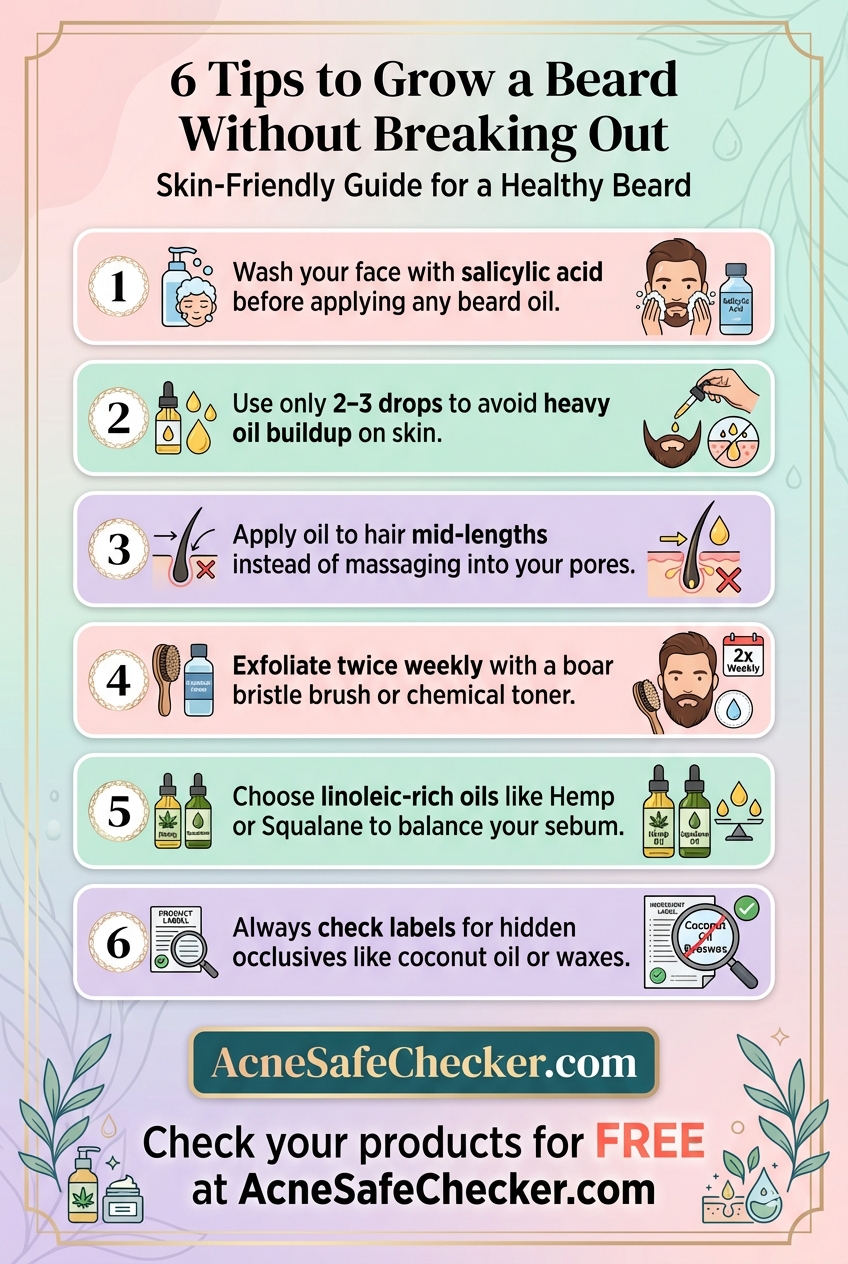
- Start with a Clean Canvas: Always wash your face and beard with a gentle, salicylic acid or benzoyl peroxide cleanser before applying oil. This removes existing bacteria and debris.
- Less is More: For a short to medium beard, 2–3 drops are usually sufficient. Over-applying even the best non-comedogenic oil can lead to buildup.
- Target the Hair, Not the Skin: Focus the application on the mid-lengths and ends of the beard hair. While some oil will inevitably touch the skin, you don't need to massage it into the pores like a moisturizer.
- Exfoliate Regularly: Use a beard brush with boar bristles or a chemical exfoliant (like an AHA/BHA toner) twice a week to help lift dead skin cells that the beard hair might be trapping against your face.
Conclusion
A great beard should never come at the cost of clear skin. By understanding the science of comedogenicity and choosing oils rich in linoleic acid—like hemp, squalane, or jojoba—you can maintain a healthy, groomed appearance while keeping your pores clear.
Remember that everyone’s skin is unique. If you transition to a non-comedogenic oil and still experience persistent breakouts, consult with a board-certified dermatologist to rule out other conditions like seborrheic dermatitis or folliculitis, which can often mimic the appearance of acne.