
For years, the conventional wisdom for those battling acne was simple: avoid oil at all costs. We were told to strip the skin with harsh, foaming detergents to banish every trace of shine. However, as a dermatologist, I have seen how this approach often backfires, leading to a compromised skin barrier, increased inflammation, and—ironically—more breakouts.
Is Your Routine Acne-Safe?
Do not guess. Instantly check your products for pore-clogging ingredients with our AI-powered tool.
Check Ingredients NowEnter the emulsifying oil cleanser. It may seem counterintuitive to put oil on oily skin, but when formulated correctly, it is one of the most effective ways to manage acne-prone complexions. The secret lies in a process called emulsification.
The Science of Emulsification: How It Works
To understand why an emulsifying oil cleanser is superior for acne, we have to look at the chemistry of cleansing. Oil dissolves oil. Throughout the day, your skin accumulates sebum (your natural oil), oxidized makeup, water-resistant sunscreen, and environmental pollutants. These substances are lipophilic, meaning they bond easily with other oils but resist water.
An emulsifying oil cleanser contains surfactants that act as a bridge between oil and water. These molecules have a lipophilic (oil-loving) tail and a hydrophilic (water-loving) head. When you massage the oil onto dry skin, the oil-loving tails grab onto the debris in your pores.
The Magic of the "Milky" Phase
The moment you add water, the hydrophilic heads turn outward, and the oil transforms into a light, milky emulsion. This allows the cleanser—and all the trapped dirt and sebum—to be rinsed away completely with water. Without this emulsification process, the oil would sit on the skin, potentially trapping bacteria and causing the very breakouts you are trying to avoid.
Why Acne-Prone Skin Benefits from Oil Cleansing
Acne is often a result of follicular occlusion—pores getting blocked by a mixture of dead skin cells and hardened sebum. Traditional water-based cleansers often lack the solvent power to penetrate deep into the pore and break down these stubborn plugs.
1. Dissolving Sebum and SPF
Water-based cleansers often skip over heavy sunscreens and waterproof makeup. By using an oil cleanser first, you ensure that these pore-clogging agents are dissolved before they can lead to congestion.
2. Protecting the Acid Mantle
Acne-prone skin is often sensitized. Over-cleansing with high-pH soaps can strip the acid mantle, the skin’s protective barrier. Oil cleansers maintain the skin’s lipid balance, ensuring that the barrier remains intact while the surface is purified.
3. Reducing Inflammation
Many botanical oils contain linoleic acid, an essential fatty acid that is often deficient in the sebum of people with acne. Topical application can help soothe inflammation and balance the skin’s oil production.
Choosing the Right Ingredients: Non-Comedogenic Is Key
Not all oils are created equal. If you have acne-prone skin, you must choose a formula specifically designed to be non-comedogenic (non-pore-clogging).
Oils to Look For:
- Squalane: A lightweight, stable oil that mimics human sebum and is highly unlikely to clog pores.
- Grapeseed Oil: High in linoleic acid and naturally mildly astringent, making it ideal for oily skin types.
- Sunflower Seed Oil: A non-volatile carrier oil that helps repair the skin barrier without feeling heavy.
- Caprylic/Capric Triglyceride: Derived from coconut but processed to remove the heavy fatty acids, leaving a silky, light texture.
Oils to Avoid:
Avoid "pure" food-grade oils that lack emulsifiers, especially coconut oil or cocoa butter. While they are moisturizing, their molecular structure is too large for most acne-prone skin and can lead to significant follicular clogging.
The Practical Guide: How to Double Cleanse Properly
To get the best results from your emulsifying oil cleanser, the technique is just as important as the product. This is known as the Double Cleanse Method.
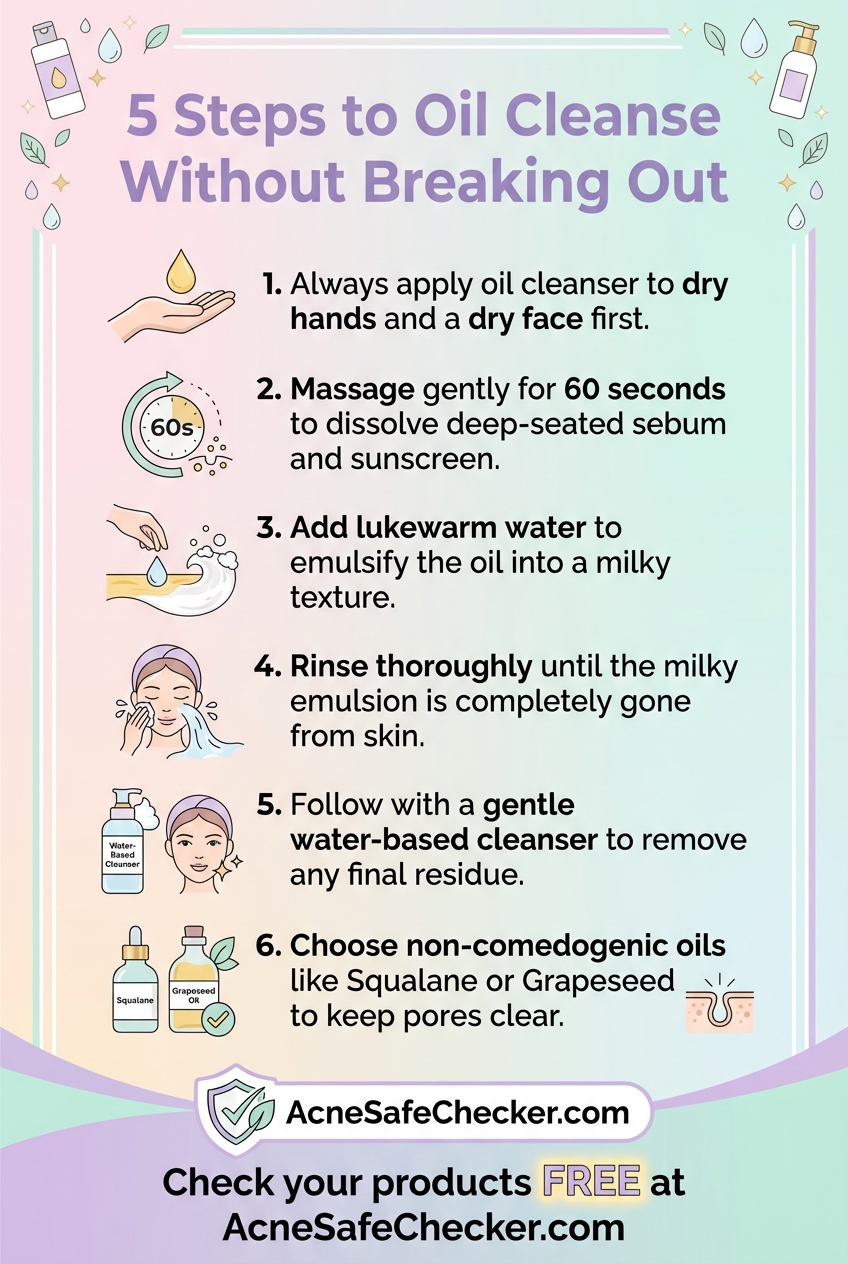
- Start with Dry Hands and a Dry Face: This is the most common mistake. Oil and water repel each other. For the cleanser to dissolve makeup and sebum, it must be applied to dry skin first.
- Massage Gently: Use circular motions for about 60 seconds. Focus on areas where you experience the most congestion, like the nose and chin.
- The Emulsification Step: Wet your hands with lukewarm water and continue massaging. Watch as the oil turns into a white, milky liquid. This is the sign that the surfactants are doing their job.
- Rinse Thoroughly: Use lukewarm water to rinse the emulsion away. Your skin should feel clean, not greasy.
- Follow with a Water-Based Cleanser: To ensure a truly "dermatologist-clean" finish, follow up with a gentle, low-pH foaming or gel cleanser. This removes any final traces of debris.
Conclusion
Finding the best oil cleanser for acne-prone skin that emulsifies is a journey toward balancing your skin’s ecosystem rather than fighting against it. By leveraging the power of "oil dissolves oil" and ensuring the product rinses away cleanly through emulsification, you can achieve a deeper clean without the irritation associated with traditional acne treatments. Remember, a clear complexion starts with a healthy skin barrier, and a high-quality emulsifying oil cleanser is often the first step in that direction.