
Finding the perfect skincare routine often feels like navigating a minefield. You analyze every label, hoping to avoid that one ingredient that will trigger a week-long breakout. If you have oily or acne-prone skin, you may have come across myristic acid in your cleansers or creams.
Is Your Routine Acne-Safe?
Do not guess. Instantly check your products for pore-clogging ingredients with our AI-powered tool.
Check Ingredients NowBut is myristic acid safe for your pores, or is it a hidden culprit behind your congestion? As a dermatologist, I often see patients frustrated by ingredients that appear "natural" but wreak havoc on their complexion. Today, we are diving deep into the science behind the myristic acid comedogenic rating and what it means for your skin health.
What Exactly is Myristic Acid?
Myristic acid, also known as tetradecanoic acid, is a common saturated fatty acid. It is naturally found in various plant and animal fats, most notably in coconut oil, palm oil, and nutmeg butter.
In the cosmetic industry, it is prized for its versatility. It functions primarily as:
- A Surfactant: It helps water mix with oil and dirt so they can be rinsed away.
- An Opacifier: It makes transparent formulas look creamy or opaque.
- An Emollient: It provides a smooth, lubricated feel to the skin.
You will most frequently find it in foaming facial cleansers, shaving creams, and some rich moisturizing lotions. While it helps create a luxurious lather, its molecular structure tells a more complicated story for those with sensitive pores.
The Comedogenic Rating: Where Does Myristic Acid Stand?
To understand the risk, we look at the comedogenic scale. This scale ranges from 0 to 5, where 0 is non-comedogenic (unlikely to clog pores) and 5 is highly comedogenic (almost certain to cause breakouts in prone individuals).
Myristic acid has a comedogenic rating of 3.
A rating of 3 is classified as moderately comedogenic. This means that while it isn't the most aggressive pore-clogger available (like isopropyl myristate, which is a 5), it still poses a significant risk to individuals with active acne or a tendency toward follicular congestion.
Why Does It Clog Pores?
From a scientific perspective, myristic acid is a long-chain fatty acid. When applied to the skin, it can penetrate the pore and mix with your natural sebum. For those with oily skin, this can thicken the sebum, making it more difficult for the pore to shed dead skin cells. This mixture forms a "plug," leading to microcomedones—the precursors to whiteheads and blackheads.
Does This Mean You Should Avoid It Entirely?
Not necessarily. The "3" rating is a guideline, but the actual risk depends on two major factors: concentration and formulation type.
1. Rinse-off vs. Leave-on Products
If myristic acid is in a foaming cleanser that stays on your face for 30 seconds before being washed away, the risk of it clogging your pores is significantly lower. However, if it is a primary ingredient in a heavy nighttime moisturizer or a foundation that sits on your skin for 12 hours, the likelihood of it causing issues increases exponentially.
2. Concentration (The "Ingredients List" Rule)
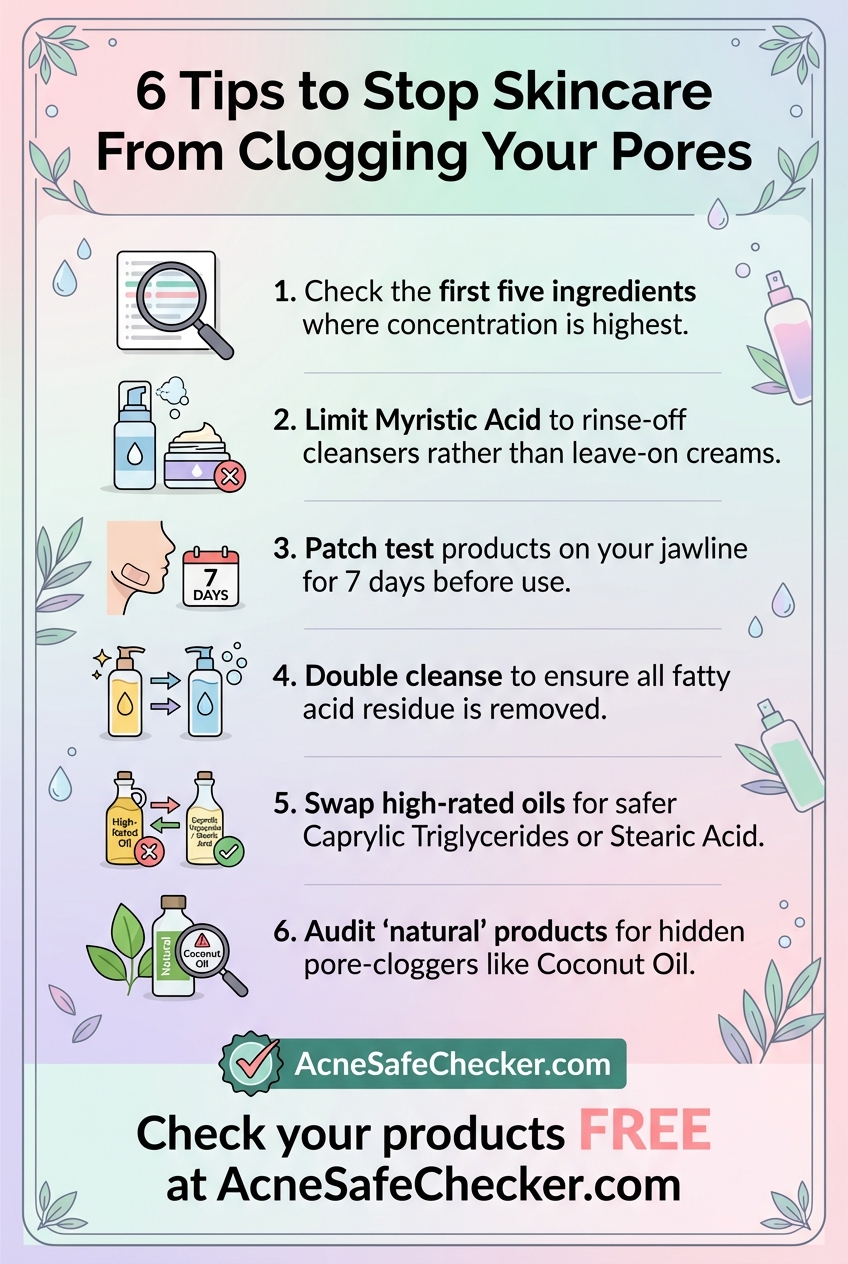
Ingredients are listed in order of concentration. If myristic acid is one of the first five ingredients, it makes up a large portion of the formula. If it is at the very bottom of the list, near the preservatives, its impact on your pores will likely be negligible.
Practical Steps for Acne-Prone Individuals
If you are currently battling breakouts or have "clogged-pore prone" skin, follow these professional recommendations:
- Check Your Labels: Look for myristic acid in the top half of your ingredient lists. If you find it in a leave-on cream and your skin is breaking out, this may be the culprit.
- The Patch Test Method: Before applying a new product all over your face, apply a small amount to a congestion-prone area (like the chin or jawline) for 5–7 days. If you see tiny bumps forming, the product is likely comedogenic for your specific skin type.
- Seek Alternatives: If you have highly reactive skin, look for products that use fatty acids with lower comedogenic ratings, such as stearic acid (rating of 2) or caprylic/capric triglycerides (rating of 2).
- Double Cleanse: If you use a product containing myristic acid, ensure you are thoroughly removing it. A gentle, non-comedogenic oil cleanser followed by a water-based cleanser can help prevent residue buildup.
The Bottom Line
Myristic acid is a functional and effective ingredient for many, but for the acne-prone community, it represents a "middle-ground" risk. With a comedogenic rating of 3, it has the potential to cause breakouts, especially in leave-on formulations.
As a dermatologist, my advice is simple: Know your skin. If your complexion is clear and your favorite cleanser contains myristic acid, there is no need to panic. However, if you are struggling with persistent texture and blackheads, auditing your cabinet for this moderately comedogenic fatty acid might be the breakthrough your skin needs. Always prioritize products labeled as "non-comedogenic," and when in doubt, consult with a professional to tailor a routine to your unique skin chemistry.