
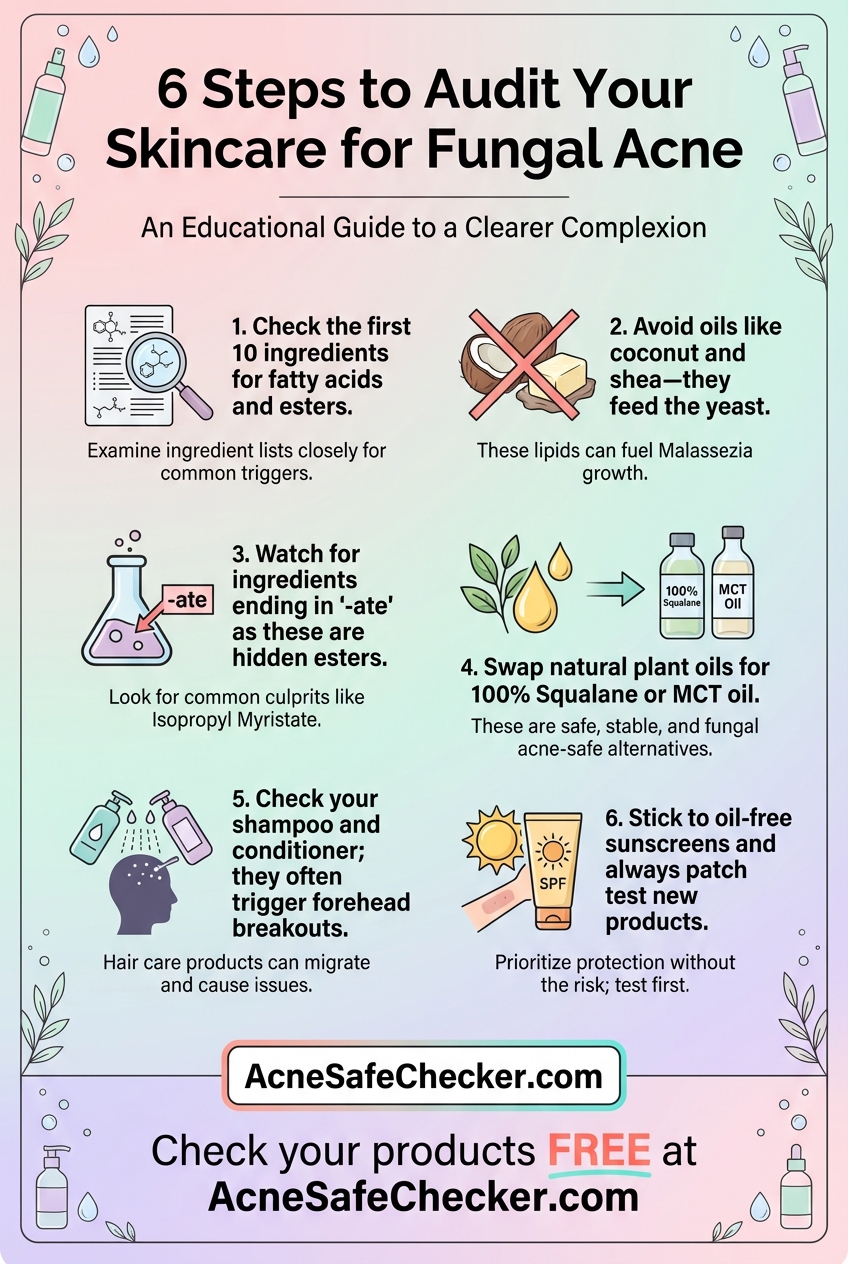
If you have ever dealt with stubborn, itchy, uniform bumps on your forehead or chest that refuse to respond to traditional benzoyl peroxide or salicylic acid treatments, you may not be dealing with acne at all. Instead, you might be experiencing Malassezia Folliculitis, commonly known as "fungal acne."
Is Your Routine Acne-Safe?
Do not guess. Instantly check your products for pore-clogging ingredients with our AI-powered tool.
Check Ingredients NowAs a dermatologist, I see patients daily who are frustrated because their expensive skincare routines are actually making their skin worse. The culprit? Specific ingredients that act as "food" for the Malassezia yeast. To achieve clear skin, you must learn how to audit your product labels. This guide will walk you through the science and the practical steps of checking ingredients for Malassezia triggers.
What is Malassezia Folliculitis?
Malassezia is a genus of fungi (yeast) that naturally resides on the skin of most adults. In a balanced microbiome, it causes no issues. However, when the environment on the skin becomes favorable—due to humidity, sweat, or specific skincare ingredients—this yeast can overgrow within the hair follicles. This leads to inflammation and the characteristic small, itchy, red bumps.
Unlike Acne Vulgaris, which is caused by bacteria (C. acnes), Malassezia thrives on lipids. This is why your choice of moisturizer, cleanser, and even sunscreen is critical. One wrong ingredient can provide the fuel needed for a fungal flare-up.
The Science of Triggers: Why Ingredients Matter
Malassezia is "lipophilic," meaning it loves fat. Specifically, most species of Malassezia lack the ability to produce their own fatty acids. To survive and reproduce, they must scavenge fatty acids from their environment—your sebum and your skincare products.
Research has shown that Malassezia species primarily consume fatty acids with carbon chain lengths ranging from C11 to C24. If a skincare ingredient falls within this range, it is essentially a buffet for the yeast.
1. Fatty Acids to Avoid
The most direct triggers are pure fatty acids. When scanning a label, look for and avoid:
- Lauric Acid (C12)
- Myristic Acid (C14)
- Palmitic Acid (C16)
- Stearic Acid (C18)
- Oleic Acid (C18)
- Linoleic Acid (C18)
2. Oils and Butters
Most natural oils are rich in the fatty acids listed above. This includes popular ingredients like coconut oil, shea butter, cocoa butter, and avocado oil. Even small amounts can trigger sensitive skin. While these are excellent for dry, non-fungal-acne-prone skin, they are problematic for those with Malassezia sensitivity.
3. Esters (The Hidden Culprits)
Esters are a combination of a fatty acid and an alcohol or glycerin. They are used as emollients and texture enhancers. You can usually identify them by the suffix "-ate". Common examples include:
- Isopropyl Palmitate
- Glyceryl Stearate
- Isopropyl Myristate
- Polysorbates (20, 40, 60, 80)
4. Fermented Ingredients
While probiotics and ferments (like Galactomyces or Saccharomyces) are trending in Korean beauty for their brightening effects, they can be highly problematic for fungal acne. Fermentation processes can stimulate yeast growth in certain individuals.
How to Audit Your Current Routine
Checking every single ingredient manually can be overwhelming. Here is a systematic approach to cleaning up your routine:
Step 1: The Ingredient Scan
Take your products and look at the first five to ten ingredients. These make up the bulk of the formula. If you see "Stearic Acid" or "Hydrogenated Coco-Glycerides" at the top of the list, it is a high-risk product.
Step 2: Use Scientific Screening
Since chemical names can be confusing, use the "C-Chain Rule." If you are unsure about an ingredient, search for its chemical structure. If it contains a fatty acid chain between 11 and 24 carbons, set it aside.
Step 3: Identify Safe Alternatives
Fortunately, not all lipids are off-limits. There are several Malassezia-safe ingredients that provide hydration without feeding the yeast:
- Caprylic/Capric Triglycerides: Also known as MCT oil (derived from coconut but with the problematic long-chain fatty acids removed).
- Squalane Oil: Note that it must be 100% pure Squalane, not Squalene. Squalane is a saturated oil that does not feed Malassezia.
- Mineral Oil and Petrolatum: These are large molecules that the yeast cannot metabolize.
- Hyaluronic Acid and Glycerin: Excellent humectants that provide moisture without lipids.
Practical Tips for Success
- Check Your Haircare: Often, "acne" on the forehead, back, and shoulders is caused by shampoo or conditioner rinsing down the skin. Many conditioners are loaded with fatty alcohols and esters.
- Don't Forget Sunscreen: Sunscreens are notoriously difficult to formulate without esters. Look specifically for oil-free, non-comedogenic formulas, and always cross-reference the ingredients.
- Patch Test: Even if a product appears "safe" on paper, everyone's microbiome is unique. Test new products on a small area of the jawline for 3–5 days before full application.
Conclusion
Managing Malassezia is less about "treating" the skin with harsh chemicals and more about "starving" the yeast by creating an inhospitable environment for its overgrowth. By becoming an expert at reading ingredient labels, you take the power back into your own hands.
Clear skin is a journey, not an overnight fix. If you have adjusted your routine to be Malassezia-safe and still see no improvement after 4–6 weeks, I recommend visiting a board-certified dermatologist for a formal skin scraping or culture to rule out other conditions. Knowledge is your best defense against breakouts—start reading those labels today!