
The Mystery of Stubborn “Acne”: Why Your Skin Isn’t Clearing Up
Is Your Routine Acne-Safe?
Do not guess. Instantly check your products for pore-clogging ingredients with our AI-powered tool.
Check Ingredients NowYou’ve tried benzoyl peroxide, you’ve sworn by salicylic acid, and you’ve spent a fortune on high-end spot treatments—yet those tiny, itchy, uniform bumps on your forehead or chest just won’t budge. If this sounds familiar, you might not be dealing with traditional acne vulgaris at all. Instead, you likely have Malassezia folliculitis, commonly known as fungal acne.
As a dermatologist, I see patients daily who are frustrated because their skincare routine is actually feeding the problem. The most common culprit? Your moisturizer. Many products designed to hydrate the skin contain ingredients that act as fuel for the yeast responsible for fungal acne. The good news is that you don’t need a luxury budget to fix it. There are several highly effective, fungal acne safe moisturizers available right at your local drugstore.
What is Fungal Acne? Understanding the Science
Fungal acne isn't actually acne. While traditional acne is caused by bacteria (C. acnes) getting trapped in pores with sebum, fungal acne is an overgrowth of Malassezia yeast in the hair follicles. This yeast is a normal part of your skin’s microbiome, but when it overproliferates, it causes inflammation.
What makes Malassezia unique—and frustrating—is its diet. This yeast thrives on fatty acids with carbon chain lengths between 11 and 24. Most traditional oils (like coconut oil, almond oil, and shea butter) and many fatty acid esters (like isopropyl palmitate or stearic acid) fall right into this range. When you apply these to your face, you are essentially providing an all-you-can-eat buffet for the yeast, leading to more breakouts and persistent itching.
Ingredients to Avoid (The Red List)
When scanning the aisles of your local CVS, Walgreens, or Target, you need to be an ingredient detective. To keep your skin fungal-acne-safe, avoid these common categories:
- Oils and Butters: Nearly all natural oils (except for Squalane, Caprylic/Capric Triglycerides, and Mineral Oil) will trigger an outbreak.
- Fatty Acids: Look out for Palmitic, Stearic, Oleic, and Linoleic acids.
- Esters: Ingredients ending in "-ate," such as Glyceryl Stearate or Isopropyl Myristate.
- Polysorbates: Often used as emulsifiers, Polysorbate 20, 40, 60, and 80 are major triggers.
- Fermented Ingredients: Since Malassezia is a fungus, some fermented filtrates (like Galactomyces) can exacerbate the condition for certain individuals.
Top Fungal Acne Safe Moisturizers at the Drugstore
Finding a formula that provides deep hydration without feeding yeast can be challenging. Here are the top dermatologist-approved picks currently available in the drugstore aisles:
1. La Roche-Posay Toleriane Sensitive Fluide
This is often considered the gold standard for sensitive, fungal acne-prone skin. It features a minimal ingredient list (only 8 ingredients) and is completely free of oils and problematic esters. It uses glycerin for hydration and niacinamide to soothe redness and repair the skin barrier. Its lightweight texture is perfect for those who find traditional creams too heavy.
2. Sebamed Clear Face Care Gel
If you have extremely oily or reactive skin, this gel is a lifesaver. It is formulated with a pH of 5.5, which supports the skin’s natural acid mantle—a vital defense against yeast overgrowth. It contains hyaluronic acid and aloe barbadensis leaf juice, providing oil-free moisture that sinks in instantly without a greasy residue.
3. Eucerin Original Healing Cream (The Rich Option)
For those with dry skin who struggle to find a fungal-acne-safe option that is rich enough, this classic ointment is a surprise winner. It relies on petrolatum and mineral oil—two ingredients that Malassezia cannot metabolize. Because it is quite thick, it is best used as a nighttime occlusive or applied to damp skin to lock in moisture.
4. Cetaphil Gentle Clear Mattifying Acne Moisturizer
Specifically formulated for acne-prone skin, this moisturizer is a rare find in the Cetaphil line that avoids the common fatty acid triggers. It provides a matte finish, making it excellent for use under makeup, while utilizing bisabolol and prebiotic thermal water to calm the skin.
Practical Tips for Managing Fungal Acne
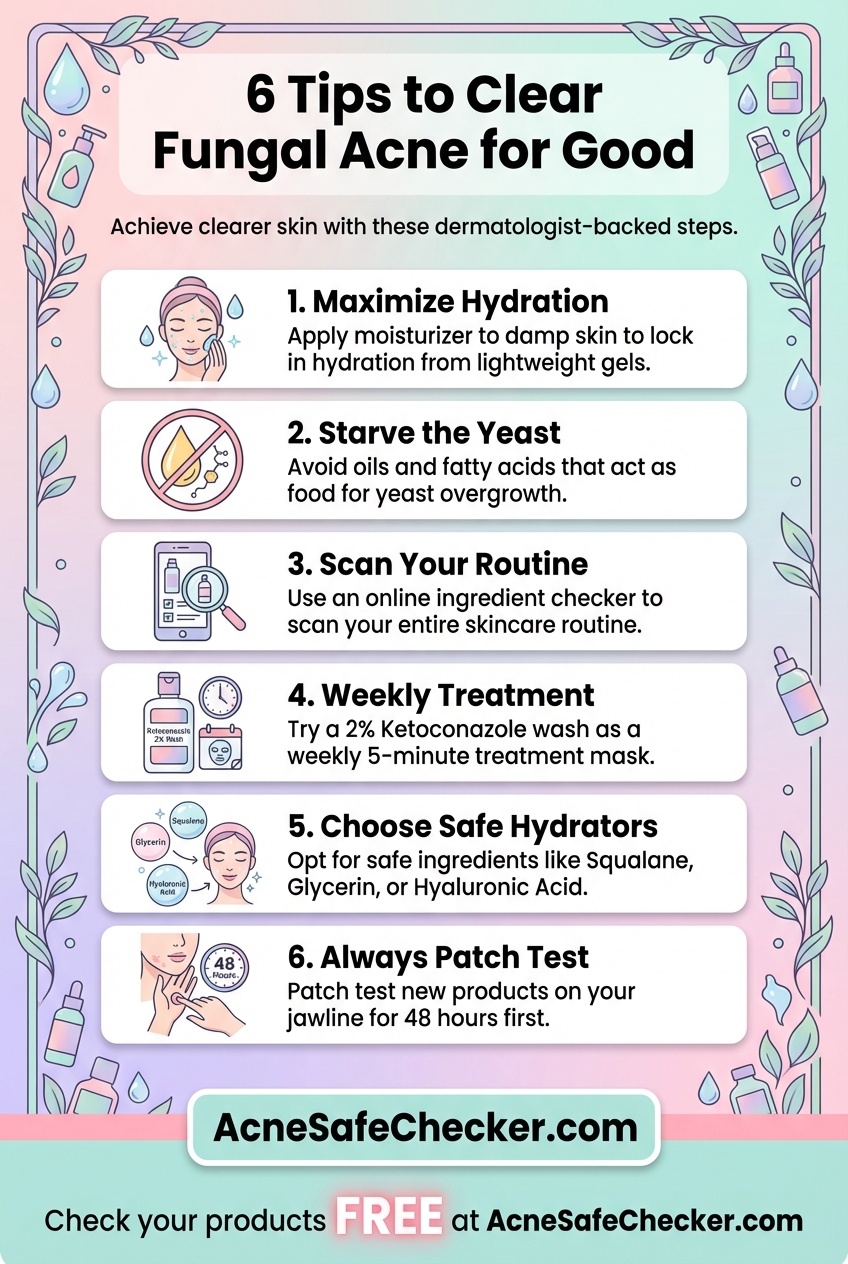
Transitioning to a fungal acne safe moisturizer is the most important step, but it is part of a larger strategy. Follow these steps for the best results:
- The Damp Skin Method: Since fungal acne safe moisturizers are often lightweight gels, apply them to slightly damp skin. This helps the humectants (like hyaluronic acid and glycerin) pull water into the skin for deeper hydration.
- Verify Your Entire Routine: A safe moisturizer won't help if your cleanser or sunscreen is full of oils. Use an online ingredient checker to scan every product in your regimen.
- Incorporate an Antifungal Wash: Occasionally, using a dandruff shampoo containing 2% Ketoconazole as a 5-minute face mask (twice a week) can help kill the excess yeast while your new moisturizer maintains the skin barrier.
- Patch Test: Even if a product is "safe" on paper, every skin microbiome is different. Always patch test on your jawline for 48 hours before full-face application.
Conclusion
Fungal acne can be an incredibly stubborn condition, but it is manageable once you understand the science of what feeds the yeast. By switching to a fungal acne safe moisturizer from the drugstore, you are removing the "fuel" from the fire and allowing your skin’s microbiome to return to its natural balance. With the right ingredients and a little patience, clear and itch-free skin is well within reach.