
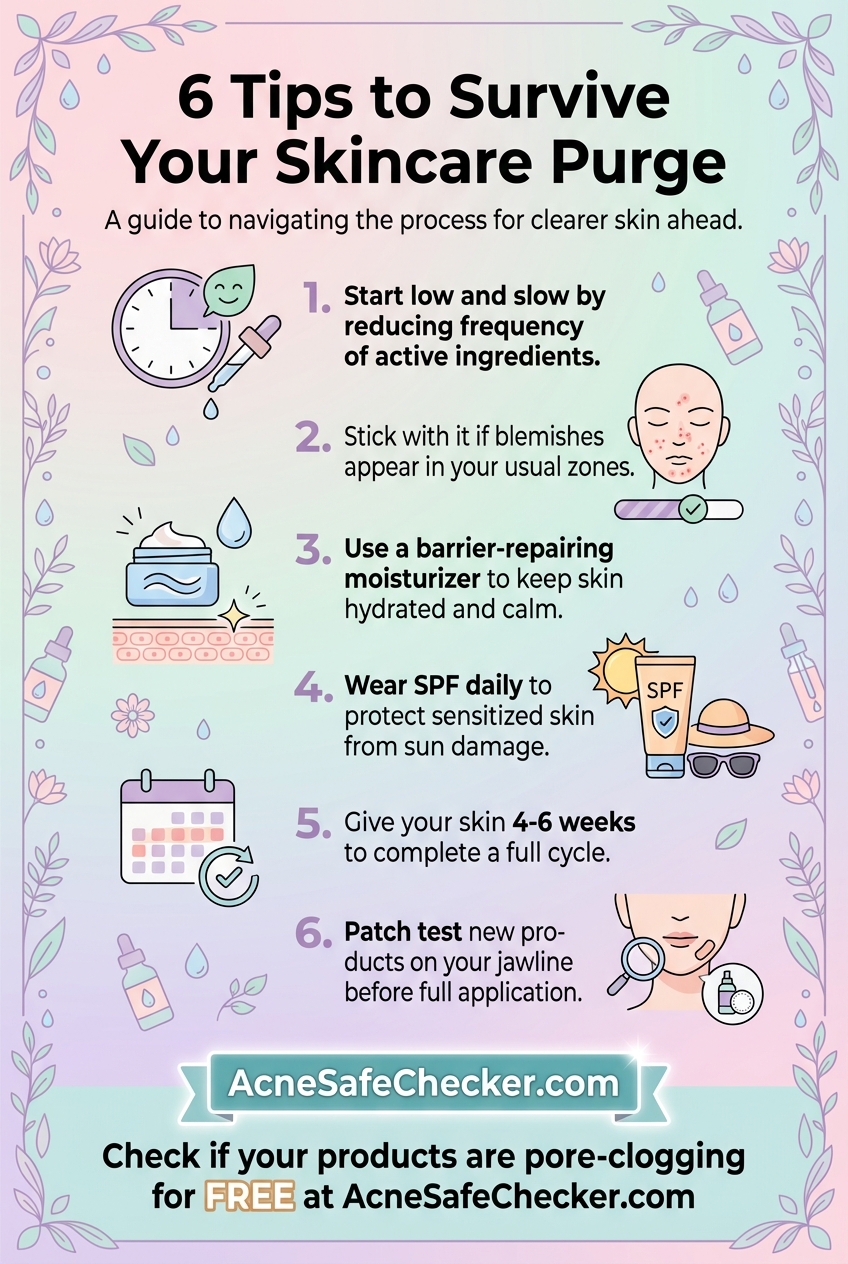
You’ve finally invested in that highly-rated retinol or that viral exfoliating acid. You’re expecting a radiant, glass-skin glow within days. Instead, you wake up to a cluster of new blemishes. Your first instinct might be to toss the product in the bin, assuming your skin is reacting poorly. But before you do, you need to determine if your skin is simply 'purging' or if you are experiencing a standard breakout.
Is Your Routine Acne-Safe?
Do not guess. Instantly check your products for pore-clogging ingredients with our AI-powered tool.
Check Ingredients NowAs a dermatologist, I see patients daily who are ready to give up on effective treatments just as they are starting to work. Distinguishing between these two reactions is the difference between achieving your skincare goals and accidentally damaging your skin barrier.
What is Skin Purging? The Science of Renewal
Skin purging is a temporary skin reaction to specific active ingredients that increase the rate of skin cell turnover. To understand purging, we have to look at the lifecycle of a blemish. A pimple doesn't start the moment you see it; it begins as a microcomedone—a microscopic clog of oil and dead skin cells deep within the pore—weeks before it surfaces.
When you use an 'active' ingredient that speeds up cellular regeneration (desquamation), you are essentially fast-forwarding your skin's natural renewal process. This causes those pre-existing, hidden clogs to rise to the surface all at once.
Common Ingredients That Trigger Purging
If your new product contains any of the following, you are likely experiencing a purge:
- Retinoids: Retinol, Tretinoin, Adapalene.
- Hydroxy Acids: Alpha-hydroxy acids (AHAs like glycolic or lactic acid) and Beta-hydroxy acids (BHAs like salicylic acid).
- Vitamin C: In high concentrations, L-ascorbic acid can trigger turnover.
- Benzoyl Peroxide: Often used in acne treatments.
- Chemical Peels: Professional-grade treatments.
What is a Reactionary Breakout?
A traditional breakout (or a reactionary breakout) is different. This occurs when a product is either clogging your pores (comedogenicity) or causing irritation/allergic contact dermatitis. Unlike purging, which is a sign that the product is doing its job by clearing out the 'gunk' faster, a breakout is your skin telling you it does not like a specific ingredient or formulation.
Breakouts can be caused by thick oils, silicones, fragrances, or even the base cream of a product that otherwise contains good actives.
How to Tell the Difference: The Three-Step Checklist
If you aren't sure which category your skin falls into, use these three clinical markers to identify the cause.
1. Location, Location, Location
Purging: This almost always occurs in the 'usual suspects' zones—the areas where you typically get oily or experience breakouts. If you usually get blackheads on your chin, a purge will manifest as a cluster of spots in that exact spot. Breaking Out: If you are suddenly seeing cysts or whiteheads in areas where you’ve never had a blemish before (like your forehead if you’re usually a chin-only breaker), this is likely a negative reaction to the product.
2. Duration and Healing Speed
Purging: Because purging is an accelerated process, these blemishes tend to appear and disappear much faster than a normal pimple. A purge usually lasts one full skin cycle, which is about 4 to 6 weeks. Breaking Out: These blemishes follow the standard trajectory—they may take a week to come to a head and another week to heal, and new ones will continue to appear as long as you use the product.
3. The Type of Blemish
Purging: Typically manifests as small whiteheads, blackheads, or tiny red bumps (papules). Breaking Out: Often presents as deeper, painful cystic acne or widespread redness and itching, which may indicate irritation rather than a turnover-related purge.
Practical Steps: What to Do Next
If You Are Purging
The mantra here is: Keep going. If you stop now, you’ve endured the 'ugly' phase without getting to the 'glow' phase. However, you can manage the severity:
- The "Low and Slow" Method: Reduce the frequency of application. If you’re using a retinoid every night, drop back to every third night until the purging subsides.
- Hydrate and Protect: Use a non-comedogenic, barrier-repairing moisturizer to soothe the skin.
- Wear SPF: Actives that cause purging often make your skin more photosensitive. Sun damage will only prolong the healing of post-inflammatory hyperpigmentation (the marks left behind by spots).
If You Are Breaking Out
If it’s been more than six weeks, or if the breakouts are in entirely new areas, it’s time to pivot:
- Stop the Product: Cease use immediately to allow your skin barrier to recover.
- Simplify: Return to a 'safe' routine consisting of a gentle cleanser, a basic moisturizer, and sunscreen.
- Patch Test: In the future, test new products on a small area of your jawline for 3-5 days before applying them to your entire face.
Conclusion
Starting a new skincare regimen requires a mix of scientific understanding and patience. While 'purging' is a frustrating rite of passage for many effective treatments, it is ultimately a sign that your skin is clearing the path for healthier, smoother cells. However, listening to your skin is paramount. If the inflammation is painful, persistent, or causing scarring, consult a board-certified dermatologist. We can help you adjust your concentrations or suggest alternative formulations that achieve results without the irritation.