
If you have been treating your breakouts with traditional acne medications like benzoyl peroxide or harsh spot treatments only to see no improvement—or worse, a flare-up—you might not be dealing with acne at all. You might be dealing with Malassezia Folliculitis, commonly known as "fungal acne."
Is Your Routine Acne-Safe?
Do not guess. Instantly check your products for pore-clogging ingredients with our AI-powered tool.
Check Ingredients NowAs a dermatologist, I see patients daily who are frustrated by small, itchy, uniform bumps that refuse to budge. The secret to clearing this condition isn't necessarily more medication; it is often about switching to a strictly fungal acne safe skincare routine. In this guide, we will break down the science behind this condition and how to build a regimen that starves the yeast while healing your skin barrier.
What is Fungal Acne? (The Science of Malassezia)
Despite the name, fungal acne isn't actually acne. Traditional acne (Acne Vulgaris) is caused by clogged pores, sebum, and the C. acnes bacteria. Fungal acne is an infection of the hair follicles caused by an overgrowth of Malassezia yeast.
This yeast is a normal part of everyone’s skin microbiome. However, under certain conditions—such as high humidity, excessive sweating, or the use of specific skincare ingredients—the yeast multiplies uncontrollably. The result is an inflammatory response that looks like small, red, monomorphic (identically shaped) papules and pustules, often on the forehead, chest, and back.
The "Food" Source: Why Your Products Matter
What makes Malassezia unique is its diet. This yeast feeds on fatty acids with carbon chain lengths between 11 and 24. Unfortunately, many common skincare ingredients, including most natural oils, esters, and polysorbates, fall right into this range. When you apply these to your face, you are essentially providing an all-you-can-eat buffet for the yeast.
Ingredients to Avoid in Your Routine
To clear fungal acne, you must eliminate products that contain these common triggers:
- Most Fatty Acids: Specifically Lauric, Myristic, Palmitic, Stearic, Oleic, and Linoleic acids.
- Most Oils: Coconut oil, almond oil, and even rosehip oil are major triggers. (The rare exceptions are Squalane, MCT oil/Caprylic/Capric Triglyceride, and Mineral oil).
- Esters: Usually identified by names ending in "-ate" (e.g., Isopropyl Palmitate, Glyceryl Stearate).
- Polysorbates: Such as Polysorbate 20, 40, 60, and 80.
- Fermented Ingredients: While great for some, Galactomyces and other ferments can worsen Malassezia for many sufferers.
Building Your Fungal Acne Safe Skincare Routine
Transitioning to a safe routine requires minimalism and labels-checking. Here is a dermatologist-recommended framework for a daily regimen.
Step 1: Gentle Cleansing
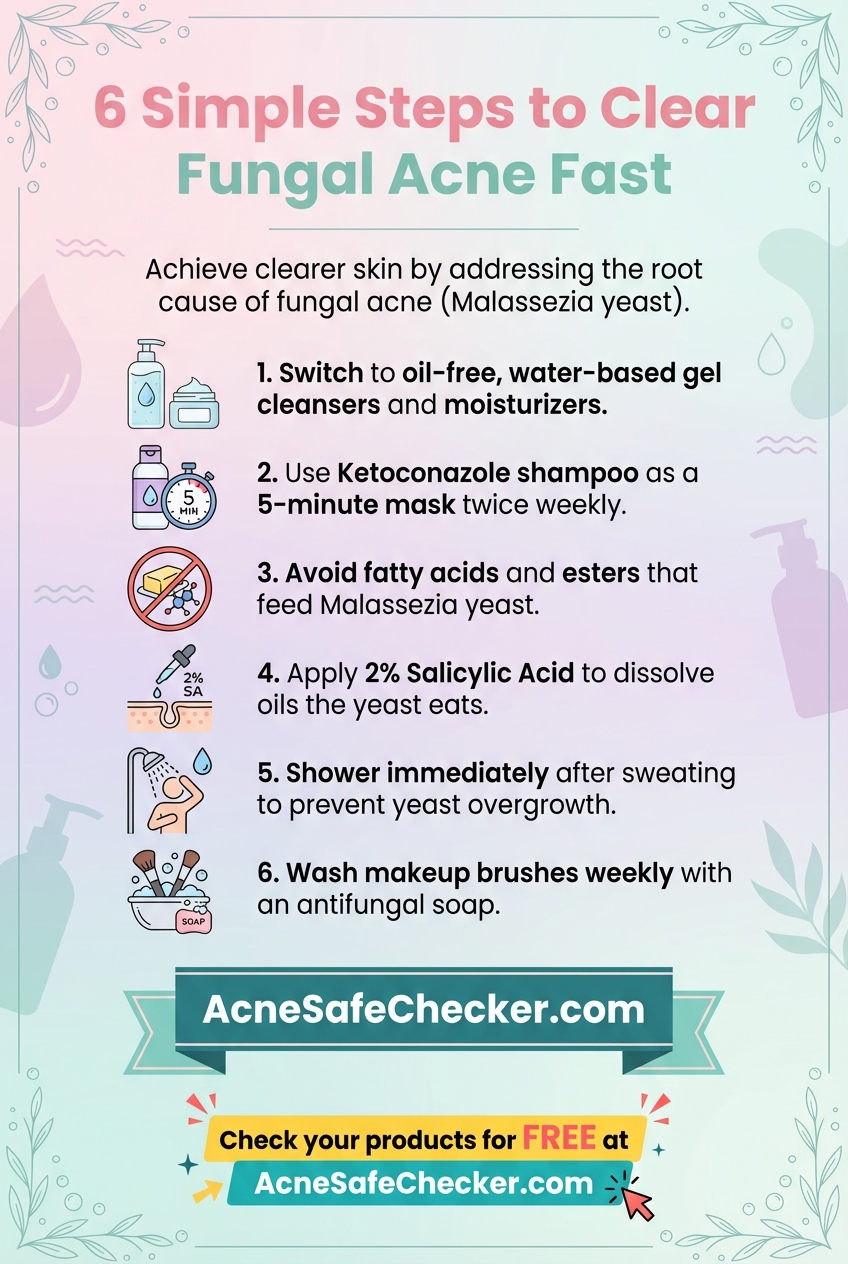
The goal is to remove excess sebum without stripping the skin barrier. Look for water-based gel cleansers that are free of oils and esters.
- Pro Tip: If your skin is particularly oily, consider a cleanser with 2% Salicylic Acid. Salicylic acid is lipophilic, meaning it gets into the pores to dissolve the oils that the yeast feeds on.
Step 2: The Targeted Treatment
This is the most critical step for active breakouts. You need an anti-fungal agent to reduce the yeast population.
- Ketoconazole: Many dermatologists recommend using a 2% ketoconazole shampoo (like Nizoral) as a 5-minute mask once or twice a week. It is a powerful antifungal that kills Malassezia on contact.
- Sulfur: Sulfur is naturally antifungal and keratolytic. A sulfur-based mask or ointment can help dry out fungal bumps rapidly.
- Urea: Urea is a keratolytic agent that helps gently exfoliate while providing intense hydration, making it harder for yeast to take root in dead skin cells.
Step 3: Oil-Free Hydration
Many people with fungal acne skip moisturizer because they fear breakouts. However, a compromised skin barrier makes it easier for yeast to invade. Choose a lightweight, oil-free gel moisturizer.
- Safe Humectants: Look for Glycerin, Hyaluronic Acid, and Aloe Vera.
- Safe Emollients: Pure Squalane oil (derived from sugarcane or olives) is one of the few oils that Malassezia cannot consume. It is excellent for sealing in moisture without triggering a flare.
Step 4: Sun Protection
Sunscreen is notoriously difficult for fungal acne sufferers because most filters are suspended in fatty acid-rich bases. Look for "oil-free" or "matte finish" sunscreens. Purely mineral sunscreens (Zinc Oxide or Titanium Dioxide) are often better tolerated, provided the inactive ingredient list is fungal-acne safe.
Lifestyle Adjustments for Clear Skin
Skincare products are only half the battle. Because Malassezia thrives in warm, moist environments, lifestyle habits play a major role:
- Shower Immediately After Exercise: Don't let sweat sit on your skin; it is the perfect breeding ground for yeast.
- Fabric Choice: Wear breathable, moisture-wicking fabrics like cotton or linen, especially if you suffer from fungal acne on your body.
- Clean Your Tools: Makeup brushes and sponges can harbor yeast. Wash them weekly with an antifungal soap or a gentle detergent.
Conclusion
Managing fungal acne requires a shift in perspective. It is less about "fighting" the skin and more about "balancing" the microbiome. By removing the specific lipids that feed Malassezia and incorporating targeted antifungal treatments, most people see a significant improvement within 2 to 4 weeks.
If your condition persists despite a strictly fungal acne safe routine, consult a board-certified dermatologist. We can provide prescription-strength topical or oral antifungals to help you get your skin back on track. Remember: consistency and ingredient awareness are your best tools for long-term clarity.