
You invest in the finest salicylic acid cleansers, use your retinoids religiously, and never skip your moisturizer. Yet, despite a clinical-grade skincare routine, those stubborn closed comedones and inflammatory papules persist. For many, the culprit isn't the treatment—it is the camouflage.
Is Your Routine Acne-Safe?
Do not guess. Instantly check your products for pore-clogging ingredients with our AI-powered tool.
Check Ingredients NowIn the dermatological world, we call this acne cosmetica: a form of acne triggered or exacerbated by the very products we use to cover it up. This is where the concept of a "makeup acne-safe checker" becomes an essential tool in your clear-skin arsenal.
The Hidden Saboteur: Why Your Foundation Might Be Your Foe
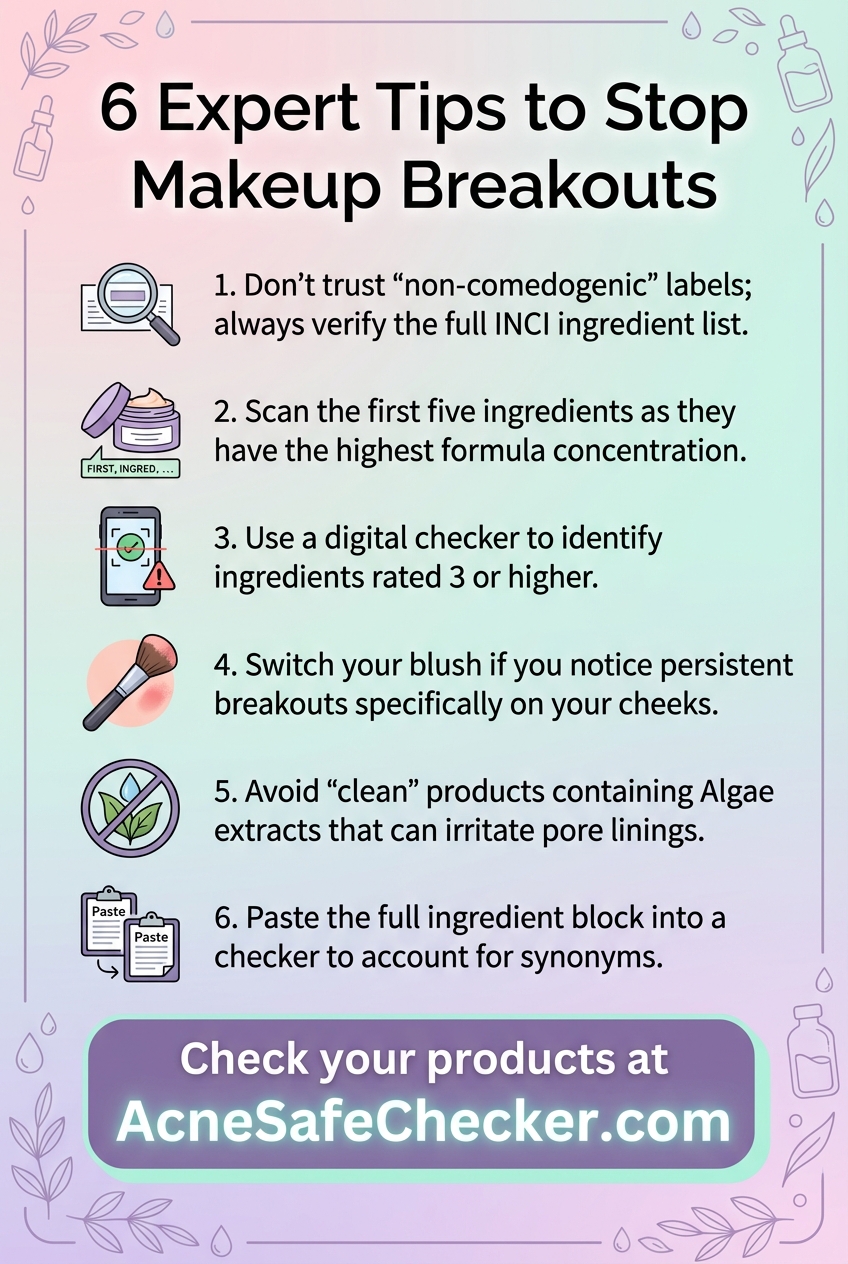
Many patients believe that if a bottle says "dermatologist-tested" or "non-comedogenic," it is a guarantee of safety. Unfortunately, the term "non-comedogenic" is not strictly regulated by the FDA. A manufacturer can claim a product is non-pore-clogging based on internal testing that may not reflect real-world usage on acne-prone skin types.
A makeup acne-safe checker is a digital tool or a methodical process used to cross-reference the International Nomenclature Cosmetic Ingredient (INCI) list of a product against databases of known comedogenic substances. By using these checkers, you move beyond marketing claims and into the realm of ingredient transparency.
Understanding Comedogenicity and the Pore-Clogging Scale
To understand why an acne-safe checker is necessary, we must understand how a pore becomes blocked. Comedogenicity refers to the tendency of an ingredient to trigger the formation of a comedo (a clogged pore).
When a comedogenic ingredient sits on the skin, it can penetrate the follicular opening and signal the skin to produce excess keratin—a process called follicular hyperkeratosis. This "sticky" keratin, combined with sebum, forms a plug. If P. acnes bacteria flourish in that plug, you get a breakout.
The Comedogenic Scale
Ingredients are typically rated on a scale of 0 to 5:
- 0: Will not clog pores
- 1-2: Low probability of clogging pores
- 3: Moderate probability
- 4-5: High probability of clogging pores
An effective acne-safe checker looks for ingredients rated 3 or higher, though for highly sensitive individuals, even a 2 can be problematic.
Common Culprits: Ingredients to Watch For
When you run your foundation or concealer through a checker, there are several "red flag" ingredients that frequently appear. Even high-end, "clean" beauty brands often use these to achieve a specific texture.
Synthetic Esters and Heavy Oils
While natural oils are popular, many are highly comedogenic. Coconut Oil (Cocos Nucifera) is a notorious level 4 on the scale. Similarly, synthetic esters like Isopropyl Myristate and Isopropyl Palmitate are used to give makeup a silky feel, but they are highly effective at clogging pores.
Algae Extracts
Often marketed as soothing or anti-aging, many algae extracts (like Carrageenan or Laminaria Digitata) are high in iodides, which can irritate the pore lining and trigger breakouts in acne-prone individuals.
D&C Red Dyes
Frequently found in blushes and lip products, certain red dyes (like D&C Red #30 or #36) are chemically derived from coal tar and are known comedogens. If you notice breakouts specifically on your cheeks, your blush is likely the offender.
How to Use a Makeup Acne-Safe Checker Effectively
To get the most out of an online ingredient checker, follow these professional steps:
- Locate the Full INCI List: Do not rely on the "Key Ingredients" listed on the front of the box. Look for the fine print on the back or the manufacturer’s website.
- Copy and Paste: Most checkers allow you to paste the entire block of text. The tool then highlights ingredients based on their comedogenic and irritation ratings.
- Check for "Hidden" Triggers: Be aware that some ingredients have multiple names. A good checker will account for synonyms.
- Evaluate the Formulation as a Whole: Science is nuanced. Sometimes, a tiny amount of a level 2 ingredient at the very bottom of a list won't cause issues because the overall concentration is low. However, if a pore-clogger is in the first five ingredients, it is best to avoid it.
The Professional Perspective: Formulation Matters
As a dermatologist, I must add a caveat: while ingredient checkers are incredibly helpful, they aren't infallible. The "matrix" of a formula—how ingredients are processed and combined—can change how they interact with the skin. For example, some ingredients are only comedogenic when used in high concentrations or when combined with specific solvents.
However, for someone struggling with persistent acne, eliminating known triggers is the smartest first step. It removes variables and allows your medical treatments to work more effectively.
Conclusion: Empower Your Skin Routine
Achieving clear skin is often a process of elimination. If you are doing everything right but still seeing "texture" and bumps, your makeup might be the missing piece of the puzzle. Using a makeup acne-safe checker transitions you from a hopeful consumer to an empowered advocate for your own skin health.
Before your next beauty purchase, take two minutes to scan the ingredients. Your pores will thank you.