
Introduction: The Hidden Culprits in Your Vanity
Is Your Routine Acne-Safe?
Do not guess. Instantly check your products for pore-clogging ingredients with our AI-powered tool.
Check Ingredients NowHave you ever purchased a high-end foundation or a moisturizer labeled "non-comedogenic," only to wake up forty-eight hours later with a fresh crop of breakouts? As a dermatologist, I see this frustration daily. Patients often feel they are doing everything right—cleansing, moisturizing, and protecting—yet their skin remains in a state of constant rebellion.
The truth is that the terms "non-comedogenic" and "dermatologist-tested" are not strictly regulated by the FDA. A product can claim it won't clog pores while still containing ingredients known to trigger acne. This is where the skincare ingredient checker copy-paste method becomes your most powerful tool in the fight for clear skin. By taking control of the data, you can move past marketing hype and look directly at the science of your skin.
What is a Skincare Ingredient Checker?
A skincare ingredient checker is a digital tool designed to cross-reference a product's ingredient list against databases of known comedogenic (pore-clogging) or irritating substances. Instead of manually researching each of the thirty-plus chemical names on the back of a bottle, these tools allow you to simply copy the text and paste it into an analyzer for an instant safety report.
Why the "Copy-Paste" Method is Essential
Manual checking is not only tedious but prone to human error. Chemical names are complex—for example, Isopropyl Myristate and Isopropyl Palmitate are both highly comedogenic, but they can easily be overlooked in a sea of fine print. The copy-paste method ensures that every single component, from the base oils to the preservatives, is scrutinized by an algorithm that doesn't get tired or distracted.
The Science of Comedogenicity: Why Pores Clog
To understand why we check ingredients, we must understand the biological process of a breakout. Acne begins in the pilosebaceous unit (the pore). When your skin produces excess sebum, it can mix with dead skin cells to form a "plug."
Certain cosmetic ingredients act as "glues" or "triggers" in this process. Scientifically, we measure this using the Comedogenic Scale, which ranks ingredients from 0 to 5:
- 0-1: Low probability of clogging pores.
- 2: Moderately low (may affect highly sensitive individuals).
- 3: Moderate (likely to cause breakouts in acne-prone skin).
- 4-5: High probability of causing comedones (blackheads and whiteheads).
Ingredients like Coconut Oil (4) or Algae Extract (5) might be "natural," but they are molecularly heavy and prone to trapping debris inside the follicular canal. An ingredient checker identifies these specific molecules instantly.
Common Red-Flag Ingredients to Watch For
When you use a copy-paste analyzer, you are primarily looking for these frequent offenders that often hide in "clean" or "luxury" beauty products:
1. Synthetic Esters
Ingredients like Isopropyl Myristate and Ethylhexyl Palmitate are used to give products a silky feel, but they are notorious for penetrating the pore and causing irritation.
2. Natural Butters and Oils
While Shea Butter is generally safe for many (rated a 0-2), Cocoa Butter and Wheat Germ Oil are highly comedogenic. "Natural" does not always mean "acne-safe."
3. Certain Algae and Seaweed Extracts
Often found in expensive "marine" skincare, these can be high in iodine and other minerals that can irritate the pore lining in some individuals, leading to inflammatory acne.
Step-by-Step Guide: How to Check Your Products
To effectively audit your routine, follow these professional steps:
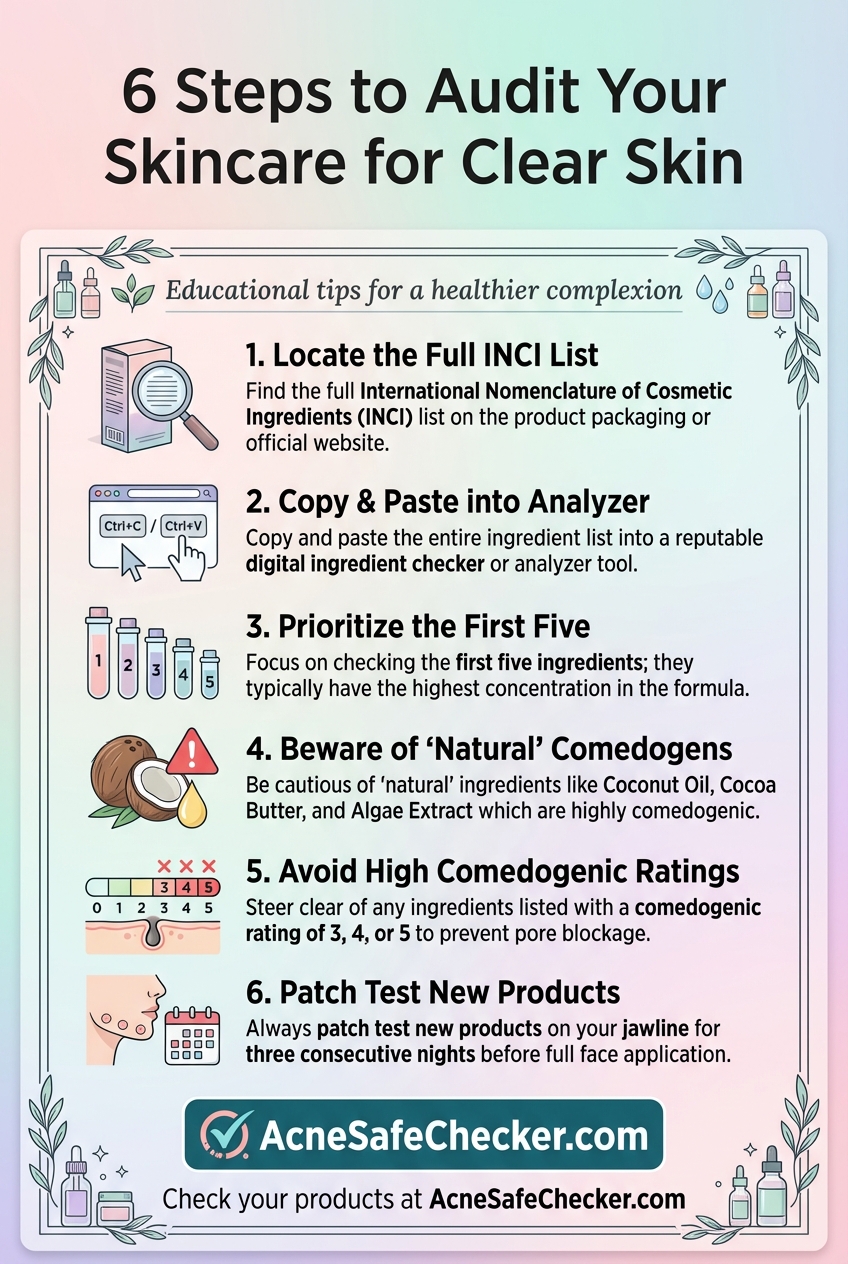
- Find the INCI List: Look for the "International Nomenclature of Cosmetic Ingredients" (INCI) list. This is usually found on the brand’s official website or the back of the physical packaging.
- Copy the Text: Highlight the entire list from the first ingredient (usually water/aqua) to the very last preservative.
- Paste into the Analyzer: Navigate to a reputable skincare ingredient checker. Paste the text into the provided field.
- Analyze the Results: Look specifically for ingredients rated 3 or higher on the comedogenicity scale.
- The "First Five" Rule: Pay closest attention to the first five ingredients listed. Ingredients are listed in order of concentration. If a pore-clogger is in the top five, it is much more likely to cause a breakout than if it is at the very end of the list.
Professional Advice for Acne-Prone Individuals
While ingredient checkers are invaluable, remember that skincare is also about formulation. Sometimes, a small amount of a comedogenic ingredient is balanced by other components that mitigate its effect. However, if you are actively struggling with cystic acne or persistent blackheads, I recommend a "Zero-Tolerance" policy for ingredients rated 4 or 5 until your skin barrier is healed.
Furthermore, always patch test. Even if a product passes the ingredient checker, your unique skin chemistry may react to a specific preservative or fragrance. Apply a small amount behind your ear or on your jawline for three nights before committing to full-face application.
Conclusion: Taking Control of Your Complexion
You do not need a medical degree to have clear skin, but you do need a strategy. The "skincare ingredient checker copy paste" method moves you away from the cycle of trial and error and toward a data-driven approach. By vetting your makeup, sunscreen, and night creams, you remove the obstacles standing between you and the radiant skin you deserve. Stop guessing, start checking, and let the science work for you.