
In the world of luxury skincare, Marula oil is often hailed as a 'miracle worker.' Extracted from the kernels of the Marula tree native to southern Africa, it has gained a cult following for its ability to provide a radiant glow and deep hydration. However, for those of us who battle persistent breakouts or enlarged pores, every new ingredient comes with a nagging question: Will this make me break out?
Is Your Routine Acne-Safe?
Do not guess. Instantly check your products for pore-clogging ingredients with our AI-powered tool.
Check Ingredients NowAs a dermatologist, I often see patients who have jumped on the facial oil trend only to arrive at my office with a flare-up of inflammatory acne. To understand if Marula oil belongs in your routine, we need to look past the marketing and dive into its comedogenic rating and fatty acid profile.
What is the Comedogenic Scale?
Before we pinpoint Marula oil’s specific score, let’s define the tool we use to measure it. The comedogenic scale ranges from 0 to 5:
- 0: Will not clog pores
- 1: Very low probability of clogging pores
- 2: Moderately low (usually safe for most acne-prone individuals)
- 3: Moderate (may cause breakouts in acne-prone skin)
- 4: Fairly high (likely to clog pores for many)
- 5: High (almost certain to cause comedones)
While this scale is a helpful guideline, it isn’t an absolute law. Factors like your unique skin chemistry, the concentration of the oil in a product, and your environment all play a role.
The Verdict: Marula Oil’s Comedogenic Rating
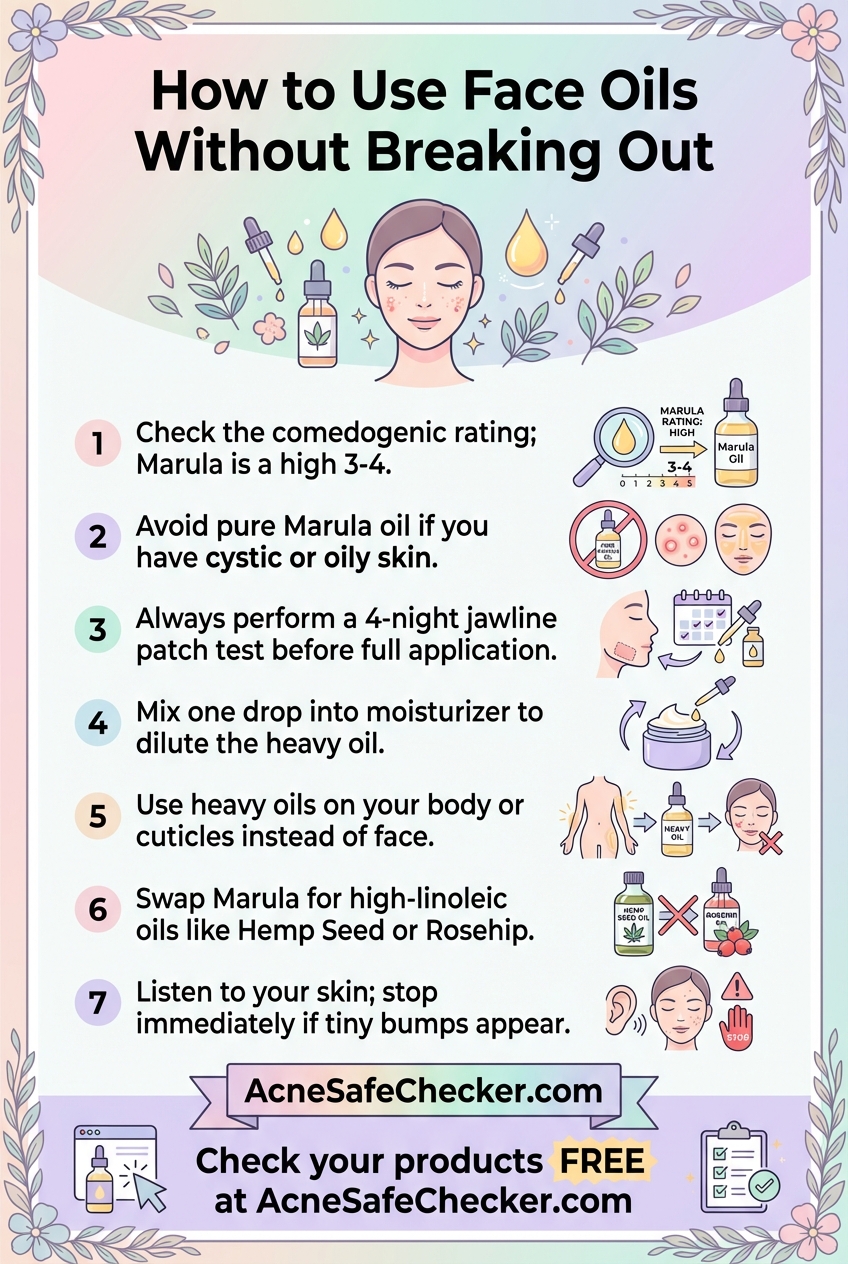
Marula oil typically carries a comedogenic rating of 3 to 4.
This puts it in the 'moderate to high' risk category for pore-clogging. For someone with very dry or mature skin, this rating might not be an issue. However, if you have oily or acne-prone skin, a rating of 3 or 4 is a significant red flag.
The Science: Oleic vs. Linoleic Acid
To understand why Marula oil sits at a 3 or 4, we have to look at its molecular makeup. Most plant oils are composed of fatty acids, primarily Oleic acid (Omega-9) and Linoleic acid (Omega-6).
Research has shown that individuals with acne-prone skin often have lower levels of Linoleic acid in their natural skin surface lipids. When Linoleic acid is low, the skin’s sebum becomes thick and sticky, leading to clogged pores.
Marula oil is incredibly high in Oleic acid (roughly 70% to 78%). While Oleic acid is fantastic at sealing in moisture and repairing the skin barrier, its heavy molecular structure can be 'too much' for pores already prone to congestion. It acts as an occlusive, which can trap dead skin cells and bacteria inside the follicle.
The Benefits: Why Use Marula Oil at All?
If the comedogenic rating is high, why is it so popular? For the right skin type, Marula oil is a powerhouse of nutrients:
- Antioxidant Protection: It is rich in Vitamin C, Vitamin E, and flavonoids. These neutralize free radicals from pollution and UV exposure, preventing premature aging.
- Amino Acids: It contains L-arginine and glutamic acid, which help hydrate and maintain the skin’s structural integrity.
- TEWL Prevention: It is excellent at preventing Transepidermal Water Loss (TEWL), making it a godsend for those with chronic dryness or eczema.
Who Should Avoid Marula Oil?
If you fall into any of the following categories, I recommend proceeding with extreme caution or avoiding pure Marula oil on your face altogether:
- Cystic Acne Sufferers: Heavy oils can exacerbate deep-seated inflammation.
- Oily Skin Types: You already produce enough sebum; adding a high-oleic oil can lead to a 'grease-slick' feel and congestion.
- Fungal Acne (Malassezia Folliculitis): Fungal acne 'feeds' on certain fatty acids. While Marula is mostly Oleic, any heavy oil can create the moist environment where yeast thrives.
Practical Advice: How to Use It Safely
If you still want to experience the glow of Marula oil, follow these dermatological tips:
1. The Patch Test
Never apply a new oil to your entire face immediately. Apply two drops to a small area along your jawline for 3-4 consecutive nights. If you don't see tiny bumps (closed comedones) or redness after a week, your skin likely tolerates it.
2. Mix, Don't Layer
Instead of applying pure oil, try mixing one drop into your water-based moisturizer. This dilutes the concentration of Oleic acid and reduces the risk of clogging while still providing antioxidant benefits.
3. Use it on the Body
The skin on your neck, chest, and body has fewer sebaceous glands than your face. Marula oil is a fantastic treatment for dry cuticles, elbows, or as a luxurious body oil post-shower.
Better Alternatives for Acne-Prone Skin
If you want the benefits of a facial oil without the risk of a 3-4 comedogenic rating, consider these 'skin-safe' alternatives:
- Squalane Oil (Rating: 0-1): Mimics your skin's natural oils and is highly stable and non-clogging.
- Hemp Seed Oil (Rating: 0): High in Linoleic acid, which can actually help thin out thick sebum.
- Rosehip Seed Oil (Rating: 1): Provides Vitamin A (retinol-like effects) and Vitamin C with a much lower risk of breakouts.
Conclusion
Marula oil is a high-quality, nutrient-dense ingredient, but it is not a 'one size fits all' solution. With a comedogenic rating of 3 to 4, it is a luxury better suited for those with dry, dehydrated, or aging skin. If you are prone to acne, your skin will likely prefer lighter, linoleic-heavy oils that support the barrier without overstaying their welcome in your pores. Always listen to your skin—it will tell you very quickly if an oil is a friend or a foe.