
The Skincare Paradox: Hydrating Without Clogging
Is Your Routine Acne-Safe?
Do not guess. Instantly check your products for pore-clogging ingredients with our AI-powered tool.
Check Ingredients NowFor many, skincare feels like a constant balancing act. On one hand, your skin feels tight, flaky, and parched—the classic signs of a compromised moisture barrier. On the other hand, you are dealing with closed comedones: those stubborn, flesh-colored bumps that never seem to come to a head but give the skin an uneven, textured appearance.
This is the "dry and congested" paradox. Traditional advice for dry skin often suggests heavy creams and thick oils, which can be a recipe for disaster for someone prone to comedones. Conversely, acne-fighting products are often too stripping, worsening the dryness and leading to more irritation. As a dermatologist, I see this daily. The secret lies in understanding the science of skin surface dynamics and choosing ingredients that provide deep hydration without creating an occlusive seal that traps sebum.
What Exactly Are Closed Comedones?
To treat them, we must first understand them. Closed comedones occur when a pore becomes completely blocked by a combination of sebum (skin oil) and dead skin cells. Unlike an open comedone (a blackhead), where the pore remains open and the debris oxidizes and turns black, a closed comedone is trapped beneath the skin's surface.
In patients with dry skin, the primary culprit is often retention hyperkeratosis. This is a fancy way of saying your skin isn't shedding dead cells efficiently. When skin is dry, the natural exfoliation process (desquamation) slows down. These dead cells then glue themselves to the sebum inside the follicle, creating a plug. If you apply a heavy, comedogenic moisturizer over this, you are essentially sealing the "gunk" inside.
Why Dry Skin Needs Specialized Care
It is a common myth that only oily skin gets acne. In reality, dry skin can be more prone to certain types of congestion because its protective barrier is weak. When the lipid barrier is compromised, the skin experiences Transepidermal Water Loss (TEWL). To compensate, the skin may actually produce a specific type of "sticky" sebum that is more likely to clog pores.
Therefore, the goal isn't just to "moisturize" but to repair the barrier while encouraging cell turnover.
Key Ingredients to Look For
When shopping for a moisturizer, look past the marketing and dive into the ingredient list. You want a formula that is "non-comedogenic," but since that term isn't strictly regulated, look for these specific scientific heavy hitters:
1. Humectants (The Water-Binders)
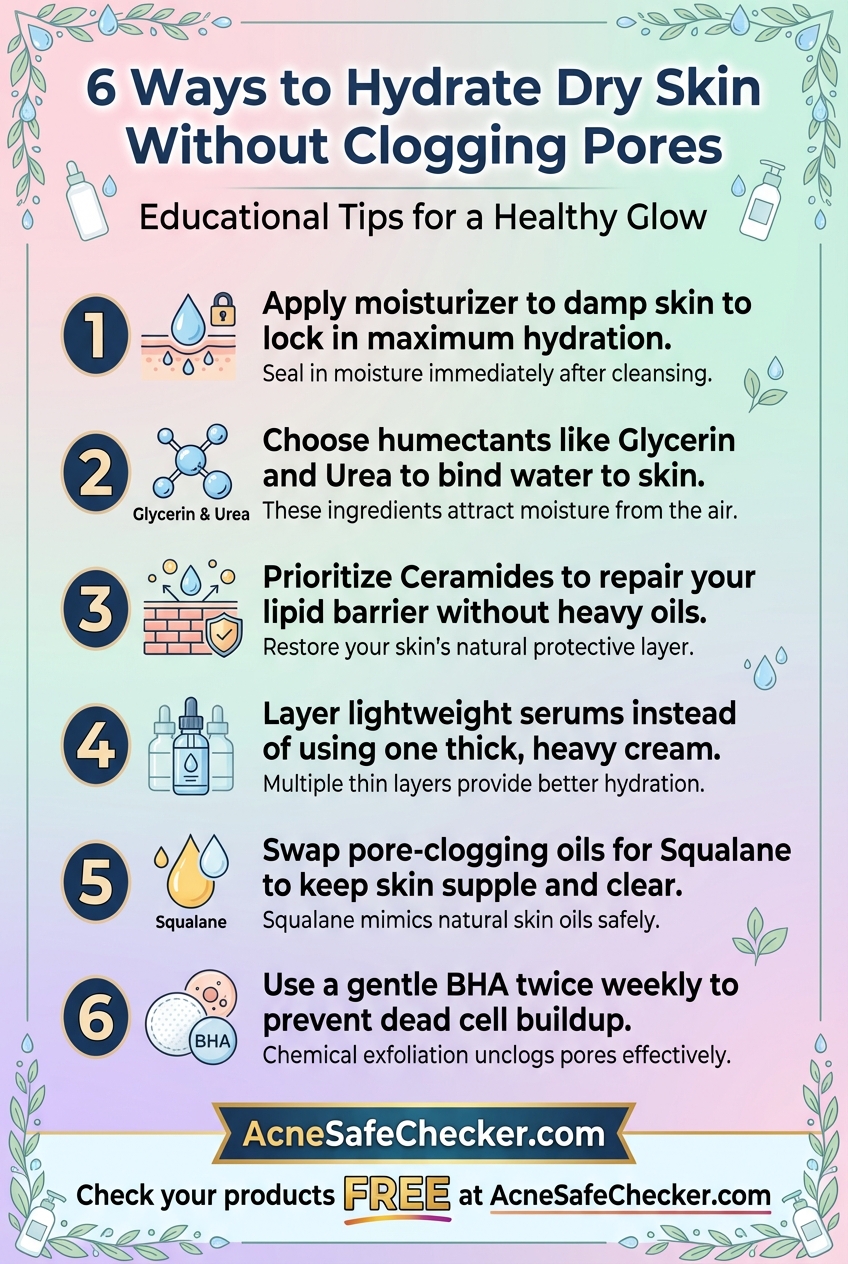
Humectants pull water into the skin without adding oil.
- Hyaluronic Acid: Holds 1,000 times its weight in water.
- Glycerin: A gold-standard humectant that is unlikely to irritate or clog.
- Urea: A unique ingredient that acts as both a humectant and a mild keratolytic (it helps dissolve the bonds between dead skin cells).
2. Barrier Repairing Lipids
Dry skin needs lipids, but they must be the right lipids.
- Ceramides: These are naturally occurring lipids in the skin. They help seal the barrier without being heavy or greasy.
- Squalane: Unlike many other oils, squalane is a hydrogenated version of squalene (a natural component of human sebum). It is highly stable, lightweight, and very low on the comedogenic scale.
3. Gentle Exfoliants
Some moisturizers contain low percentages of acids to keep pores clear while hydrating.
- Lactic Acid: An Alpha Hydroxy Acid (AHA) that exfoliates the surface while also acting as a humectant.
- Salicylic Acid (BHA): If formulated in a creamy base, a small amount of BHA can penetrate the pore to dissolve the plug without drying out the surrounding skin.
Ingredients to Avoid
If you are prone to closed comedones, steer clear of these common offenders often found in "dry skin" products:
- Isopropyl Myristate and its derivatives: Known to be highly comedogenic.
- Heavy Waxes and Thickening Agents: Ingredients like Lanoceryl Alcohol or certain heavy paraffin-based waxes can create a film that is too occlusive.
- Coconut Oil: While great for the body, it is notoriously pore-clogging for the face.
A Professional Routine for Dry, Comedone-Prone Skin
To manage this condition, your application technique is just as important as the product itself. Follow these steps:
- Double Cleanse with Caution: Use a lightweight cleansing oil or micellar water to remove makeup/SPF, followed by a gentle, non-foaming water-based cleanser. This ensures no debris is left behind to be trapped by your moisturizer.
- Apply on Damp Skin: To maximize hydration with less product, apply your humectant-rich moisturizer while your skin is still slightly damp from washing.
- Layer Thinly: Instead of one thick layer of a heavy cream, try layering a hydrating serum under a lightweight, oil-free lotion. This provides the same level of hydration with a lower risk of occlusion.
- Weekly Keratolytic Treatment: Incorporate a leave-on exfoliant (like a 2% Salicylic Acid or a 5% Glycolic Acid) twice a week at night. This keeps the cellular "traffic" moving so the moisturizer doesn't have anything to trap.
Conclusion
Dealing with closed comedones and dry skin requires a nuanced approach. You cannot simply blast the skin with acne actives, nor can you drench it in heavy oils. By choosing non-comedogenic humectants like glycerin and barrier-supporting ceramides, you can restore your skin's glow and smoothness simultaneously.
Remember, skincare is a marathon, not a sprint. It typically takes 4 to 6 weeks for the skin's turnover cycle to show the results of a new regimen. Be patient, stay consistent, and your skin will find its balance.