
It is a cruel irony of skincare: you do the right thing by applying daily sun protection, only to be rewarded with a cluster of tiny, stubborn bumps across your forehead or cheeks. If you’ve noticed your sunscreen is breaking you out in small bumps, you aren’t alone. This common reaction—often referred to as "SPF-induced acne"—is one of the primary reasons people skip this vital step in their routine.
Is Your Routine Acne-Safe?
Do not guess. Instantly check your products for pore-clogging ingredients with our AI-powered tool.
Check Ingredients NowHowever, as a dermatologist, I’m here to tell you that the solution isn't to ditch the SPF, but to understand why your current formula is failing your pores. Let’s dive into the science of why these bumps appear and how you can achieve sun protection without the congestion.
Identifying the Bumps: What Are They?
Not all "bumps" are created equal. When patients complain about sunscreen reactions, they are usually describing one of three distinct conditions:
1. Closed Comedones (Whiteheads)
These are classic clogged pores. When sunscreen ingredients mix with your natural sebum and dead skin cells, they form a plug. Because the pore remains closed to the air, it appears as a small, flesh-colored or white bump rather than a blackhead. These are the most common result of "heavy" sunscreen formulas.
2. Fungal Acne (Malassezia Folliculitis)
If the bumps are uniform in size, itchy, and appear in clusters (often on the forehead or hairline), you might be dealing with fungal acne. Certain ingredients in sunscreens—like specific fatty acids and oils—can "feed" the yeast that naturally lives on your skin, leading to an overgrowth in the hair follicles.
3. Allergic Contact Dermatitis
Sometimes, those small bumps are actually a form of irritation or an allergic reaction to chemical UV filters. This is often accompanied by redness, itching, or a slight stinging sensation. This is a sign that your skin's barrier is reacting to a specific active ingredient rather than a clogged pore.
The Science: Why Sunscreen Triggers Breakouts
Sunscreen is uniquely formulated to stay on the skin. Unlike a moisturizer that absorbs deeply, SPF is designed to form a protective film on the surface to reflect or absorb UV rays. This "filming" property is what makes it effective, but it also makes it potentially occlusive.
The Occlusion Effect
Many traditional sunscreens use heavy emollients, silicones, or oils to ensure the product is water-resistant. For acne-prone individuals, this creates a "greenhouse effect" on the skin, trapping heat, sweat, and bacteria underneath the product. This environment is a breeding ground for the inflammation that leads to those tiny, raised bumps.
Chemical vs. Physical Filters
Chemical filters (like oxybenzone, avobenzone, and octocrylene) work by absorbing UV rays and converting them into heat. For some, this heat can trigger sensitivity or "heat rash" (miliaria). Physical or mineral filters (Zinc Oxide and Titanium Dioxide), on the other hand, sit on top of the skin and reflect rays. While generally safer for sensitive skin, poorly formulated mineral sunscreens can be thick and "pasty," leading to mechanical clogging of the pores if not washed off properly.
Key Ingredients to Watch Out For
If you are prone to breakouts, scan your ingredient list for these common culprits:
- Isopropyl Palmitate & Isopropyl Myristate: Highly comedogenic thickeners used to give products a smooth feel.
- Coconut Oil (Cocos Nucifera Oil): Often found in "natural" or organic sunscreens, but notorious for clogging pores.
- Heavy Silicones: While dimethicone is generally safe, high concentrations can trap other comedogenic ingredients against the skin.
- Synthetic Fragrances: A leading cause of irritation-related bumps and allergic reactions.
Practical Steps to Clear, Protected Skin
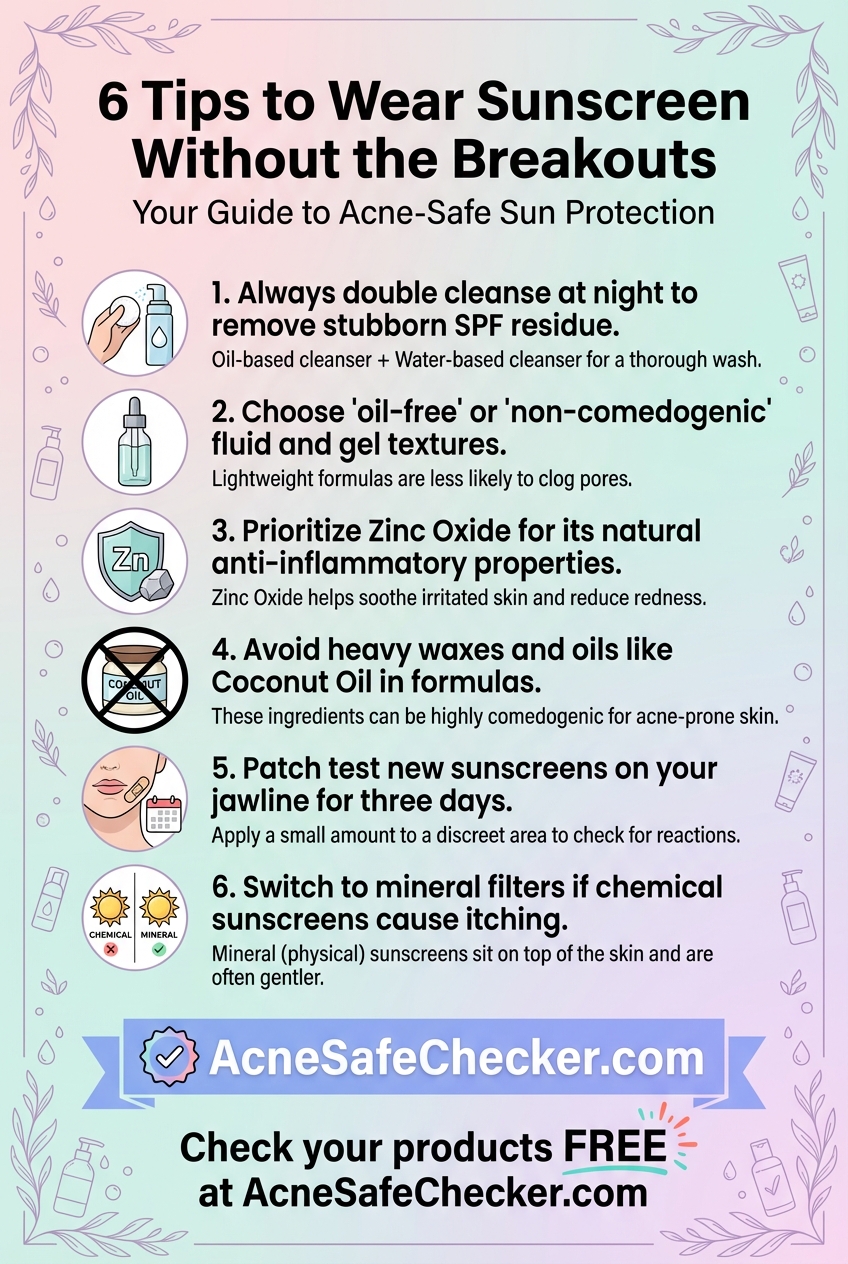
1. Look for "Non-Comedogenic" and "Oil-Free"
While these terms aren't strictly regulated, they indicate that the manufacturer has formulated the product specifically to avoid pore-clogging. Seek out "fluid," "milk," or "gel" textures rather than thick creams, as these typically contain fewer heavy waxes.
2. Prioritize Zinc Oxide
Zinc Oxide is a dermatologist’s favorite. Not only is it a broad-spectrum blocker, but it also has natural anti-inflammatory properties that can help soothe existing acne while protecting the skin. Look for "micronized" zinc to avoid the heavy white cast.
3. The "Double Cleanse" Rule
This is the most important step for SPF users. Sunscreen is designed to be stubborn. A single pass with a gentle water-based cleanser often leaves behind a residue of SPF and sebum. Start with an oil-based cleanser or micellar water to break down the sunscreen film, followed by your regular foaming or hydrating cleanser. This ensures your pores are truly clear before you sleep.
4. Patch Test New Formulas
Before applying a new SPF all over your face, test it on a small area (like the jawline) for three to five days. If small bumps appear in that localized area, you know the formula isn't right for your skin chemistry before a full-face breakout occurs.
Conclusion
Finding the right sunscreen can feel like a game of trial and error, but it is a journey worth taking. The "small bumps" you are experiencing are a signal from your skin that your current formula is too occlusive or contains an irritant—not a sign that you should stop using sun protection altogether. By switching to a non-comedogenic mineral formula and mastering the art of the double cleanse, you can keep your skin both clear and shielded from the long-term damage of the sun.