
If you have a dedicated grooming routine but still find yourself battling stubborn bumps along your hairline and forehead, the culprit might not be your face wash or your diet. It might be your hair styling product. Known in the dermatology world as acne venenata, or more commonly, pomade acne, this condition is a frequent frustration for those who use heavy waxes, oils, and styling creams.
Is Your Routine Acne-Safe?
Do not guess. Instantly check your products for pore-clogging ingredients with our AI-powered tool.
Check Ingredients NowAs a dermatologist, I often see patients who spend hundreds of dollars on premium skincare, only to have their progress hindered by the very products they use to style their hair. In this guide, we will dive into the science of why pomade causes acne, how to identify it, and the practical steps you can take to clear your skin without sacrificing your style.
What Exactly is Pomade Acne?
Pomade acne is a specific type of breakout caused by the topical application of comedogenic (pore-clogging) substances to the hair. When you apply pomade, wax, or heavy oils, these products don’t always stay on the hair shaft. Through sweat, natural scalp oils, and even contact with your pillow at night, the product migrates onto the forehead and temples.
Once on the skin, these heavy ingredients create an occlusive seal over your pores. This seal traps sebum (your skin's natural oil), dead skin cells, and Cutibacterium acnes (the bacteria responsible for breakouts). The result is a cluster of small, uniform bumps—usually whiteheads or flesh-colored papules—concentrated exactly where your hair meets your skin.
The Science of Comedogenicity: Ingredients to Watch For
Not all hair products are created equal. The likelihood of a product causing forehead acne depends on its comedogenic rating—a scale that measures how likely an ingredient is to block pores. If your styling product contains high concentrations of the following, it may be the source of your skin woes:
1. Petrolatum and Mineral Oil
These are classic ingredients in traditional pomades. While they are excellent for hold and shine, they are highly occlusive. They form a barrier that is difficult for the skin to breathe through, frequently leading to blockages.
2. Lanolin
Derived from sheep's wool, lanolin is a common emollient. While moisturizing, it is a known trigger for many acne-prone individuals due to its thick, waxy consistency.
3. Coconut Oil (Cocos Nucifera)
Often marketed as a 'natural' alternative, coconut oil actually has a very high comedogenic rating (4 out of 5). Using it near the hairline is a recipe for forehead congestion.
4. Beeswax
Found in 'clays' and 'pastes,' beeswax provides great texture but can be difficult to wash off the skin, leading to a build-up that eventually clogs the hair follicles.
How to Identify Pomade Acne
How do you know if your breakouts are 'standard' acne or specifically pomade-induced? Look for these three clinical signs:
- The Distribution: The breakouts are primarily located along the hairline, the temples, or the upper forehead. If you have a fringe or bangs, you might also see spots where the hair rests against the skin.
- The Appearance: Unlike hormonal acne, which often results in deep, painful cysts, pomade acne usually manifests as 'closed comedones'—small, non-inflammatory white bumps that give the skin an uneven texture.
- The Timing: You notice the breakouts worsen a few days after a fresh haircut or when you start using a new styling product.
Practical Steps to Clear Your Forehead
You don’t have to choose between a great hairstyle and clear skin. By making a few strategic adjustments to your routine, you can eliminate pomade acne.
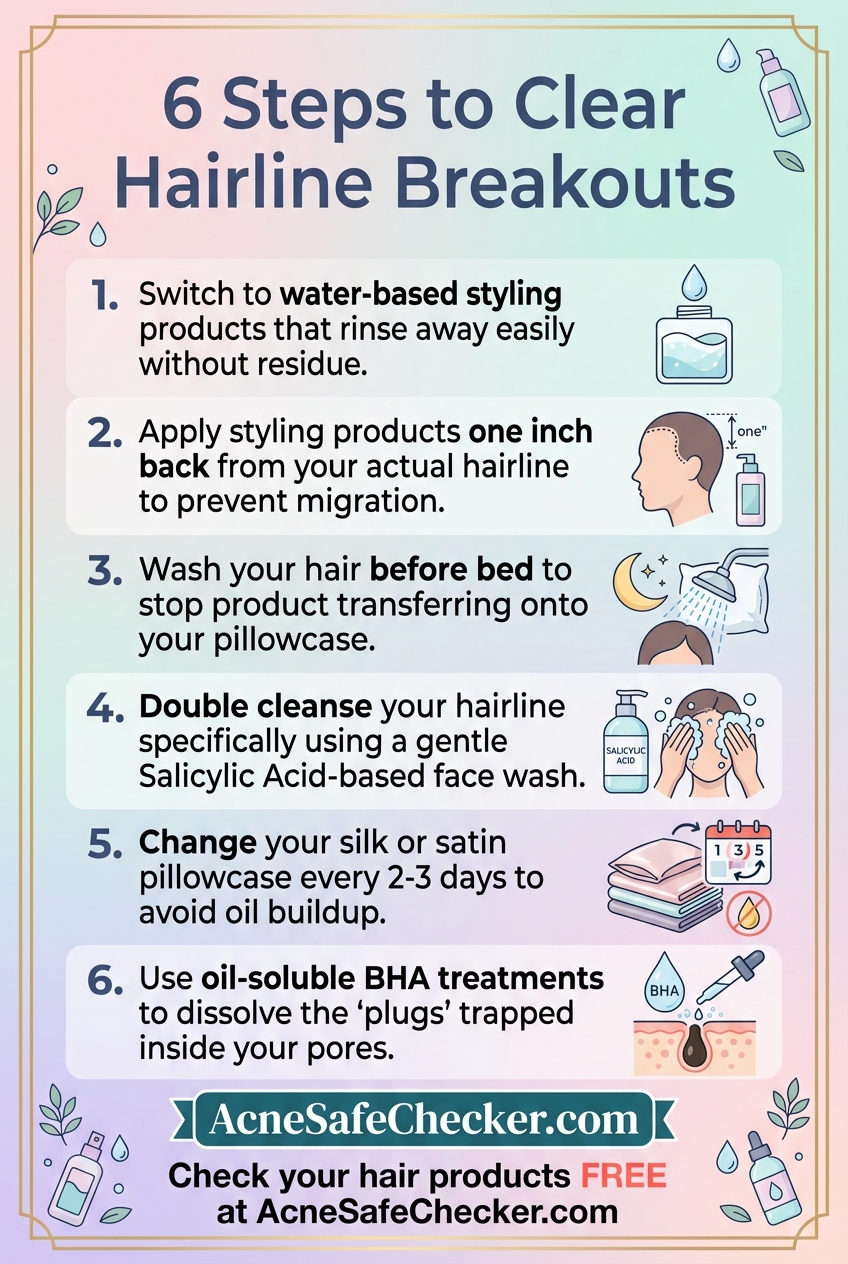
1. Switch to Water-Based Products
Look for styling products labeled as "water-soluble" or "water-based." These formulas are designed to rinse out easily with water. Because they don't rely on heavy oils for hold, they are significantly less likely to clog your pores if they migrate to your forehead.
2. The 'One-Inch' Rule
When applying your styling product, avoid starting at the very front of your hairline. Instead, start an inch back and work the product toward the back of your head first. Use whatever is left on your hands for the front, ensuring you don't apply the product directly onto the skin of the forehead.
3. Wash Your Hair Before Bed
If you leave pomade in your hair overnight, it transfers to your pillowcase. Your face then rests on that oily residue for eight hours. If you can’t wash your hair at night, try to at least use a silk or satin pillowcase and change it every 2-3 days.
4. The 'Double Cleanse' for Your Hairline
When washing your face, be intentional about cleaning the 'danger zone'—the area where your hair meets your forehead. Many people stop an inch short of the hairline to avoid getting soap in their hair, leaving pomade residue behind. Use a gentle, salicylic acid-based cleanser to dissolve the oils in this specific area.
Dermatologist-Recommended Treatments
If you already have a breakout, here is how to treat it effectively:
- Salicylic Acid (BHA): This oil-soluble acid can penetrate deep into the pores to dissolve the 'plug' created by the pomade.
- Retinoids: Over-the-counter adapalene gel is highly effective at increasing cell turnover and preventing the formation of new comedones.
- Benzoyl Peroxide: If the bumps have become red or inflamed, a 2.5% benzoyl peroxide wash can help kill the bacteria trapped under the product residue.
Conclusion
Forehead acne is often an external problem with an external solution. By becoming a 'label reader' and adjusting how you apply your styling products, you can maintain your look while keeping your complexion clear. Remember: skincare doesn't stop at your eyebrows, and haircare doesn't stop at your scalp. When the two work in harmony, your skin will reflect that balance.