
Introduction: The Ingredient Label Dilemma
Is Your Routine Acne-Safe?
Do not guess. Instantly check your products for pore-clogging ingredients with our AI-powered tool.
Check Ingredients NowIf you have ever spent twenty minutes in a drugstore aisle squinting at the tiny print on the back of a moisturizer, you are not alone. For those of us with acne-prone or sensitive skin, ingredient labels aren’t just suggestions—they are a roadmap to either a clear complexion or a frustrating breakout.
One ingredient that appears with surprising frequency in both high-end and affordable skincare is soybean oil (often listed as Glycine Soja Oil). While it sounds natural and nourishing, its impact on your pores is a topic of significant debate in the dermatological community. In this article, we will break down the soybean oil comedogenic rating, the science behind how it interacts with your skin, and whether you should keep it in your beauty routine.
Understanding the Comedogenic Scale
Before we dive into soybean oil specifically, we must understand the tool used to measure it: the Comedogenic Scale. This scale ranges from 0 to 5:
- 0: Will not clog pores
- 1: Very low probability of clogging pores
- 2: Moderately low (usually safe for most people)
- 3: Moderate (may cause breakouts in acne-prone individuals)
- 4: Fairly high (likely to cause breakouts)
- 5: High (almost certain to cause breakouts)
What is the Comedogenic Rating of Soybean Oil?
Soybean oil typically carries a comedogenic rating of 4 to 5.
This places it in the "high risk" category. For a dermatologist, a rating of 4 or 5 is a red flag for any patient currently struggling with inflammatory acne, hormonal breakouts, or oily skin. Because of its molecular structure and thickness, soybean oil is highly likely to become trapped within the hair follicle, leading to the formation of comedones (blackheads and whiteheads).
The Science: Why Does Soybean Oil Clog Pores?
The reason soybean oil ranks so high on the scale comes down to its fatty acid profile. Soybean oil is particularly rich in oleic acid.
Oleic Acid vs. Linoleic Acid
Our skin’s natural sebum (oil) contains a balance of fatty acids. Research suggests that people with acne-prone skin often have sebum that is deficient in linoleic acid and over-concentrated in oleic acid.
- Oleic Acid (Omega-9): This is a thick, rich fatty acid. While it is excellent for repairing a damaged skin barrier in very dry skin types, it can make sebum more viscous and "sticky." This stickiness makes it harder for the oil to flow out of the pore, leading to a blockage.
- Linoleic Acid (Omega-6): This is a thinner, lighter fatty acid. Acne-prone skin usually thrives on oils high in linoleic acid (like hemp seed or rosehip oil) because they help thin out the sebum.
Since soybean oil is high in oleic acid, applying it to skin that is already prone to congestion is often like adding fuel to a fire.
Is Soybean Oil Always Bad for Your Skin?
Despite its high comedogenic rating, soybean oil isn't a "toxic" ingredient. In fact, it has several dermatological benefits for the right candidate:
- Rich in Vitamin E: It is a potent antioxidant that helps protect the skin from environmental stressors and UV damage.
- Barrier Repair: For individuals with extremely dry, flaky skin or conditions like eczema, the occlusive nature of soybean oil can help lock in moisture and heal the skin barrier.
- Isoflavones: Soy contains phytoestrogens that may help improve skin elasticity and collagen production in mature skin.
However, these benefits are usually outweighed by the risk of breakouts if you have an oily or combination skin type.
How to Spot Soybean Oil in Your Skincare
When scanning your products, look for the following names on the International Nomenclature of Cosmetic Ingredients (INCI) list:
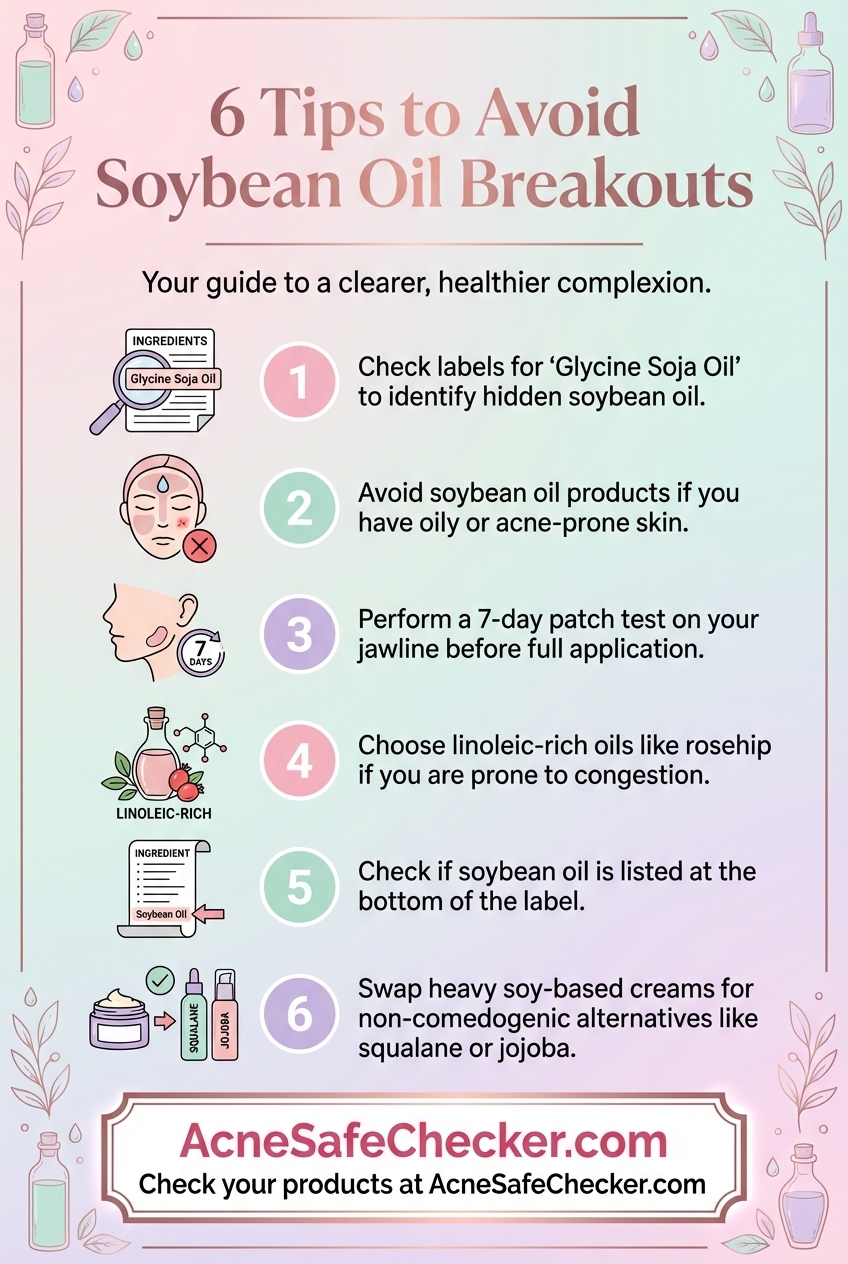
- Glycine Soja Oil
- Soybean Oil
- Hydrogenated Soybean Oil (This is often even more comedogenic due to the hydrogenation process)
- Soy Oil
It is frequently found in oil-based cleansers, thick night creams, and even some "natural" liquid foundations.
Practical Advice: Should You Keep or Toss?
As a dermatologist, my advice depends entirely on your skin's unique behavior. Here is how to decide:
Avoid Soybean Oil if:
- You have active acne or are prone to blackheads.
- You have very oily skin.
- You notice small, flesh-colored bumps (subclinical acne) appearing after starting a new product.
You Can Use Soybean Oil if:
- You have very dry or mature skin and rarely experience breakouts.
- The ingredient is listed near the very bottom of the label (meaning it is present in a very low concentration).
- It is in a "wash-off" product like a cleanser, though even then, those with severe acne should exercise caution.
The Golden Rule: The Patch Test
If you find a product you love that contains soybean oil, don't panic. Perform a patch test. Apply the product to a small, acne-prone area (like the side of your jawline) for 5-7 days. If no new comedones appear, your skin may be able to tolerate the formulation.
Conclusion
While soybean oil offers moisturizing benefits and antioxidant protection, its comedogenic rating of 4-5 makes it a risky choice for the acne-prone community. Skincare is never one-size-fits-all, but if you are struggling to clear your skin and your current products contain Glycine Soja Oil, it might be time to swap them for non-comedogenic alternatives like squalane or jojoba oil. Always listen to your skin—it usually tells you exactly what it needs.