
For many of my patients, the daily makeup routine feels like a high-stakes gamble. You want to conceal redness and control midday shine, but the very products designed to help often lead to a vicious cycle of 'acne cosmetica'—clogged pores and inflammatory breakouts caused by cosmetic ingredients.
Is Your Routine Acne-Safe?
Do not guess. Instantly check your products for pore-clogging ingredients with our AI-powered tool.
Check Ingredients NowIf you have oily or acne-prone skin, finding a setting powder that performs without compromising your skin health is essential. Recently, the conversation has shifted toward talc-free formulas. In this guide, we will explore why talc-free is often the preferred choice for sensitive, reactive skin and how to identify truly acne-safe setting powders that keep your complexion clear.
Why the Shift Away from Talc?
Talc is a naturally occurring mineral composed of magnesium, silicon, and oxygen. For decades, it has been the gold standard in setting powders because of its ability to absorb moisture and provide a silky texture. However, as a dermatologist, I see two primary reasons patients are moving away from it.
1. The Purity and Irritation Factor
Talc is often mined in proximity to asbestos. While modern cosmetic-grade talc is highly regulated and tested for purity, many individuals with reactive skin find that talc-based powders feel 'heavy' or suffocating. For someone already dealing with compromised skin barriers or active acne, minimizing potential irritants is a top priority.
2. Texture and Pore-Clogging Potential
While talc itself is generally considered non-comedogenic on a technical scale, the way it is formulated in heavy powders can contribute to a 'cakey' finish. This thick layer can trap sebum and bacteria underneath, creating a microenvironment ripe for P. acnes bacteria to flourish.
Understanding 'Acne-Safe' Ingredients
When we talk about an 'acne-safe' setting powder, we are looking for formulas that are non-comedogenic (won't clog pores) and non-acnegenic (won't cause new breakouts). When you remove talc, manufacturers must use alternative minerals and botanical bases. Here is what you should look for on the ingredient label:
Silica (Spherical Silica)
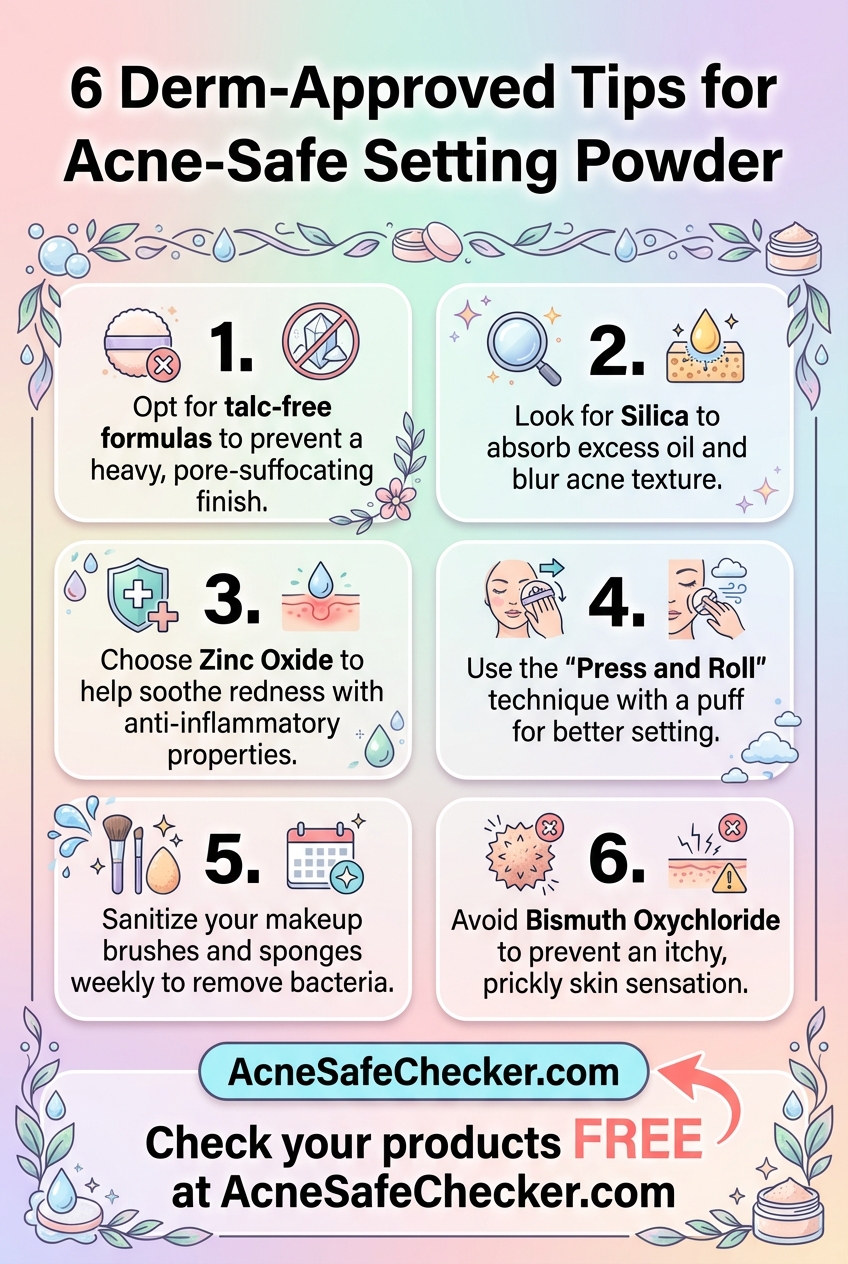
Silica is a powerhouse for acne-prone skin. It is highly absorbent, soaking up excess oil without settling into fine lines or pores. Spherical silica, specifically, provides a 'blurring' effect that can help disguise the texture of active breakouts and acne scarring.
Zinc Oxide and Titanium Dioxide
These are mineral UV filters that often double as pigments in setting powders. Zinc oxide is particularly beneficial for acne-prone individuals because it has inherent anti-inflammatory properties, which can help soothe the redness associated with inflammatory acne.
Kaolin or Bentonite Clay
For those with exceptionally oily skin, powders containing small amounts of kaolin clay can be transformative. These clays gently draw out impurities and control sebum production throughout the day.
Cornstarch or Rice Powder
These are common talc alternatives in 'clean' beauty. They are effective at absorbing oil and are generally very gentle, though individuals with fungal acne (pityrosporum folliculitis) should use these with caution, as some theories suggest yeast may feed on organic starches.
Scientific Explanation: The Role of Particle Size
The reason some powders cause breakouts while others don't often comes down to particle size and 'slip.' In my practice, I explain to patients that acne-safe powders utilize 'micronized' particles. These particles are small enough to sit evenly on the skin’s surface to reflect light and absorb oil, but large enough that they do not become deeply embedded within the follicular opening.
By choosing a talc-free powder with high-quality minerals, you are allowing for better 'skin breathability.' This prevents the occlusion of the sebaceous glands, which is the primary trigger for the formation of comedones (blackheads and whiteheads).
Practical Steps for Choosing and Applying Your Powder
Identifying a talc-free label is only the first step. To truly protect your skin, follow these clinical recommendations:
- Check for Bismuth Oxychloride: This is a common mineral alternative to talc that provides a shimmery finish. However, many people find it causes an itchy, prickly sensation and can lead to cystic breakouts. If you have sensitive acne-prone skin, avoid this ingredient.
- Avoid Added Oils and Waxes: Some 'hydrating' powders add coconut oil or ethylhexyl palmitate to prevent dryness. These are highly comedogenic and should be avoided at all costs if you are prone to acne.
- The 'Press and Roll' Technique: Instead of using a large, fluffy brush to buff powder into the skin—which can irritate active acne and spread bacteria—use a clean powder puff or a damp sponge. Press the powder into the skin and roll it. This sets the makeup without disturbing the skin's surface.
- Sanitize Your Tools: This is the most overlooked step in acne management. Brushes and puffs collect sebum, dead skin cells, and bacteria. Wash your application tools at least once a week with a gentle, fragrance-free cleanser.
Conclusion
Navigating the world of cosmetics with acne-prone skin can be frustrating, but you don't have to sacrifice a flawless finish for clear skin. By opting for a talc-free, non-comedogenic setting powder formulated with skin-loving ingredients like silica and zinc oxide, you provide your skin with the environment it needs to heal.
Remember, makeup should be an extension of your skincare. If a product consistently causes redness or new bumps, listen to your skin and pivot. Consulting with a board-certified dermatologist can further help you tailor your routine to your specific skin type, ensuring that your quest for a matte finish doesn't come at the cost of your complexion.