
Finding the perfect foundation often feels like an endless cycle of trial and error, especially for those of us dealing with acne-prone or sensitive skin. You find a product that offers beautiful coverage and a radiant glow, only to wake up the next morning with new congestion and breakouts.
Is Your Routine Acne-Safe?
Do not guess. Instantly check your products for pore-clogging ingredients with our AI-powered tool.
Check Ingredients NowOne ingredient that frequently appears in these conversations—and on the back of almost every foundation bottle—is mica. As a common mineral used for its shimmer and texture-enhancing properties, many wonder: Does mica clog pores? In this guide, we will break down the science of mica, its impact on the skin, and why it might (or might not) be the culprit behind your skin concerns.
What Exactly is Mica?
Mica is a naturally occurring group of silicate minerals that are mined from the earth. In the world of cosmetics, mica is prized for its ability to be ground into a fine powder that reflects light. This is what gives your foundation, highlighter, or eyeshadow that "lit-from-within" glow or a silky, smooth finish.
Beyond aesthetics, mica is used as a bulking agent to improve the feel of a product on the skin, making it easier to blend. Because it is chemically inert—meaning it doesn't react with other ingredients or the skin itself—it has long been a staple in both traditional and mineral makeup formulations.
The Scientific Verdict: Does Mica Clog Pores?
To answer the primary question: No, mica itself is considered non-comedogenic.
In dermatology, we use the "Comedogenic Scale" to rank ingredients from 0 to 5 based on their likelihood of clogging pores (occluding the hair follicle). A score of 0 means the ingredient will not clog pores, while a 5 represents a high probability of causing comedones (blackheads and whiteheads).
Mica carries a comedogenic rating of 0.
Because mica particles are flat, plate-like structures, they sit on the surface of the skin rather than sinking into the pore. Unlike certain oils or thick waxes, mica does not have the chemical composition to mix with your skin's natural sebum and create a "plug" in the follicle.
Why Mica Often Gets the Blame for Breakouts
If mica isn't the problem, why do so many people report breaking out after using foundations containing it? There are several scientific and practical reasons for this common misconception:
1. The Company It Keeps
Mica is rarely the only ingredient in a foundation. Many liquid and cream foundations use mica alongside high-comedogenic ingredients like isopropyl myristate, certain coconut derivatives, or heavy silicones. When a breakout occurs, the mica is visible (due to the shimmer), making it an easy target for blame, while the true pore-clogging culprits remain hidden in the fine print.
2. Bismuth Oxychloride Sensitivity
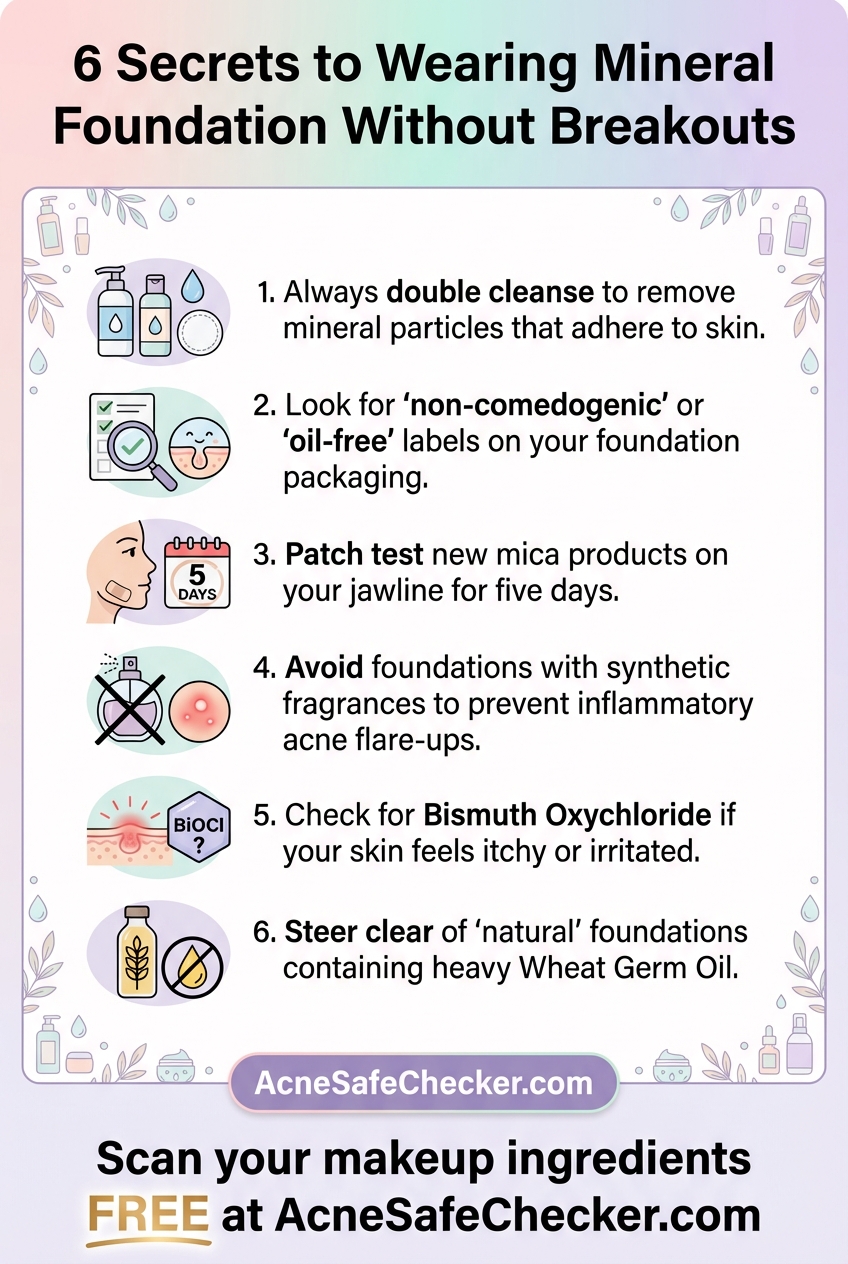
In many mineral foundations, mica is paired with Bismuth Oxychloride. Unlike mica, Bismuth Oxychloride has a crystalline, heavy structure that can cause significant itching and irritation for people with sensitive skin. This irritation can lead to inflammation that mimics an acne flare-up, leading users to believe the mica is clogging their pores.
3. Particle Size and Quality
Low-grade mica that hasn't been properly refined can have jagged edges. While these edges aren't "clogging" the pore in a traditional sense, they can cause micro-abrasions on the skin's surface. This compromises the skin barrier, leading to redness and potentially allowing bacteria to enter, which triggers acne.
Is Your Foundation the Real Problem? How to Tell
If you suspect your makeup is causing your skin issues, it’s important to look at the entire formulation. As a dermatologist, I recommend looking for these specific red flags in your foundation:
- Synthetic Fragrances: A leading cause of contact dermatitis and inflammatory breakouts.
- Alcohol Denat: Can strip the skin barrier, causing the skin to overproduce oil to compensate, which leads to clogged pores.
- Heavy Oils: Ingredients like wheat germ oil or cocoa butter can have high comedogenic ratings.
Practical Tips for Using Mica-Based Foundations
If you have acne-prone skin but love the finish that mica provides, follow these steps to ensure your skin stays clear:
Use the "Double Cleanse" Method
Because mica is designed to adhere to the skin for a long-wearing finish, a simple water-based cleanser might not remove it all. Start with an oil-based cleanser or micellar water to break down the minerals and pigments, then follow up with a gentle, pH-balanced foaming cleanser to clear the pores.
Check for "Non-Comedogenic" Labels
While not a guarantee, looking for products labeled "non-comedogenic" or "oil-free" is a great starting point. These products are specifically formulated to exclude the most common pore-clogging offenders.
Patch Test New Products
Before applying a new mica-heavy foundation to your entire face, test it on a small area near your jawline for three to five days. This will help you determine if your skin reacts to the specific formulation without risking a full-face breakout.
Conclusion: The Bottom Line on Mica
In the search for skin-friendly makeup, mica is generally a safe bet. It provides the aesthetic benefits we want—shimmer, blur, and silkiness—without the inherent risk of follicular occlusion. If you are experiencing breakouts, it is much more likely that the culprit is another ingredient in the formula, a lack of thorough cleansing, or an underlying skin sensitivity to the texture of the mineral itself.
By understanding the science behind your makeup and maintaining a diligent skincare routine, you can enjoy the radiant glow of mica-infused foundation without compromising your skin's health.