
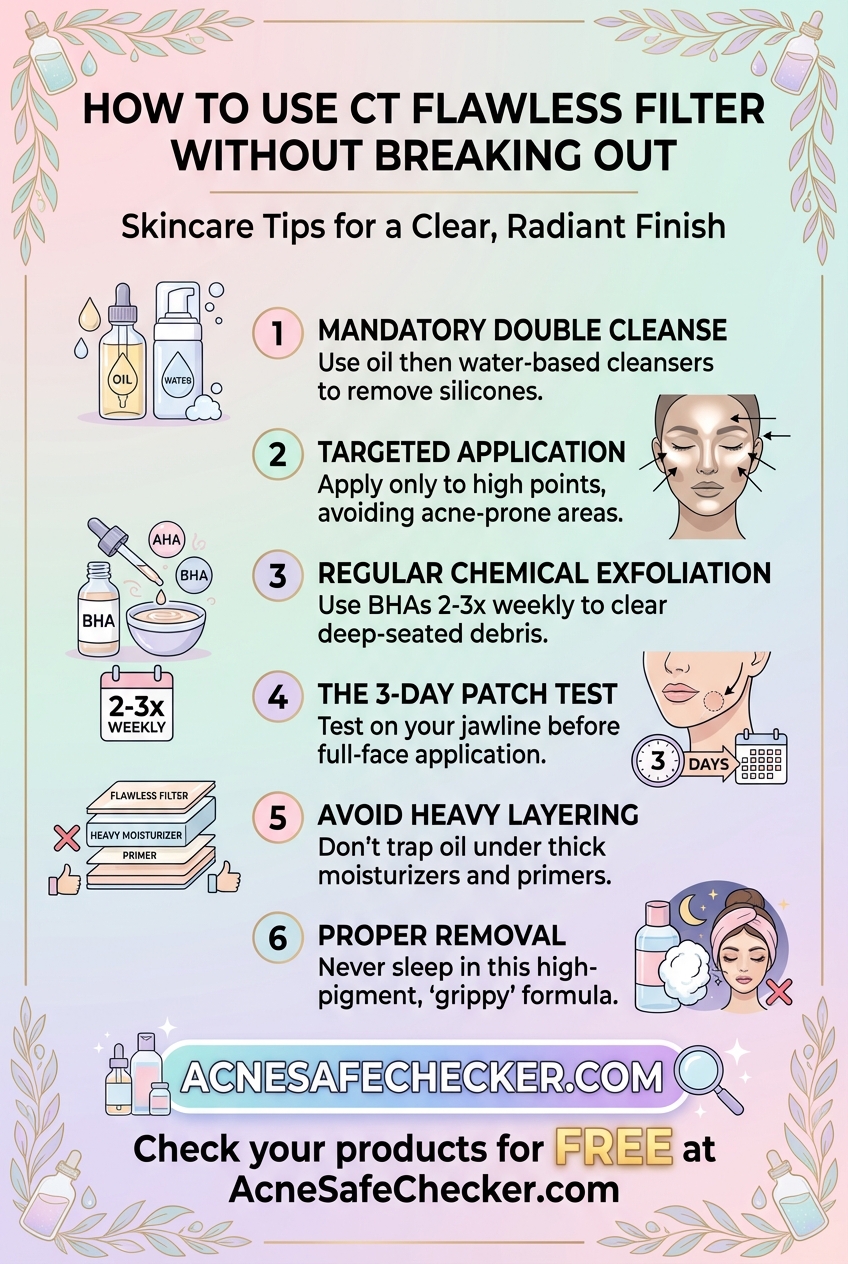
The Charlotte Tilbury Hollywood Flawless Filter has achieved legendary status in the beauty world. Marketed as a hybrid between a primer, highlighter, and skin tint, it promises a “red carpet glow” in a bottle. However, for those with acne-prone or sensitive skin, any new product introduction comes with a looming question: Will this make me break out?
Is Your Routine Acne-Safe?
Do not guess. Instantly check your products for pore-clogging ingredients with our AI-powered tool.
Check Ingredients NowAs a dermatologist, I often see patients who love the aesthetic results of “glowy” products but struggle with the subsequent congestion. In this article, we will dissect the formulation of the Flawless Filter, identify potential triggers, and provide a clinical perspective on whether this cult favorite is safe for your pores.
Understanding the Formula: Is It Comedogenic?
To determine if a product causes acne, we must look at its comedogenicity—the likelihood that it will cause comedones (clogged pores). While the beauty industry often uses the term “non-comedogenic” as a marketing tool, it is important to remember that this label is not strictly regulated by the FDA. What works for one person’s skin barrier may cause “acne cosmetica” in another.
Key Ingredients Under the Microscope
When we analyze the Charlotte Tilbury Flawless Filter ingredient list, several components stand out from a dermatological standpoint:
1. Bismuth Oxychloride
This is a common mineral found in many “shimmering” makeup products. While it provides a beautiful pearlescent finish, Bismuth Oxychloride has a unique crystalline structure that can be irritating to some skin types. For individuals with sensitive or reactive skin, this irritation can lead to inflammation, which is a precursor to inflammatory acne.
2. Silicones (Cyclohexasiloxane and Others)
Silicones are used to give the product its signature smooth, blurring effect. Contrary to popular myths, silicones themselves do not “clog” pores in a traditional sense; their molecules are often too large. However, they can act as an occlusive barrier. This means they can trap sweat, sebum, and dead skin cells underneath the makeup, creating a breeding ground for C. acnes bacteria.
3. Emollients and Esters
The formula contains various esters and fatty alcohols that provide the “slip” and hydration. Ingredients like Glyceryl Stearate and Ethylhexylglycerin are generally safe, but for those with very oily skin, the heavy emollient nature of the product may contribute to a feeling of congestion if not removed properly.
Why Some People Break Out (And Others Don’t)
If you have noticed whiteheads or texture after using this product, it is likely due to one of three factors:
- Follicular Occlusion: The product’s “grippy” and reflective nature involves a high concentration of pigments and micas. If these are forced into the pores—especially through heavy-handed application or lack of proper cleansing—they can cause physical blockages.
- Sensitivity vs. Acne: What looks like acne may actually be contact dermatitis or a reaction to the heavy fragrance or Bismuth Oxychloride. These small, itchy red bumps are often mistaken for traditional breakouts.
- The Layering Effect: Most people don't use Flawless Filter alone. When layered over a rich moisturizer and under a heavy foundation, you create a “suffocation” effect on the skin that exacerbates oil production.
Dermatologist-Approved Tips for Using Flawless Filter
You don’t necessarily have to toss your bottle in the trash if you love the glow. Here is how to minimize the risk of breakouts:
1. The Double Cleanse is Mandatory
Because this product is designed to “stay put” and reflect light, it is more stubborn to remove than a standard tinted moisturizer. Use an oil-based cleanser or micellar water first to break down the silicones and pigments, followed by a water-based gel or foam cleanser to deep-clean the pores.
2. Avoid High-Congestion Areas
If you are prone to breakouts on your chin or forehead, try using the Flawless Filter as a targeted highlighter on the high points of your cheekbones and the bridge of your nose only. Avoid applying it to areas where you have visible, active congestion.
3. Check Your Exfoliation Routine
Using a chemical exfoliant (like Salicylic Acid or Glycolic Acid) 2–3 times a week can help clear out any residual debris that the Flawless Filter might leave behind. This prevents the “build-up” that eventually leads to a flare-up.
4. Patch Test
Before applying it all over your face, apply a small amount to your jawline for three consecutive days. If you see no signs of irritation or new comedones, you are likely safe to proceed.
The Final Verdict
Does Charlotte Tilbury Flawless Filter cause acne? Not directly. It does not contain highly comedogenic ingredients like coconut oil or isopropyl myristate. However, its occlusive nature and the presence of Bismuth Oxychloride make it a “high-risk” product for individuals already struggling with oily, acne-prone, or highly sensitive skin.
If you have a clear skin type and a rigorous cleansing routine, you are unlikely to experience issues. If you have active acne, you may want to opt for a lighter, oil-free liquid highlighter that lacks the heavy silicone base. Always listen to your skin; if the glow comes at the cost of your skin’s health, it’s time to look for a non-comedogenic alternative.