
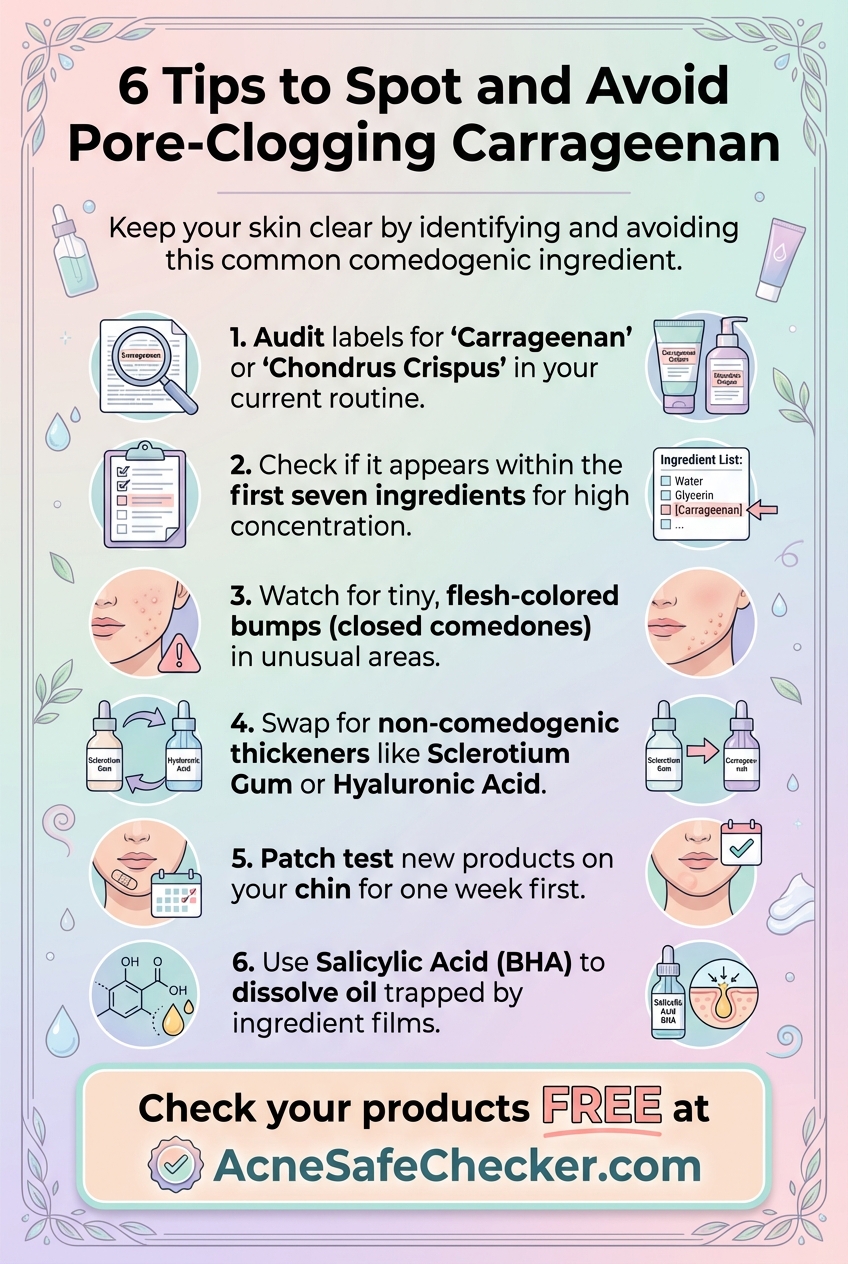
Finding the perfect skincare routine often feels like a game of trial and error. You purchase a product marketed for "sensitive skin" or labeled as "natural," only to wake up a few days later with a cluster of new breakouts. If you have acne-prone skin, you’ve likely heard of the term "comedogenic ingredients"—substances known to clog pores and trigger blemishes.
Is Your Routine Acne-Safe?
Do not guess. Instantly check your products for pore-clogging ingredients with our AI-powered tool.
Check Ingredients NowOne ingredient that frequently appears on these "no-fly lists" is carrageenan. But what exactly is it, and is the fear surrounding it justified? As a dermatologist, I see many patients frustrated by hidden triggers in their cosmetics. Today, we are going to dive deep into the science of carrageenan to determine if it’s the culprit behind your clogged pores.
What is Carrageenan?
Carrageenan is a natural ingredient derived from red seaweed (specifically Chondrus crispus, also known as Irish Moss). Because of its unique gelatinous properties, it is widely used in both the food and cosmetic industries as a thickening agent, stabilizer, and emulsifier.
In skincare, you’ll find it in everything from luxury moisturizers and eye creams to shampoos and foundations. It gives products a smooth, silky texture and helps bind water to the skin, providing a temporary feeling of hydration. On an ingredient label, it might appear as:
- Carrageenan
- Chondrus Crispus
- Chondrus Crispus Extract
- Magnesium Aluminum Silicate (sometimes blended with it)
The Comedogenicity Scale: Why Carrageenan Stands Out
To understand if an ingredient clogs pores, dermatologists often refer to the comedogenicity scale. This scale ranges from 0 to 5:
- 0: Will not clog pores
- 1–2: Low risk of clogging pores
- 3: Moderate risk
- 4–5: High risk of clogging pores
Carrageenan is almost universally rated as a 5 on this scale. This is the highest possible rating, suggesting that it has a significant potential to cause comedones (blackheads and whiteheads) in individuals who are prone to them.
The Science Behind the Clogging
Carrageenan is a large polysaccharide. Its molecular structure allows it to form a film over the surface of the skin. While this film is great for "locking in moisture," it can also act as a physical barrier that traps sebum (skin oil), dead skin cells, and bacteria inside the follicle. For someone with naturally oily or acne-prone skin, this creates the perfect environment for a breakout to form.
Is the Rating 100% Accurate?
It is important to provide a bit of nuance. The comedogenicity scale was originally developed using rabbit ear assays, where the ingredient was applied at 100% concentration to a rabbit's ear. Human skin is different, and we rarely use carrageenan at 100% concentration; it is usually a small percentage of a larger formula.
However, even with these caveats, the clinical consensus among acne specialists remains: if you are highly prone to breakouts, carrageenan is an ingredient you should likely avoid. Unlike some ingredients that are only mildly problematic, carrageenan’s high viscosity and film-forming nature make it a "high-offender" in the world of cosmetic chemistry.
How to Tell if Your Skin is Reacting to Carrageenan
Not everyone who uses a product containing carrageenan will break out. If you have very dry skin and rarely experience acne, you might use a carrageenan-infused cream without any issues.
However, if you experience the following, your skin may be sensitive to this ingredient:
- Congestion in unusual places: You notice tiny, flesh-colored bumps (closed comedones) in areas where you don’t usually break out.
- Delayed breakouts: You start a new product, and 2–3 weeks later, your skin texture feels "bumpy" or uneven.
- Worsening of existing acne: Your current acne treatments don't seem to be working because your makeup or moisturizer is constantly re-clogging the pores.
Practical Steps for Clearer Pores
If you suspect carrageenan is causing issues for your skin, follow these steps to clear up your complexion:
1. Audit Your Current Routine
Check the labels of your moisturizer, foundation, primer, and even your hair conditioner. If you see "Carrageenan" or "Chondrus Crispus" in the first five to seven ingredients, it is present in a high enough concentration to potentially cause issues.
2. Look for Safer Alternatives
If you love the silky feel that carrageenan provides, look for products that use non-comedogenic thickeners or hydrators. Ingredients like Hyaluronic Acid, Glycerin, or Sclerotium Gum can provide hydration and texture without the high risk of clogging pores.
3. Patch Test Everything
Even products labeled "Non-Comedogenic" can sometimes cause issues. When starting a new product, apply a small amount to a specific area of your face (like the side of your chin) for a week to see if any congestion develops before applying it all over.
4. Focus on Salicylic Acid
If you have been using a product with carrageenan and your pores feel congested, look for a cleanser or toner containing Salicylic Acid (BHA). This oil-soluble acid can penetrate deep into the pores to dissolve the