
Finding the root cause of persistent breakouts can feel like an endless game of detective. You’ve adjusted your diet, you’re washing your silk pillowcases weekly, and you’ve invested in expensive serums—yet those stubborn whiteheads and bumps won’t budge. Often, the culprit isn’t a lack of hygiene or the wrong active ingredient, but a common additive hiding in plain sight: Sodium Chloride.
Is Your Routine Acne-Safe?
Do not guess. Instantly check your products for pore-clogging ingredients with our AI-powered tool.
Check Ingredients NowAs a dermatologist, I frequently see patients who are shocked to learn that simple table salt—sodium chloride—might be the primary trigger for their adult acne or follicular congestion. In this guide, we will dive deep into the science of comedogenicity, why sodium chloride is used in skincare, and how to determine if it’s the reason your skin isn't clearing up.
What is Sodium Chloride and Why is it in Your Products?
Sodium chloride is the chemical name for common salt. While we primarily associate it with the kitchen, it is a staple in the personal care industry. Its functions are largely structural rather than therapeutic:
- Thickening Agent: In many liquid formulations, particularly shampoos and cleansers, salt is used to increase viscosity, giving the product a rich, luxurious feel.
- Preservative Support: It can help stabilize certain formulations.
- Exfoliation: In physical scrubs, it acts as a mechanical abrasive to slough off dead skin cells.
While salt is natural and generally safe to ingest, its interaction with the delicate environment of your pores is a different story entirely.
The Comedogenic Scale: Where Does Sodium Chloride Rank?
The "comedogenic scale" is a tool used by dermatologists and estheticians to rank how likely an ingredient is to cause a comedone (a clogged pore). The scale ranges from 0 to 5:
- 0: Will not clog pores
- 1-2: Low risk of clogging
- 3: Moderate risk
- 4-5: High risk
Sodium Chloride carries a comedogenic rating of 5. This puts it in the same category as high-risk ingredients like seaweed extract and isopropyl myristate. For individuals prone to acne, specifically acne cosmetica, an ingredient with a rating of 5 is a significant red flag.
The Science of How Salt Clogs Pores
You might wonder how a water-soluble mineral can clog a pore. The mechanism isn't necessarily about the salt physically "plugging" the hole like a cork. Instead, it’s about the physiological reaction within the hair follicle.
Follicular Irritation
When sodium chloride penetrates the pore, it can act as an irritant to the follicular lining. This irritation triggers a process called retention hyperkeratosis, where the skin produces excess keratin cells that don’t shed properly. These cells mix with your natural sebum (oil), creating a sticky plug that eventually leads to a microcomedone.
Dehydration and Sebum Viscosity
Salt is hygroscopic, meaning it draws water out of the skin. While this can sometimes be used to reduce swelling, in the context of a pore, it can dehydrate the surrounding tissue and thicken the sebum. Thicker sebum is much harder for the skin to expel naturally, leading to deep-seated congestion.
Rinse-Off vs. Leave-On Products
Context is vital when evaluating sodium chloride. The risk profile changes depending on how the product is used.
Shampoos and Conditioners
This is where sodium chloride is most commonly found. If you struggle with "backne" (acne on the back) or breakouts along the hairline and jawline, your hair care products are the likely suspects. When you rinse your hair, the salty residue runs down your face and back, potentially clogging pores in those areas.
Moisturizers and Foundations
If sodium chloride is present in a leave-on product like a moisturizer or a liquid foundation, the risk is much higher. Because the product sits on the skin for 8 to 12 hours, the salt has ample time to irritate the follicular lining.
Practical Steps: How to Audit Your Routine
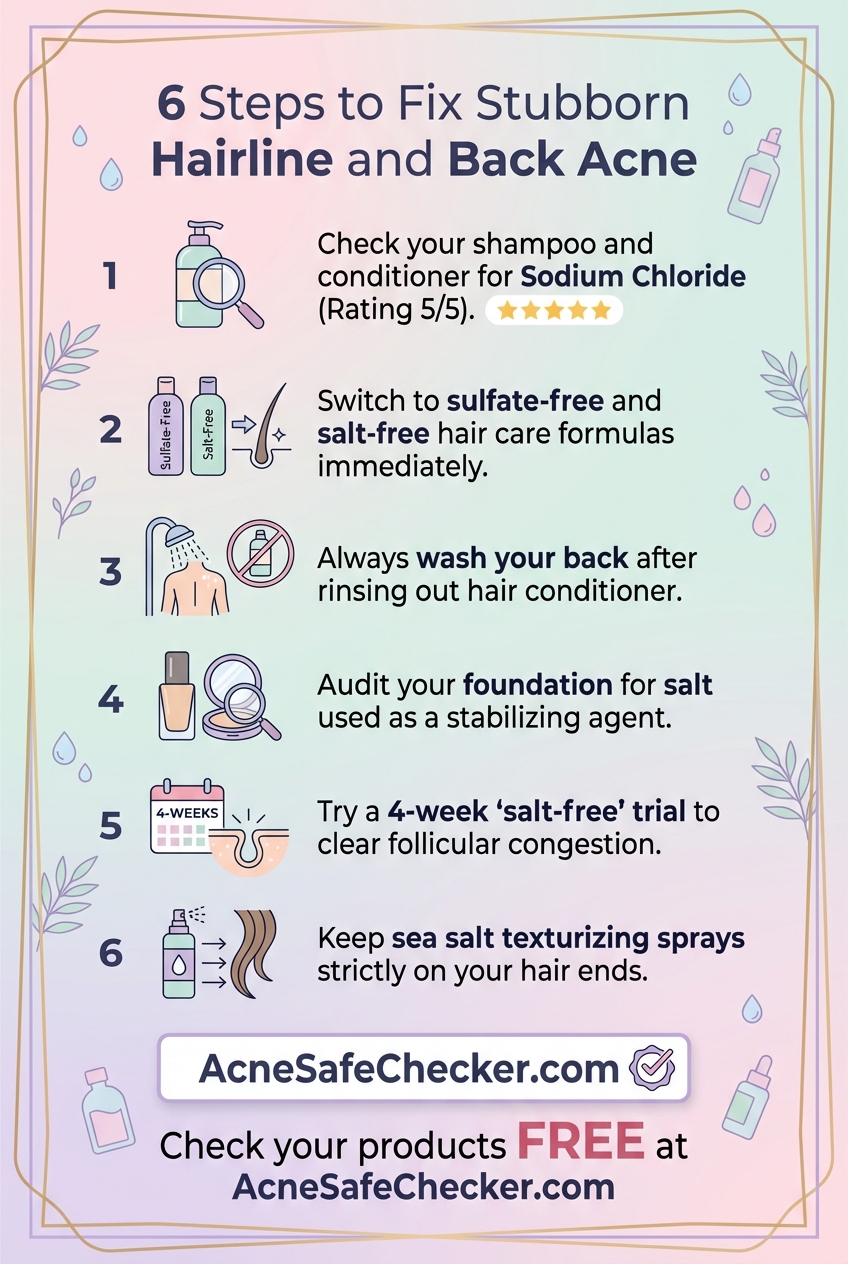
If you are struggling with persistent congestion, I recommend a "salt-free" trial for at least four weeks. Here is how to navigate the process:
1. Read the Ingredient Deck
Look for "Sodium Chloride" specifically. It is usually listed toward the middle or end of the list, but for acne-prone individuals, even small amounts can be problematic.
2. Check Your Haircare First
Since it’s a common thickener in affordable and high-end shampoos alike, start there. Switch to a sulfate-free and sodium chloride-free formula to see if your hairline and body acne improve.
3. Evaluate Your Makeup
Many "dewy" or "long-wear" foundations use salts to manage the emulsion's stability. If you notice breakouts specifically in areas where you apply heavy makeup, check those labels immediately.
4. Look for Alternatives
If you love the texture that sodium chloride provides (like in sea salt hair sprays), try to keep the product strictly on the ends of your hair and avoid contact with your skin.
Conclusion: Should You Avoid It Entirely?
Not everyone needs to fear sodium chloride. If you have clear skin and your current routine is working, there is no medical reason to swap your products. However, for the "acne-prone" population—those who fight constant blackheads, whiteheads, and texture—sodium chloride is often a silent trigger.
Understanding the chemistry of what you put on your face is the first step toward long-term skin health. By identifying and removing high-ranking comedogenic ingredients like sodium chloride, you allow your skin’s natural shedding process to function correctly, leading to a clearer, smoother complexion.