
The Mineral Makeup Paradox: When 'Clean' Beauty Causes Breakouts
Is Your Routine Acne-Safe?
Do not guess. Instantly check your products for pore-clogging ingredients with our AI-powered tool.
Check Ingredients NowFor years, mineral makeup has been marketed as the ultimate solution for acne-prone and sensitive skin. Dermatologists often recommend it because it traditionally lacks the heavy oils, waxes, and fragrances found in liquid foundations. However, many patients come into my clinic frustrated: they switched to mineral powders to save their skin, only to find their acne worsening or their face feeling itchy and inflamed.
When we look closer at their ingredient labels, one name almost always appears: Bismuth Oxychloride.
If you have noticed a 'prickly' sensation or a sudden increase in cystic bumps since switching to a mineral brand, you aren't imagining things. While technically listed as non-comedogenic by some standards, this specific ingredient is a massive trigger for many. In this article, we will dive into the science of why this 'natural' mineral behaves the way it does on your skin.
What Exactly is Bismuth Oxychloride?
Bismuth Oxychloride (often listed as CI 77163) is a naturally occurring mineral, but the version used in cosmetics is a synthetic byproduct of refined lead and copper. It is prized in the beauty industry for one primary reason: its aesthetic finish.
It has a distinct, crystalline structure that provides a pearlescent, 'glowy' finish to powders. It also acts as a heavy filler, helping makeup adhere to the skin and providing that 'creamy' feel that many consumers love in a dry powder. Without it, many mineral foundations would look matte or flat.
Is Bismuth Oxychloride Comedogenic? The Technical vs. Practical Truth
When we discuss whether an ingredient is 'comedogenic,' we are technically asking if it physically plugs the pore to form a comedone (a blackhead or whitehead). On the standard comedogenicity scale, Bismuth Oxychloride usually ranks a 0 to 1, meaning it is theoretically unlikely to clog pores.
However, this rating is misleading for acne sufferers.
In my professional experience, while it may not 'plug' the pore in the way a thick wax does, it triggers a 'mechanical' form of acne. The crystal shape of the bismuth molecule is unique; it is heavy and has sharp, barbed edges. As you buff the powder into your skin—a common application technique for mineral makeup—you are essentially grinding these microscopic barbs into your pores.
Why Your Skin Reacts: The Irritation Loop
For those with sensitive or acne-prone skin, Bismuth Oxychloride causes issues through three main pathways:
1. Mechanical Irritation
The 'barbed' shape of the crystals causes micro-tears and friction within the follicle. This leads to inflammation. In the world of dermatology, we know that inflammation is the precursor to an acne lesion. When the skin is irritated, it produces more sebum and sheds skin cells more rapidly, creating the perfect storm for a breakout.
2. The 'Itch-Scratch' Cycle
Many users report that their face feels itchy as they sweat or as the day goes on. This is the bismuth crystals poking the skin. When you scratch or even just touch your face to relieve that itch, you introduce bacteria and further inflame existing pimples, leading to what looks like a classic acne flare-up.
3. Cystic Response
Because Bismuth Oxychloride is a heavy mineral, it can sink deep into the pores. For individuals with already sluggish pore turnover (retention hyperkeratosis), these heavy particles can get trapped, leading to deep, painful cystic bumps rather than just surface-level whiteheads.
How to Identify Bismuth Oxychloride in Your Routine
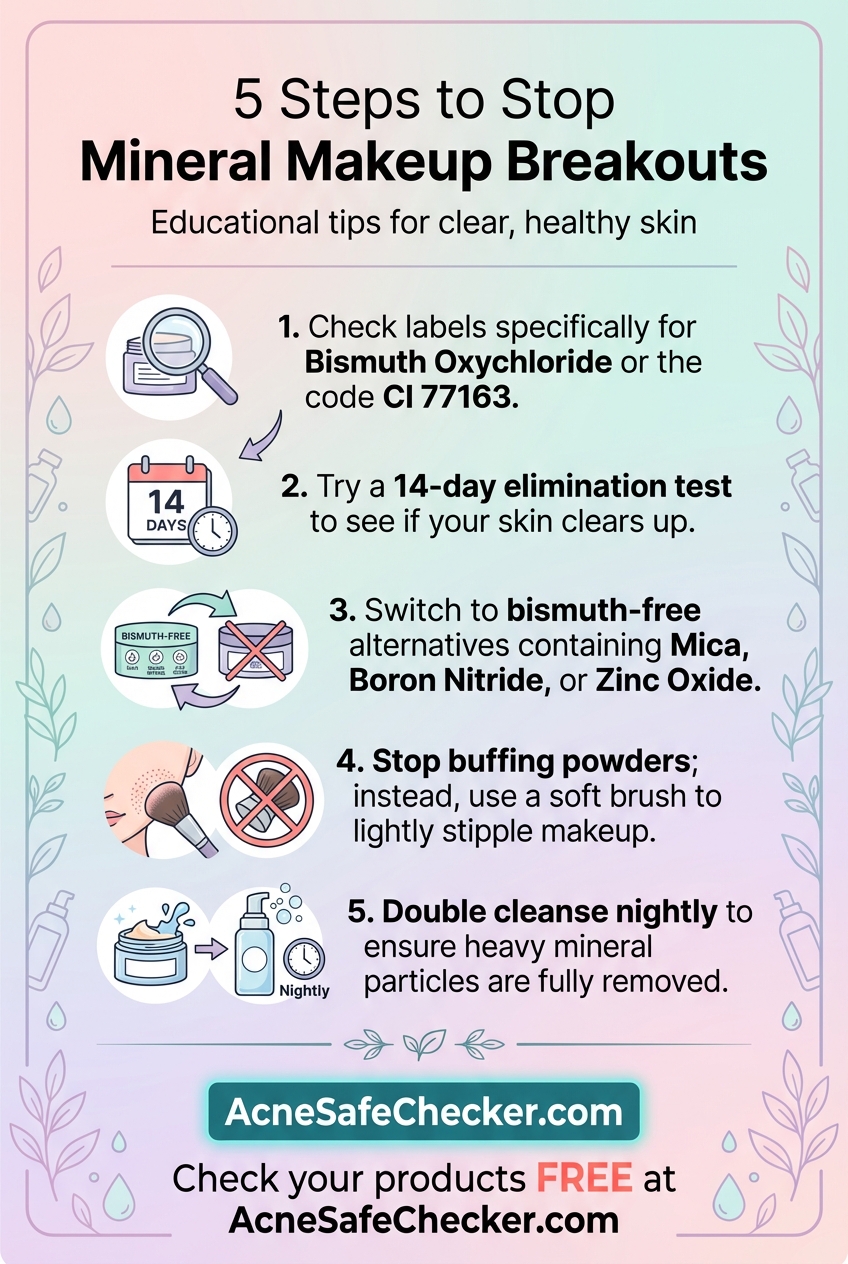
You don’t need a degree in chemistry to spot this ingredient, but you do need to read the 'Fine Print' or the 'May Contain' section of your makeup labels. Look for:
- Bismuth Oxychloride
- CI 77163
It is most commonly found in loose powder foundations, pressed blushes, and highlighters. Even brands marketed as 'dermatologist tested' or 'hypoallergenic' frequently use it because it is an inexpensive way to add weight and glow to a product.
Practical Steps: Switching to Acne-Safe Makeup
If you suspect your makeup is the culprit behind your breakouts, follow these steps to clear your complexion:
- The Elimination Test: Stop using any product containing Bismuth Oxychloride for 14 days. This is usually enough time for the mechanical irritation to subside.
- Look for Bismuth-Free Alternatives: Many modern mineral brands now proudly label themselves as 'Bismuth-Free.' These brands often use Mica (for shimmer), Boron Nitride (for slip), or Zinc Oxide (for soothing) instead.
- Change Your Application Technique: If you must use a product with bismuth, avoid 'buffing' it into the skin with a dense brush. Instead, use a soft brush to lightly 'stipple' or dust the product on to minimize friction.
- Double Cleanse: Heavy minerals require more than a simple face wash to remove. Use an oil-based cleanser followed by a gentle water-based cleanser to ensure no crystal particles remain in your pores overnight.
Conclusion
While Bismuth Oxychloride might not be 'comedogenic' in a laboratory setting, its physical structure makes it a significant trigger for anyone prone to acne or sensitive skin. If you’ve been doing 'everything right' with your skincare but your breakouts won't budge, the answer might be hidden in your foundation jar.
By choosing bismuth-free formulations, you can enjoy the skin-protecting benefits of mineral makeup—like natural SPF and oil absorption—without the itching, redness, and cystic flare-ups. Your skin deserves ingredients that soothe, not ingredients that scratch.