
As a dermatologist, one of the most frequent questions I encounter in my clinic is, "If I buy an oil-free moisturizer, will it stop my breakouts?" It is a logical question. For decades, we have been conditioned to associate oil with acne. However, in the modern world of cosmetic chemistry, the answer is more nuanced than a simple yes or no.
Is Your Routine Acne-Safe?
Do not guess. Instantly check your products for pore-clogging ingredients with our AI-powered tool.
Check Ingredients NowMany consumers use the terms "oil-free" and "non-comedogenic" interchangeably, assuming that if a product lacks oil, it cannot possibly clog their pores. This is a common misconception that often leads to frustration when a "safe" product still causes whiteheads, blackheads, or inflammatory acne. To achieve truly clear skin, you must understand the scientific distinction between these two marketing claims.
Defining the Terms: Oil-Free vs. Non-Comedogenic
To navigate the skincare aisle effectively, we first need to strip away the marketing jargon and look at what these terms actually signify from a formulation standpoint.
What Does "Oil-Free" Really Mean?
Technically, an oil-free label means the product is formulated without traditional oils, such as mineral oil, vegetable oils (like olive or jojoba), or animal-derived lipids (like lanolin). These products are often formulated for people with seborrhea—excessive oil production—because they provide hydration without adding more grease to the skin's surface.
However, being oil-free does not mean a product is free of emollients or thickening agents. Manufacturers often replace oils with synthetic ingredients, esters, or silicones to provide a smooth texture. Some of these synthetic replacements can be just as pore-clogging as traditional oils.
What Does "Non-Comedogenic" Really Mean?
The term "non-comedogenic" is specifically designed for the acne-prone community. It indicates that the product has been formulated or tested to ensure it does not cause comedones—the medical term for the precursor to a pimple (clogged pores).
In scientific testing, non-comedogenic products are often evaluated using a comedogenicity scale (ranging from 0 to 5). A rating of 0 means it is highly unlikely to clog pores, while a 5 means it is almost certain to do so. A non-comedogenic product typically utilizes ingredients that sit on the surface of the skin or penetrate without getting trapped in the follicular opening.
The Crucial Difference: Why Oil-Free Isn't Enough
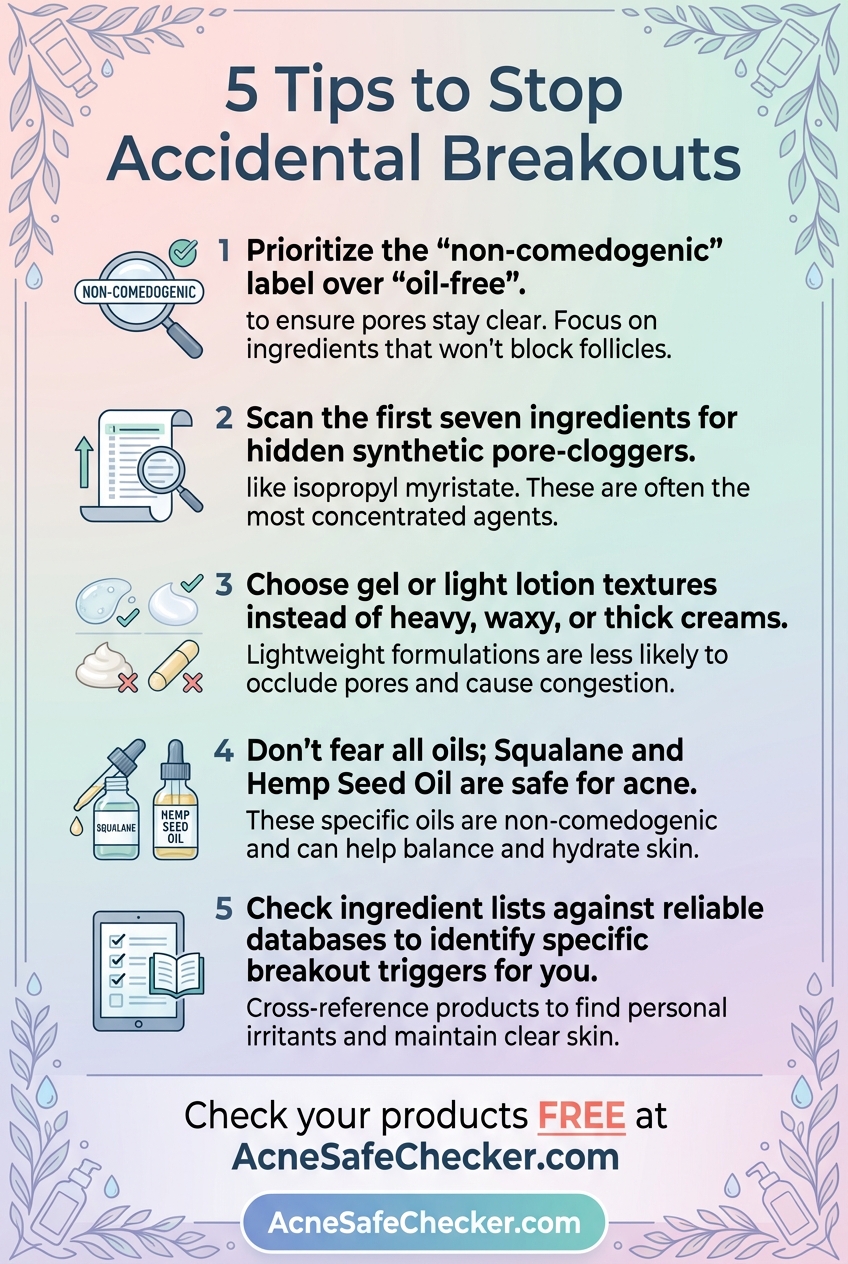
The most important takeaway is this: A product can be oil-free but still be highly comedogenic. Conversely, a product can contain certain oils and still be non-comedogenic.
The "Oil-Free" Trap
Many oil-free foundations and sunscreens use ingredients like isopropyl myristate, isopropyl palmitate, or decyl oleate. These are synthetic esters used to give products a silky feel. Despite not being "oils" in the traditional sense, they are notorious for their high comedogenicity ratings. If you have acne-prone skin and use an oil-free product containing these ingredients, you may still experience "acne cosmetica"—acne triggered by topical products.
The Benefit of Some Oils
On the flip side, some oils are actually beneficial or neutral for the skin. For example, Squalane and Hemp Seed Oil have very low comedogenicity ratings. They provide essential fatty acids to the skin barrier without obstructing the pore. Therefore, seeing an oil in an ingredient list shouldn't be an automatic cause for alarm, provided the overall formulation is non-comedogenic.
The Science of a Clogged Pore
To understand why these labels matter, we have to look at the biology of the pore (the pilosebaceous unit). Acne begins with a process called follicular hyperkeratosis. This is when dead skin cells inside the pore stick together instead of shedding.
When you apply a comedogenic ingredient, it acts as a "glue," causing these dead cells and your natural sebum to form a plug. This plug, or microcomedone, creates an oxygen-free environment where C. acnes bacteria thrive, leading to inflammation and a visible breakout. While oil-free products reduce the amount of surface lipids, only non-comedogenic products are designed to prevent this internal plugging of the pore.
Practical Steps for Choosing the Right Skincare
If you are struggling with breakouts, follow these clinical guidelines to ensure your routine is helping rather than hindering your progress:
- Prioritize "Non-Comedogenic" Over "Oil-Free": If you have to choose between the two labels, non-comedogenic is the safer bet for acne-prone individuals. Ideally, look for products that carry both claims.
- Scan for Red-Flag Ingredients: Even if a label says non-comedogenic, it is wise to check for common offenders in the first five to seven ingredients. Avoid:
- Isopropyl Myristate
- Sodium Lauryl Sulfate (SLS)
- Coconut Oil (Cocos Nucifera Oil)
- Algae Extract
- Lanolin
- Consider Your Skin Type: If you have dry but acne-prone skin, an oil-free moisturizer might not be hydrating enough, causing your skin to produce more oil to compensate. In this case, a non-comedogenic cream with ceramides or hyaluronic acid is a better choice.
- The "Feel" Test: Most truly non-comedogenic, oil-free products will have a gel or light lotion consistency. If a product feels heavy, waxy, or greasy, it may contain hidden comedogenic waxes or thickeners.
- Use Reliable Databases: There are several online "pore-clogging ingredient checkers" where you can paste an ingredient list to see if it contains substances known to trigger breakouts.
Conclusion
In the world of dermatology, transparency is key. While "oil-free" is a helpful starting point for those with extremely greasy skin, it is not a guarantee against acne. To protect your pores, you must look for the "non-comedogenic" label and, more importantly, learn to identify the specific ingredients that your unique skin reacts to.
By focusing on formulation rather than just marketing buzzwords, you can build a skincare routine that supports a clear, healthy complexion without the fear of hidden triggers. Remember, clear skin isn't just about what you take away (the oil); it's about the quality of what you put on.