
For anyone who has ever spent twenty minutes in a drugstore aisle squinting at the tiny print on the back of a moisturizer bottle, the term "comedogenic" is likely a familiar foe. When you have acne-prone or sensitive skin, every ingredient feels like a potential trigger. One ingredient that frequently pops up in both high-end and affordable formulations is Butyl Stearate.
Is Your Routine Acne-Safe?
Do not guess. Instantly check your products for pore-clogging ingredients with our AI-powered tool.
Check Ingredients NowAs a dermatologist, I often see patients who are doing everything right—cleansing, medicating, and protecting—yet they still suffer from persistent whiteheads and localized congestion. Often, the culprit is a hidden emollient in their makeup or sunscreen. Today, we are going to dive deep into the science of Butyl Stearate to determine if it belongs in your skincare routine or if it’s secretly sabotaging your glow.
What is Butyl Stearate?
Butyl Stearate is an ester formed from the reaction of butyl alcohol and stearic acid (a fatty acid found naturally in animal and vegetable fats). In the world of cosmetic chemistry, it serves primarily as an emollient and skin-conditioning agent.
Its job is to make a product feel smooth, spreadable, and luxurious. It creates a thin, protective layer on the surface of the skin, which helps to lock in moisture and prevent transepidermal water loss (TEWL). Because of its oily consistency, you will frequently find it in:
- Lipsticks and lip balms
- Foundation and concealers
- Moisturizing creams
- Sunscreens
- Nail polishes
The Comedogenic Scale: Where Does Butyl Stearate Rank?
To understand if an ingredient is "pore-clogging," dermatologists refer to the comedogenic scale. This scale ranges from 0 to 5:
- 0: Will not clog pores
- 1: Very low probability of clogging pores
- 2: Moderately low probability
- 3: Moderate probability
- 4: Fairly high probability
- 5: High probability of clogging pores
Butyl Stearate typically carries a comedogenic rating of 3.
Why a Rating of 3 is Significant
A rating of 3 puts Butyl Stearate in the "moderate" category. For someone with very dry skin and no history of acne, this ingredient is likely harmless and may even provide much-needed lipid replenishment. However, for those with oily or acne-prone skin, a rating of 3 is often considered the "danger zone."
The Science: How Butyl Stearate Affects Your Pores
To understand why Butyl Stearate can be problematic, we have to look at the anatomy of a pore (the pilosebaceous unit). Acne occurs when sebum (your skin's natural oil) becomes trapped by dead skin cells and external substances, leading to a plug or "comedo."
Butyl Stearate has a molecular structure that allows it to penetrate the follicle effectively. Because it is a fatty acid ester, it can blend with your skin's natural oils. In individuals with overactive sebaceous glands, Butyl Stearate can thicken the sebum, making it more difficult for the oil to flow freely to the skin's surface. This results in the formation of microcomedones—the invisible precursors to the blackheads and whiteheads we see on the surface.
Furthermore, some research suggests that certain fatty acid esters can serve as a food source for Cutibacterium acnes (the bacteria responsible for inflammatory acne), though the primary issue with Butyl Stearate remains its physical ability to obstruct the pore.
Acne Cosmetica: The Hidden Trigger
Many patients are surprised to learn that their breakouts are actually a condition known as Acne Cosmetica. This is a form of acne triggered by the use of cosmetic products. Unlike hormonal acne, which often appears along the jawline as deep cysts, Acne Cosmetica usually presents as small, itchy bumps or whiteheads spread across the forehead, cheeks, or chin.
If you use a foundation or primer containing Butyl Stearate and notice a "bumpy" texture to your skin that doesn't seem to go away with traditional acne treatments, your makeup might be the culprit.
Who Should Avoid Butyl Stearate?
Skincare is rarely one-size-fits-all. Whether you should avoid Butyl Stearate depends largely on your skin type:
1. The Acne-Prone Individual
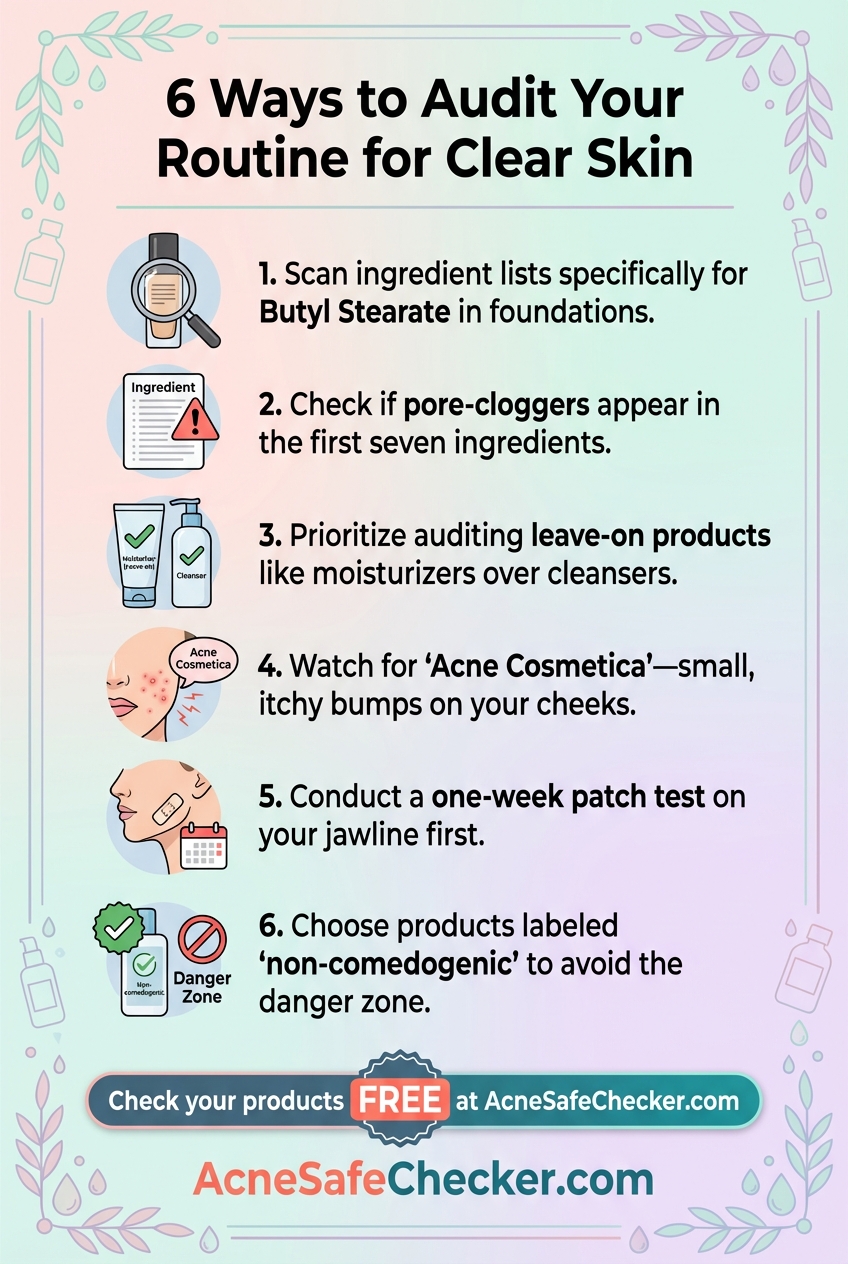
If you struggle with frequent breakouts, blackheads, or enlarged pores, I recommend avoiding products where Butyl Stearate is listed in the first five to seven ingredients. The higher it is on the list, the higher the concentration.
2. The Oily Skin Type
If your skin produces excess shine throughout the day, your pores are already under pressure. Adding a moderate comedogen like Butyl Stearate can tip the balance toward congestion.
3. The Dry or Mature Skin Type
If your skin is chronically dry, flaky, or showing signs of aging, Butyl Stearate can actually be beneficial. Its emollient properties help to smooth the skin's texture and provide a protective barrier that dry skin lacks.
How to Audit Your Skincare Routine
Ready to check your products? Here is a step-by-step guide to managing potentially comedogenic ingredients:
- Check the Ingredient Deck: Look for "Butyl Stearate" specifically. Don't confuse it with "Stearic Acid" or "Isostearyl Stearate," which have different ratings (though they are related).
- Evaluate Product Type: A wash-off cleanser with Butyl Stearate is less concerning than a leave-on moisturizer or a heavy foundation that sits on your skin for 12 hours.
- The "Patch Test" Method: If you love a product that contains this ingredient, use it on only one area of your face (like the side of your jaw) for a week. If that area stays clear while the rest of your face breaks out, the ingredient might be okay for you.
- Look for "Non-Comedogenic" Labels: While not a legal guarantee, products labeled "non-comedogenic" are generally formulated to exclude ingredients with a rating of 3 or higher.
Final Verdict
Is Butyl Stearate comedogenic? Yes, moderately.
While it is a safe and effective emollient for many, it poses a significant risk for those prone to acne and congestion. If you are fighting a losing battle with your skin texture, it is worth scanning your labels for this ingredient. Switching to products with lower comedogenic ratings (0-1) can often lead to a visible improvement in skin clarity within just one or two skin cycles (about 28 to 56 days).
Remember, your skin is a living organ that reacts to everything you put on it. Being an informed consumer is the first step toward achieving the clear, healthy complexion you deserve.