
For anyone who has spent years battling breakouts, the idea of applying oil to your face can feel counterintuitive—even frightening. You have likely been told to seek out "oil-free" products and avoid anything that might suffocate your pores. However, in recent years, jojoba oil has emerged as a "holy grail" ingredient in the skincare community.
Is Your Routine Acne-Safe?
Do not guess. Instantly check your products for pore-clogging ingredients with our AI-powered tool.
Check Ingredients NowBut the burning question remains: Is jojoba oil truly non-comedogenic, or is it just another marketing trend that will leave you with a fresh crop of comedones? As a dermatologist, I want to bridge the gap between clinical science and your daily vanity routine to help you understand how this unique substance interacts with your skin.
Understanding the Comedogenic Scale
To determine if an ingredient is safe for acne-prone skin, we often refer to the comedogenic scale. This scale ranges from 0 to 5:
- 0: Will not clog pores
- 1: Very low probability of clogging pores
- 2: Moderately low (safe for most, but may affect highly sensitive individuals)
- 3: Moderate (likely to cause breakouts in acne-prone skin)
- 4-5: High probability of clogging pores (stay away if you have oily skin)
Jojoba oil typically sits at a 2 on the comedogenic scale. While it is not a 0, it is considered "low-comedogenic." For the vast majority of people—even those with oily or combination skin—a rating of 2 is well-tolerated and unlikely to cause blockages.
The Science of Jojoba: Why It’s Not Actually an Oil
To understand why jojoba oil is so well-received by the skin, we have to look at its molecular structure. Chemically speaking, jojoba oil isn’t an oil at all; it is a liquid wax ester.
This distinction is vital. Human sebum (the natural oil your skin produces) is composed of approximately 25–30% wax esters. Because jojoba oil so closely mimics the structure of your skin's natural oils, your skin "recognizes" it.
The Mimicry Effect
When you apply jojoba oil, your skin perceives that it has sufficient moisture and lubrication. In some cases, this can actually trick the skin into slowing down its own sebum production. For patients struggling with overactive sebaceous glands and the resulting "shiny face," jojoba oil can act as a regulator, helping to balance the skin’s natural ecosystem rather than disrupting it.
Benefits of Jojoba Oil for Acne-Prone Skin
Beyond its low comedogenic rating, jojoba oil offers several therapeutic benefits for those dealing with inflammation and acne:
1. Anti-Inflammatory Properties
Acne is fundamentally an inflammatory condition. Jojoba oil contains high levels of vitamin E and B-complex vitamins, which help soothe redness and promote skin repair. This makes it an excellent choice for calming the irritation often caused by harsh acne treatments like benzoyl peroxide or retinoids.
2. Antimicrobial Action
While not a replacement for medical-grade antibiotics, jojoba oil has natural antimicrobial properties. It can inhibit the growth of certain bacteria and fungi that may exacerbate skin infections or inflammatory acne.
3. Enhanced Skin Barrier Function
Many people with acne inadvertently damage their skin barrier by over-cleansing. Jojoba oil provides a breathable protective layer that prevents transepidermal water loss (TEWL) without the heavy, "greasy" feel of occlusive oils like coconut oil.
Potential Risks: Can It Cause Breakouts?
While jojoba oil is generally safe, skincare is never one-size-fits-all. A small percentage of users may experience a "purging" period or a reaction.
- The Purging Myth: Some claim jojoba oil pulls toxins to the surface. In reality, if you are breaking out significantly after using it, it is likely a sensitivity or a true clog rather than a "detox."
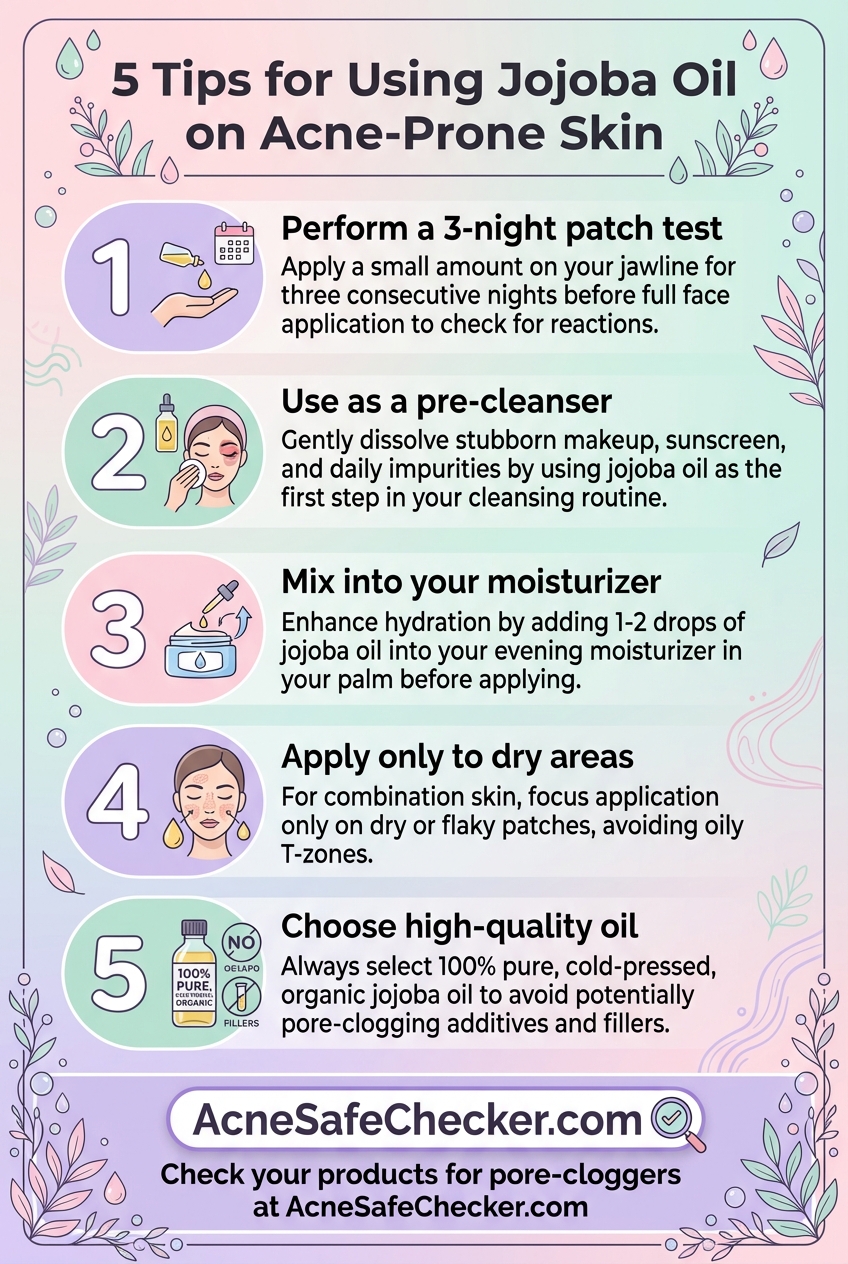
- Quality Matters: Always ensure you are using 100% pure, cold-pressed, organic jojoba oil. Synthetic versions or blends containing cheap filler oils (like soybean or mineral oil) are much more likely to cause pore blockages.
How to Incorporate Jojoba Oil into Your Routine
If you are nervous about starting, follow these dermatologist-recommended steps:
- The Patch Test: Apply a small amount of oil to the side of your neck or just under your jawline for three consecutive nights. If no redness or small bumps appear, you are likely safe to use it on your face.
- Start with Cleansing: If you are afraid of leaving oil on your skin, try "double cleansing." Use jojoba oil to dissolve makeup and sunscreen, then follow up with a gentle, water-based foaming cleanser.
- Mix with Your Moisturizer: Add one or two drops of jojoba oil to your evening moisturizer. This provides the benefits of the wax esters without a concentrated application.
- Target Dry Areas: If you have combination skin, apply jojoba oil only to dry patches or areas where you experience flakiness from acne medications.
The Verdict
Is jojoba oil non-comedogenic? While it technically sits at a "2" on the scale, its unique chemical composition as a wax ester makes it one of the most compatible and safe options for acne-prone individuals. It mimics our skin’s natural biology in a way that very few botanical ingredients can.
If you have been avoiding oils out of fear, jojoba oil is the perfect entry point. When used correctly, it doesn’t just sit on top of your skin—it works with it to soothe, protect, and balance.