
Finding the perfect skincare routine often feels like navigating a minefield. You research the best active ingredients, invest in high-end serums, and stick to a strict regimen, yet those stubborn breakouts persist. If you have acne-prone skin, the culprit might not be your lack of consistency, but a specific ingredient hiding in your products: Laureth-4.
Is Your Routine Acne-Safe?
Do not guess. Instantly check your products for pore-clogging ingredients with our AI-powered tool.
Check Ingredients NowAs a dermatologist, I frequently see patients who are doing 'everything right' but are using products containing highly comedogenic surfactants and emulsifiers. Today, we are going to dive deep into the science of Laureth-4, why it is problematic for certain skin types, and how you can make more informed choices for a clearer complexion.
What is Laureth-4?
Laureth-4 is a synthetic polymer used in the cosmetics industry primarily as an emulsifier and surfactant. Chemically, it is a polyoxyethylene ether of lauryl alcohol. In simpler terms, it is an ingredient that helps mix oil and water—two substances that naturally want to stay separate.
You will often find Laureth-4 in a wide range of personal care items, including:
- Cleansers and body washes
- Shampoos and conditioners
- Moisturizers and lotions
- Shaving creams
- Bath oils
Its ability to create a smooth texture and help products rinse off easily makes it a favorite for formulators. However, for those with a predisposition to acne, these benefits come with a significant cost.
Is Laureth-4 Comedogenic?
To put it bluntly: Yes, Laureth-4 is highly comedogenic.
In the world of dermatology, we use a comedogenicity scale ranging from 0 to 5 to determine how likely an ingredient is to clog pores:
- 0: Non-comedogenic
- 1: Very low chance of clogging pores
- 2: Low chance
- 3: Moderate chance
- 4: High chance
- 5: Very high chance
Laureth-4 typically carries a rating of 4 or 5. This puts it in the 'red zone' for anyone prone to blackheads, whiteheads, or cystic acne. Even in rinse-off products like cleansers, it can sometimes leave enough residue to trigger a reaction in sensitive follicles.
The Science: How Laureth-4 Affects Your Pores
Why does this specific ingredient cause so much trouble? To understand this, we have to look at how a comedo (a clogged pore) forms.
Acne-prone skin often suffers from a process called retention hyperkeratosis. In this state, the skin produces more dead skin cells than it can shed, and these cells become 'sticky.' When Laureth-4 is applied to the skin, its chemical structure allows it to penetrate the hair follicle.
Once inside, Laureth-4 can irritate the follicular lining and exacerbate the stickiness of those skin cells. This creates a plug of sebum and debris—the perfect environment for C. acnes bacteria to thrive. Because Laureth-4 is derived from lauryl alcohol, it has a fatty acid component that the skin's natural chemistry may struggle to process if the barrier is already compromised or if the pore structure is narrow.
Why is it Still Used in Skincare?
You might wonder: If Laureth-4 is so bad for acne, why do companies keep using it?
There are three main reasons:
- Texture and Performance: It provides an excellent 'slip' and helps products feel luxurious on the skin.
- Cost-Effectiveness: It is a relatively inexpensive ingredient for manufacturers to source.
- Skin Diversity: Not everyone has acne-prone skin. For individuals with very dry, non-acne-prone skin, Laureth-4 might not cause any visible issues. However, if you are reading this, chances are your skin is more reactive.
How to Identify Laureth-4 on a Label
When scanning an ingredient list, Laureth-4 is usually easy to spot, but it is important to distinguish it from its 'cousins.'
For example, Laureth-23 is often used in the same products. While Laureth-4 has a high comedogenicity rating, Laureth-23 is typically rated much lower (usually around a 0-1). The number refers to the 'moles' of ethylene oxide used in the ethoxylation process. Generally, as the number increases, the ingredient becomes more water-soluble and less likely to clog pores.
Always check for:
- Laureth-4
- Polyethylene glycol (4) lauryl ether
- POE (4) lauryl ether
Practical Steps for Acne-Prone Individuals
If you are currently struggling with breakouts and suspect your products might be to blame, follow these steps:
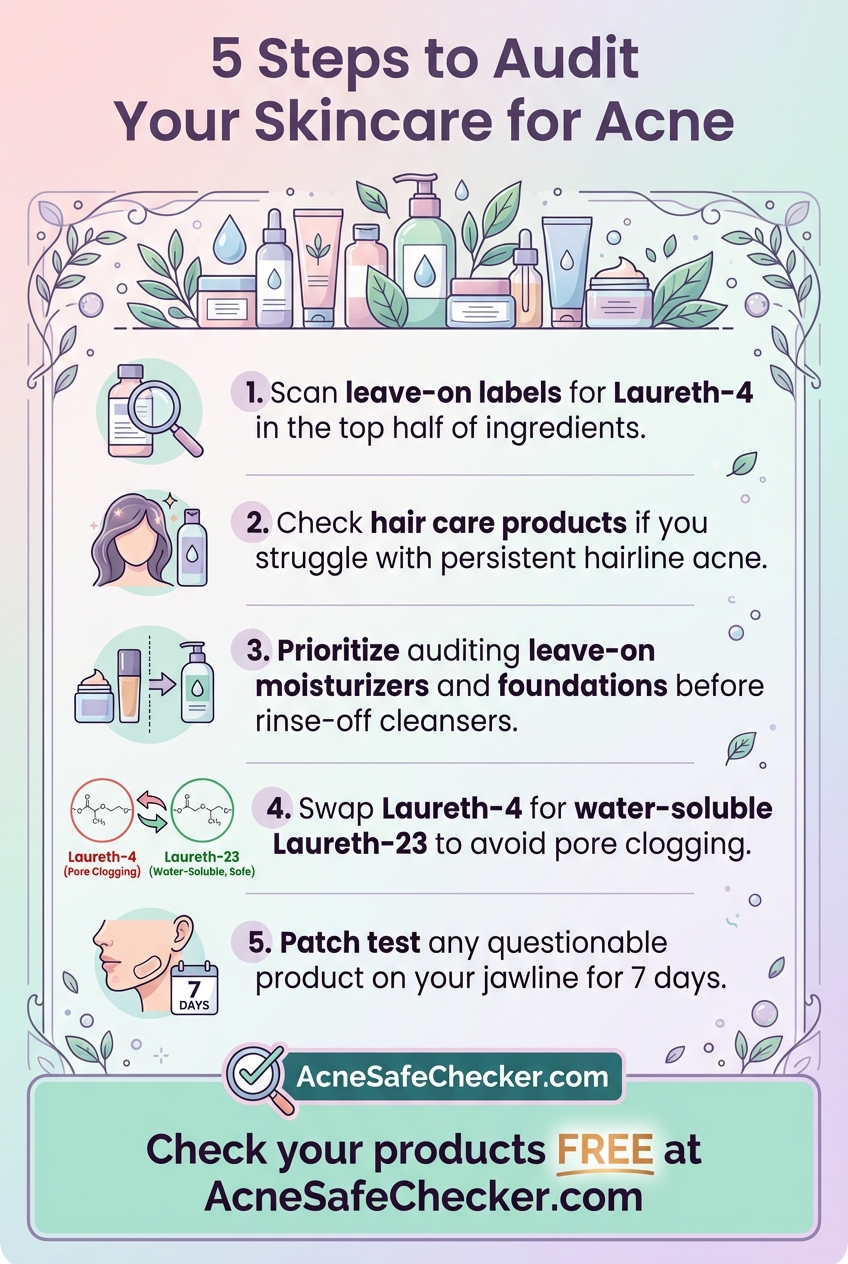
- The Ingredient Audit: Go to your bathroom cabinet and check the labels of your leave-on products (moisturizers, sunscreens, and foundations) first. If Laureth-4 is in the top half of the ingredient list, it is likely contributing to your congestion.
- The Rinse-Off Rule: While rinse-off products like shampoos or cleansers are less likely to cause deep cysts, they can still cause 'hairline acne' or small bumps on the forehead. If you have acne in these areas, check your hair care for Laureth-4.
- Look for Alternatives: Seek out products labeled 'non-comedogenic,' but don't stop there. Learn to recognize safe emulsifiers and surfactants like Caprylic/Capric Triglyceride (usually safe for most) or Glycerin-based compounds.
- Patch Test: If you find a product you love that contains a questionable ingredient, patch test it on a small area of your jawline for at least 5-7 days before applying it to your entire face.
Conclusion
In the journey toward clear skin, knowledge is your most powerful tool. While Laureth-4 is an effective emulsifier for many, it is a significant 'red flag' for the acne-prone community. By eliminating this high-ranking comedogenic ingredient from your routine, you give your pores a chance to breathe and your other acne treatments a better chance to work.
Remember, everyone's skin is unique. What causes a breakout for one person may be perfectly fine for another. However, if you are fighting an uphill battle with your complexion, removing Laureth-4 is a scientifically backed place to start. Stay vigilant with your labels, and your skin will thank you.