
For many people with acne-prone or oily skin, applying sunscreen feels like a double-edged sword. On one hand, you know that UV protection is non-negotiable for preventing premature aging and skin cancer. On the other hand, many traditional sunscreens feel heavy, greasy, and often lead to a 'breakout flare-up' by the next morning.
Is Your Routine Acne-Safe?
Do not guess. Instantly check your products for pore-clogging ingredients with our AI-powered tool.
Check Ingredients NowIf you have ever skipped SPF because you were afraid of the resulting pimples, this guide is for you. As a dermatologist, I hear this concern daily. The good news is that formulation science has come a long way. You don’t have to choose between sun protection and clear skin. Here is everything you need to know about finding a sunscreen that doesn't clog pores.
What Does 'Non-Comedogenic' Actually Mean?
In the world of skincare, you will frequently see the term "non-comedogenic." This is the clinical way of saying a product is formulated specifically not to cause comedones—the medical term for the blockages that lead to blackheads and whiteheads.
When a product is labeled non-comedogenic, it means the ingredients have been screened for their likelihood to occlude (block) the hair follicle. Historically, this was tested on rabbit ears, but modern testing involves human trials and sophisticated ingredient analysis. However, it is important to remember that 'non-comedogenic' is not a regulated legal term by the FDA. It is a claim made by manufacturers, which is why understanding the ingredient list is your best defense.
The Science: Why Does Sunscreen Clog Pores?
To understand why some sunscreens cause breakouts, we have to look at how they interact with your skin's natural oil, known as sebum. Pores become clogged through a process called follicular hyperkeratosis—where dead skin cells and excess oil get trapped inside the pore.
Certain ingredients in sunscreens act as 'occlusives.' While occlusives are great for people with extremely dry skin because they lock in moisture, they can be disastrous for acne-prone individuals. These ingredients sit on top of the skin, creating a film that traps heat, sweat, and sebum. This creates an anaerobic environment where P. acnes bacteria thrive, leading to inflammation and breakouts.
Furthermore, some chemical UV filters can cause 'contact dermatitis' or heat-induced sensitivity, which mimics the appearance of acne. This is why many people with sensitive pores prefer mineral-based options.
Mineral vs. Chemical Sunscreens for Acne-Prone Skin
When choosing a sunscreen that doesn't clog pores, the first decision is usually between a physical (mineral) and a chemical blocker.
Physical (Mineral) Sunscreens
Mineral sunscreens use Zinc Oxide or Titanium Dioxide to reflect UV rays.
- The Benefit: Zinc oxide is actually a skin-soothing ingredient. It has mild anti-inflammatory properties, making it an excellent choice for those with active acne or rosacea.
- The Downside: Older formulations were thick and left a white cast, which felt 'heavy' on the pores. Modern 'micronized' or tinted mineral sunscreens have solved this issue, providing a lightweight finish.
Chemical Sunscreens
Chemical sunscreens use ingredients like Avobenzone, Octisalate, or Oxybenzone to absorb UV rays and convert them into heat.
- The Benefit: These formulas are typically thinner, more transparent, and easier to wear under makeup.
- The Downside: The heat-conversion process can sometimes irritate sensitive, acne-prone skin. Additionally, some chemical filters are oil-soluble, requiring a lipid-heavy base that may contribute to pore clogging.
Ingredients to Look For (And Ingredients to Avoid)
The 'Green List' (Pore-Friendly Ingredients)
- Niacinamide (Vitamin B3): This is a powerhouse for acne. It helps regulate oil production and calms redness.
- Hyaluronic Acid: Provides hydration without the need for heavy oils or waxes.
- Silica: Often found in 'oil-control' sunscreens, it helps absorb excess sebum throughout the day to maintain a matte finish.
The 'Red List' (Potential Pore-Cloggers)
If you are prone to breakouts, try to avoid products containing high concentrations of:
- Isopropyl Myristate and Isopropyl Palmitate: Common emollients that are highly comedogenic.
- Coconut Oil (Cocos Nucifera): While great for hair, it is a known pore-clogger on the face.
- Certain Silicones: While not all silicones clog pores, heavy Dimethicone in high concentrations can trap sweat in active individuals.
- Synthetic Fragrances: These don't necessarily clog pores, but they cause irritation that can exacerbate existing acne.
Practical Steps for Clear-Skin Sun Protection
Finding the right bottle is only half the battle. How you use it matters just as much.
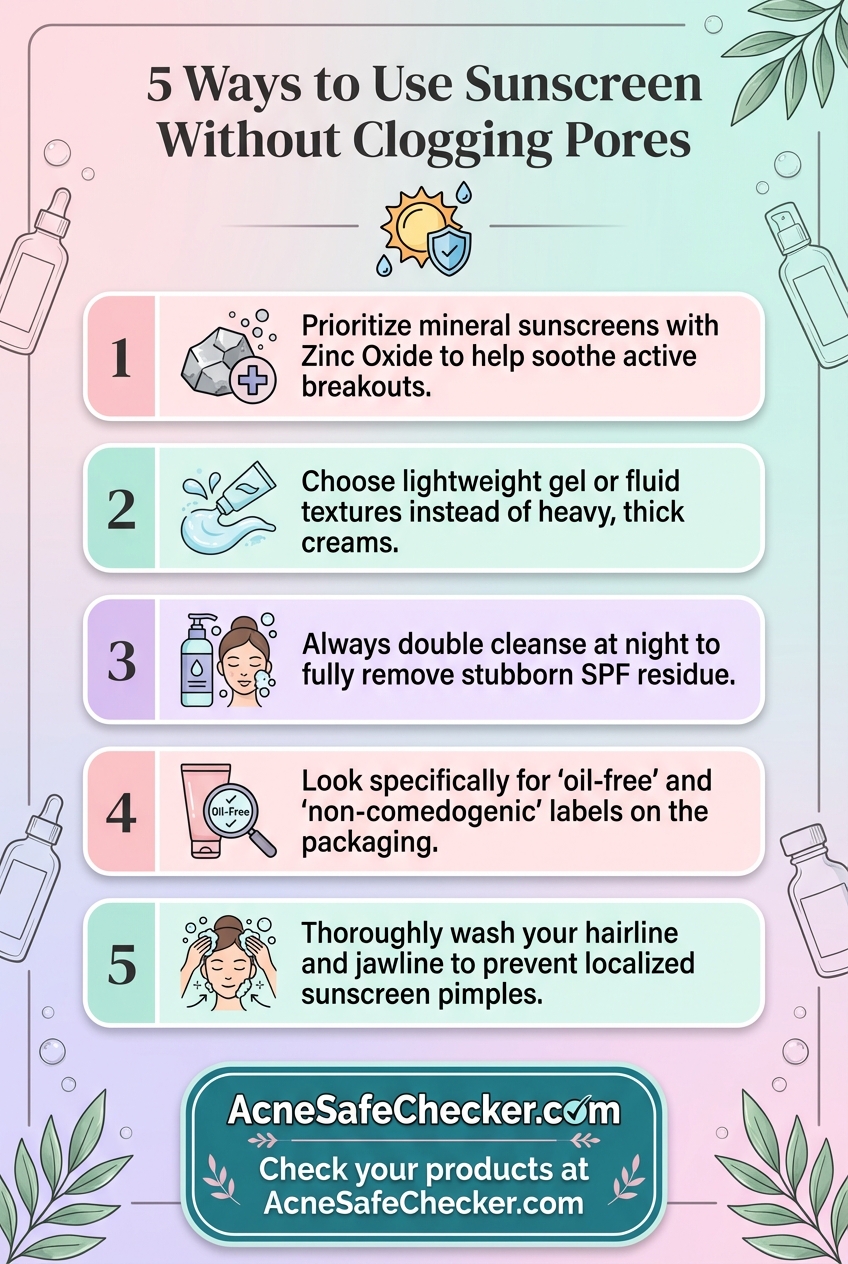
- Look for 'Oil-Free' and 'Non-Comedogenic' Labels: Use these as your starting point, but always check the texture. If it feels like a heavy body lotion, it’s likely not right for your face.
- Choose Gel or Fluid Textures: Look for 'milk,' 'fluid,' or 'gel' formulations. These have a higher water content and fewer heavy waxes than traditional creams.
- The Double Cleanse is Mandatory: Even the best non-comedogenic sunscreen can cause issues if it isn't properly removed. Sunscreen is designed to stick to the skin. At night, use a micellar water or a gentle oil cleanser first to break down the SPF, followed by your regular water-based cleanser.
- Don't Forget Your Scalp and Jawline: Often, 'sunscreen acne' appears along the hairline or jawline because we fail to wash those areas thoroughly at the end of the day.
Conclusion
Protecting your skin from the sun should not mean sacrificing the clarity of your complexion. By prioritizing mineral filters like Zinc Oxide, seeking out oil-free fluid textures, and ensuring a thorough double-cleanse at night, you can enjoy the sun while keeping your pores clear.
Remember, the 'best' sunscreen is the one you are actually willing to wear every single day. If your current SPF feels like a mask, keep searching—the perfect, pore-friendly formula is out there.