
The Hidden Link Between Your Haircare and Your Skin
Is Your Routine Acne-Safe?
Do not guess. Instantly check your products for pore-clogging ingredients with our AI-powered tool.
Check Ingredients NowYou have a dedicated skincare routine for your face, you change your pillowcases weekly, and you never sleep in your makeup—yet, the breakouts on your back and shoulders persist. If this sounds familiar, the culprit might not be your skin type, but rather your shower routine.
As a dermatologist, I frequently see patients struggling with "bacne" (back acne) who are surprised to learn that their luxurious, salon-grade shampoo or conditioner is the primary irritant. This phenomenon is known in the medical community as acne cosmetica—acne triggered by topical products. In this guide, we will explore the science behind how shampoo causes back acne and provide actionable steps to clear your skin without sacrificing your hair health.
Understanding Acne Cosmetica: How Haircare Affects Your Skin
Acne is typically caused by four factors: excess oil production, bacteria (C. acnes), hormones, and clogged pores. While back acne can be hormonal or sweat-induced, hair products introduce a fifth factor: external pore-clogging agents.
The "Rinse-Down" Effect
When you rinse shampoo or conditioner out of your hair, the product flows down your back. Many modern hair products are designed to be "substantive," meaning they are formulated to stick to the hair shaft to provide shine and smoothness. Unfortunately, these same ingredients are often "occlusive" on the skin, meaning they create a film that traps sebum, dead skin cells, and bacteria inside the follicle. This leads to the formation of comedones (whiteheads and blackheads) and inflammatory papules.
Red Flag Ingredients: What to Look for on the Label
Not all shampoos are created equal. If you are prone to body breakouts, you should become an avid label-reader. Here are the primary offenders often found in haircare products:
1. Sulfates (SLS and SLES)
Sodium Lauryl Sulfate (SLS) and Sodium Laureth Sulfate (SLES) are surfactants that create that satisfying lather. However, they are highly irritating to the skin barrier. While they don't necessarily clog pores directly, they can strip the skin of its natural oils, leading to compensatory oil production and inflammation, which exacerbates acne.
2. Silicones
Commonly listed as Dimethicone, Cyclomethicone, or Amodimethicone, silicones are what give hair its silky texture. On the skin, they act like plastic wrap. They trap sweat and bacteria against the skin, which is a recipe for "acne mechanica" and clogged pores.
3. Heavy Oils and Butters
Ingredients like coconut oil (Cocos Nucifera), shea butter, and cocoa butter are fantastic for dry hair but are highly comedogenic. Coconut oil, in particular, is rated a 4 out of 5 on the comedogenicity scale, making it one of the most likely natural ingredients to cause breakouts.
4. Quaternary Ammonium Compounds ("Quats")
Ingredients like Polyquaternium-7 or Behentrimonium Chloride are used to reduce static and detangle hair. These are often designed to stay on the hair even after rinsing, which means they stay on your skin, too.
The Science of Pore Clogging (Comedogenicity)
The back is particularly susceptible to acne because the skin there has a high density of sebaceous (oil) glands. When you use a heavy, oil-rich conditioner, the molecules are often small enough to enter the pore but too heavy to be easily washed away by water alone.
Scientific studies on comedogenicity show that when these substances remain on the skin for even a few minutes during a shower, they can begin the process of follicular occlusion. Once the pore is blocked, the anaerobic environment allows acne-causing bacteria to thrive, leading to the red, painful bumps often seen on the upper back and shoulders.
Dermatologist-Approved Tips to Prevent Shampoo-Induced Bacne
Transitioning to clear skin doesn't necessarily mean you have to stop using your favorite products, but it does mean you need to change how you use them.
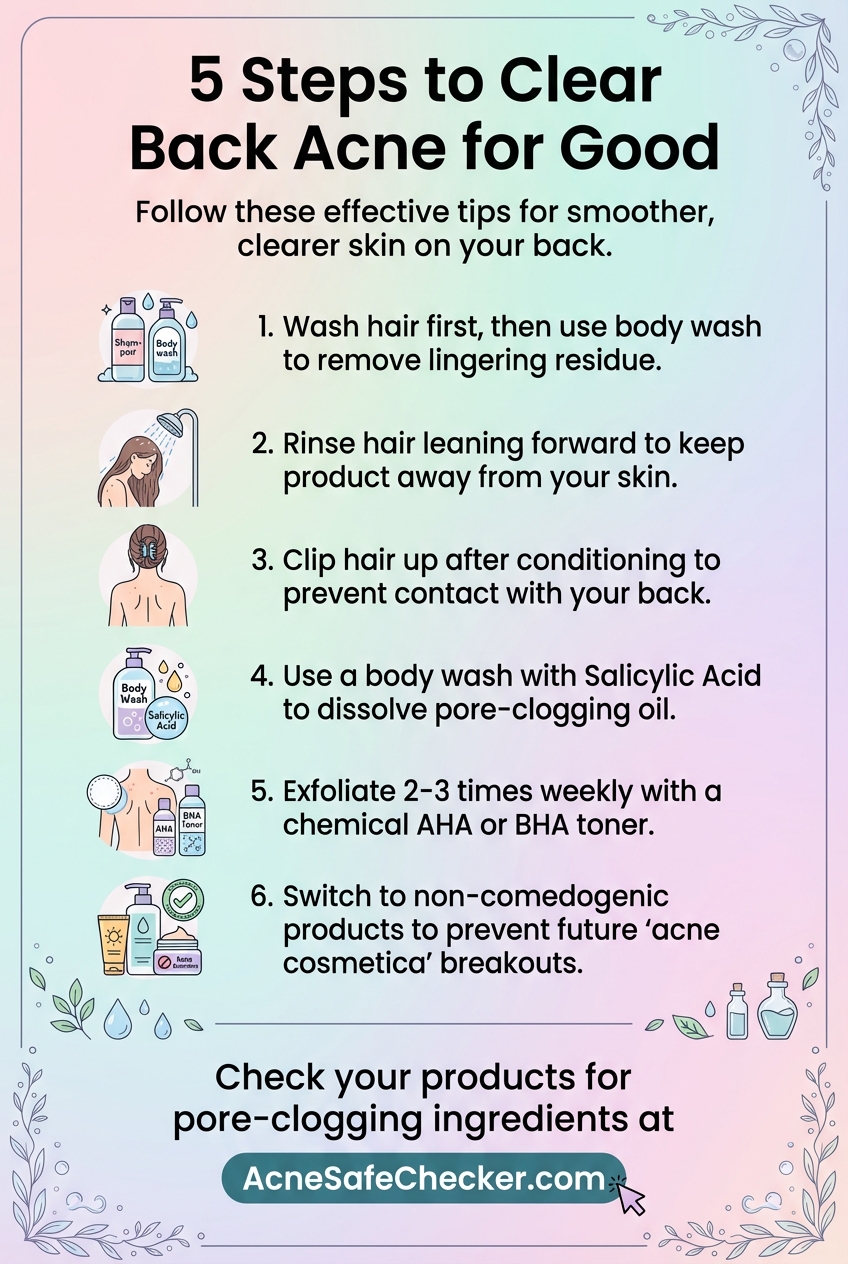
Step 1: The Sequence Matters
This is the most important change you can make. Most people wash their hair last. Instead, follow this order:
- Shampoo and condition your hair.
- Rinse thoroughly while leaning your head forward to keep residue off your back.
- Clip your hair up and out of the way.
- Lastly, wash your body. Using a gentle, non-comedogenic body wash as the final step ensures you remove any lingering hair product residue from your skin.
Step 2: Use an Active Body Wash
If you are already dealing with breakouts, look for a body wash containing Salicylic Acid (BHA) or Benzoyl Peroxide. Salicylic acid is oil-soluble, meaning it can get inside the pore to dissolve the "glue" holding the clog together. Benzoyl peroxide kills the bacteria that causes inflammatory acne.
Step 3: Check for "Non-Comedogenic" Labels
While not a perfect guarantee, products labeled "non-comedogenic" or "oil-free" have been tested to ensure they are less likely to cause breakouts. There are now several haircare brands specifically formulated to be "skin-safe" for acne-prone individuals.
Step 4: Exfoliate Regularly
Use a chemical exfoliant (like an AHA/BHA toner or pads) on your back two to three times a week. This helps keep the skin cells turning over and prevents the buildup that leads to clogs.
Conclusion: Clearer Skin Starts at the Scalp
Back acne can be incredibly frustrating and impact your confidence, but in many cases, the solution is sitting right on your shower shelf. By understanding the link between occlusive haircare ingredients and your skin’s health, you can make informed choices.
Remember: your skin is an organ that needs to breathe. By refining your washing sequence and opting for non-comedogenic formulations, you can enjoy beautiful hair and clear, healthy skin simultaneously. If your bacne persists despite these changes, consult a board-certified dermatologist to rule out other underlying causes.